Stock Analysis · Bumi Resources (PBMRY)
Overview
Bumi Resources is an Indonesian coal producer focused mainly on thermal coal, the type of coal used in power generation. Through its mining subsidiaries, the company produces, markets, and sells coal to utilities and industrial customers, with Asia as its core market. For U.S. investors using the PBMRY ticker, the business exposure is therefore largely tied to Indonesian coal production, export demand, and seaborne coal prices.
The company’s revenue base is highly concentrated. Public company disclosures and subsidiary descriptions indicate that coal mining and coal sales account for the overwhelming majority of turnover, while other activities are much smaller and mostly linked to services or supporting operations around the mining business.
- Coal sales: approximately 95%+ of revenue. This includes thermal coal sold domestically and for export through major operating units such as Kaltim Prima Coal and Arutmin Indonesia.
- Mining-related and other services: less than 5% of revenue. This can include supporting activities, contracting, and smaller non-core items depending on the reporting period.
Bumi’s business model is simple to understand: it extracts coal at large Indonesian mines, ships it to customers, and earns more when production volumes are steady and coal prices remain favorable. That simplicity also means results can move sharply when coal benchmarks fall.
The multi-year earnings flow shows a business that benefited enormously from the coal boom in 2022, then normalized. Revenue stayed relatively large afterward, but profit conversion weakened sharply from the peak, highlighting how sensitive the company is to pricing and margin swings rather than just tonnage.
Key Figures
| Metric | Value | Sector ⓘ |
|---|---|---|
| Date | Oct 03, 2026 | |
| Context | ||
| Sector | Energy | |
| Industry | Thermal Coal | |
| Market Cap ⓘ | $7.37B | |
| Beta ⓘ | -0.00 | |
Value (Cheapness) | ||
| P/E Ratio ⓘ | 31.86 | 14.47 |
| P/B Ratio ⓘ | 10.93 | 1.70 |
| FCF Yield ⓘ | -2.60% | 8.66% |
| Dividend Yield ⓘ | N/A | 3.77% |
| EBIT / EV ⓘ | 4.94% | 7.46% |
| PEG ⓘ | N/A | |
Growth (Business expansion) | ||
| Revenue Growth ⓘ | 36.40% | 27.35% |
| RPS Growth (5Y CAGR) ⓘ | -27.16% | 6.75% |
| EPS Growth (5Y CAGR) ⓘ | N/A | -15.45% |
| BVPS Growth (5Y CAGR) ⓘ | N/A | 5.85% |
| Margin Growth (5Y Trend) ⓘ | -35.44% | 0.75% |
| FCF Growth (5Y CAGR) ⓘ | -31.87% | 3.62% |
| DPS Growth (5Y CAGR) ⓘ | N/A | 16.85% |
Quality (Business durability) | ||
| ROIC (Latest) ⓘ | N/A | 11.33% |
| ROA (Latest) ⓘ | 2.88% | 6.03% |
| ROIC (5Y Median) ⓘ | 7.75% | 10.16% |
| ROA (5Y Median) ⓘ | 2.01% | 5.34% |
| Net Debt / EBIT (Latest) ⓘ | 2.45 | 1.62 |
| Net Debt / EBIT (5Y Median) ⓘ | 1.82 | 1.91 |
| Net Debt / EBITDA (Latest) ⓘ | 2.18 | 1.06 |
| Net Debt / Assets ⓘ | 12.05% | 17.29% |
| EBITDA / Interest ⓘ | 5.90 | 9.64 |
| Operating Margin (Latest) ⓘ | 14.03% | 16.32% |
| Operating Margin (5Y Median) ⓘ | 14.58% | 19.53% |
| Debt to Equity (Latest) ⓘ | 44.03% | 54.41% |
| Profit Margin (Latest) ⓘ | 7.40% | 8.79% |
| Free Cash Flow (Latest) ⓘ | -$191.43M | |
Momentum (Price trend) | ||
| 3Y Return ⓘ | +54.86% | +62.93% |
| 12M Return (excl. last month) ⓘ | +102.73% | +44.83% |
| 6M Return ⓘ | -58.63% | -1.62% |
| Price vs. 200-Day MA ⓘ | -32.54% | +5.18% |
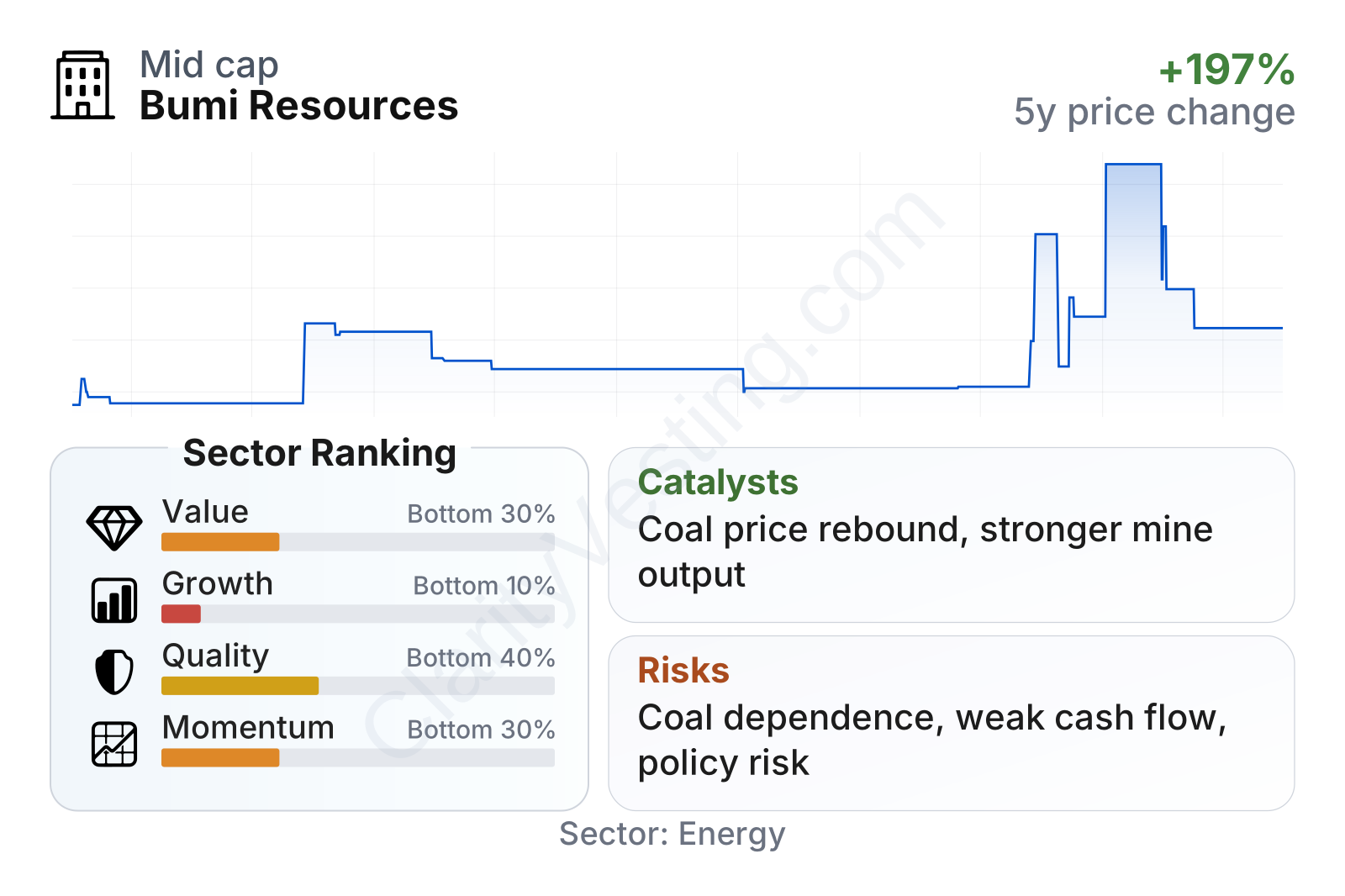
Bumi Resources sits in the lower tier of its sector on value, quality, growth, and momentum measures. The standout issue is not scale—the company is a large coal producer—but efficiency and consistency. Revenue growth has recently improved, yet longer-term per-share growth and cash generation remain weak. Valuation multiples also look demanding compared with the sector, especially relative to current profitability.
Growth
Coal is not a classic structural growth industry in the way that software, semiconductors, or renewable equipment can be. In the long run, thermal coal faces pressure from decarbonization policies, financing constraints, and the gradual buildout of cleaner power systems. Still, the sector remains important in several Asian economies where electricity demand is rising and coal is still a major part of the generation mix. That creates a more mixed backdrop: weak long-term environmental positioning, but continued medium-term demand in cost-sensitive markets.
For Bumi Resources, the main growth logic is less about entering a new industry and more about maximizing production, managing costs, and capturing demand from Asian power markets. If coal demand in Indonesia, China, India, and other regional buyers remains resilient, the company can still post stronger results even in a sector with limited long-term appeal.
The recent revenue trend shows a rebound after a difficult 2023–2024 period. The latest year-over-year growth rate is ahead of the sector median, which suggests the company has regained some momentum. However, the earlier decline also shows how quickly sales can reverse when coal pricing softens or shipment dynamics change. This is a cyclical recovery, not a smooth compounding pattern.
Cash generation is the more cautious signal. Free cash flow has been volatile and recently negative again after a much stronger period earlier in the cycle. For a mining company, this matters because accounting profit can look acceptable while actual cash available after capital spending becomes much tighter. A sustained improvement in free cash flow would be a more convincing sign than revenue growth alone.
A practical catalyst for the company is any period of firm seaborne thermal coal prices combined with stable production from its core mines. Another positive factor is that Bumi has already gone through a major debt cleanup over the past several years, which reduces the burden that once dominated the investment debate around the company. Recent corporate updates have also continued to emphasize production continuity and operational delivery from its main subsidiaries, which is important because mine output is the foundation for any earnings recovery.
Risks
This article is for informational purposes only and does not constitute financial advice. Some content is AI-generated. See Disclaimer