Stock Analysis · PT Bumi Resources Tbk (PBMRF)
Overview
PT Bumi Resources Tbk is an Indonesian coal producer focused mainly on thermal coal, the type primarily used for power generation. The company operates through major mining assets in Indonesia and sells coal to domestic and export customers. In practical terms, its business is straightforward: extract coal, ship it to customers, and earn revenue based largely on sales volume and coal prices.
The company’s revenue is overwhelmingly tied to coal sales. Public disclosures and operating descriptions indicate a highly concentrated business model, with coal mining and coal trading-related activities representing nearly all revenue. For a simple long-term view, that means PBMRF is much more a direct play on coal demand, coal prices, mining efficiency, and Indonesian resource policy than a diversified energy company.
Main revenue sources can be summarized as follows:
- Thermal coal sales: approximately 90% to 100% — coal sold to utilities, industrial users, and trading counterparties, with revenue influenced by benchmark coal prices, production levels, and shipping logistics.
- Other mining and support-related revenue: limited — may include ancillary services, non-core activities, or other smaller items, but these are not the primary driver of the business.
Bumi’s financial path over recent years has been shaped by a familiar commodity pattern: revenue surged during stronger coal markets, then normalized as prices cooled. Even so, the company remained profitable in recent annual results, and interest expense has fallen sharply from earlier levels, showing some balance-sheet repair compared with its more distressed past. The trade-off is that profitability remains volatile because the company is still heavily exposed to one commodity.
The operating picture shows how exposed the company is to commodity cycles. Revenue and operating income rebounded strongly in 2022, weakened in 2023 and 2024 as market conditions normalized, and improved again in 2025. Interest costs are much lower than they were several years ago, which helps, but swings in gross profit still pass quickly through to net income.
Key Figures
| Metric | Value | Sector ⓘ |
|---|---|---|
| Date | Oct 17, 2026 | |
| Context | ||
| Sector | Energy | |
| Industry | Thermal Coal | |
| Market Cap ⓘ | $3.68B | |
| Beta ⓘ | 0.06 | |
Value (Cheapness) | ||
| P/E Ratio ⓘ | N/A | 15.44 |
| P/B Ratio ⓘ | 9.65 | 1.73 |
| FCF Yield ⓘ | -5.21% | 8.20% |
| Dividend Yield ⓘ | N/A | 3.59% |
| EBIT / EV ⓘ | 4.95% | 7.46% |
| PEG ⓘ | N/A | |
Growth (Business expansion) | ||
| Revenue Growth ⓘ | 36.40% | 26.90% |
| RPS Growth (5Y CAGR) ⓘ | -27.16% | 6.90% |
| EPS Growth (5Y CAGR) ⓘ | -55.15% | -15.73% |
| BVPS Growth (5Y CAGR) ⓘ | N/A | 6.07% |
| Margin Growth (5Y Trend) ⓘ | -35.44% | 0.58% |
| FCF Growth (5Y CAGR) ⓘ | -31.87% | 1.86% |
| DPS Growth (5Y CAGR) ⓘ | N/A | 16.79% |
Quality (Business durability) | ||
| ROIC (Latest) ⓘ | N/A | 11.40% |
| ROA (Latest) ⓘ | 2.87% | 6.06% |
| ROIC (5Y Median) ⓘ | 7.75% | 10.30% |
| ROA (5Y Median) ⓘ | 2.01% | 5.42% |
| Net Debt / EBIT (Latest) ⓘ | 2.41 | 1.64 |
| Net Debt / EBIT (5Y Median) ⓘ | 1.82 | 1.83 |
| Net Debt / EBITDA (Latest) ⓘ | 2.09 | 1.08 |
| Net Debt / Assets ⓘ | 11.87% | 17.29% |
| EBITDA / Interest ⓘ | 6.10 | 9.64 |
| Operating Margin (Latest) ⓘ | 14.18% | 16.27% |
| Operating Margin (5Y Median) ⓘ | 14.58% | 20.39% |
| Debt to Equity (Latest) ⓘ | 44.03% | 54.76% |
| Profit Margin (Latest) ⓘ | 7.40% | 8.82% |
| Free Cash Flow (Latest) ⓘ | -$191.39M | |
Momentum (Price trend) | ||
| 3Y Return ⓘ | +73.68% | +67.38% |
| 12M Return (excl. last month) ⓘ | +3200.00% | +49.19% |
| 6M Return ⓘ | +253.57% | +7.07% |
| Price vs. 200-Day MA ⓘ | -3.06% | +9.56% |
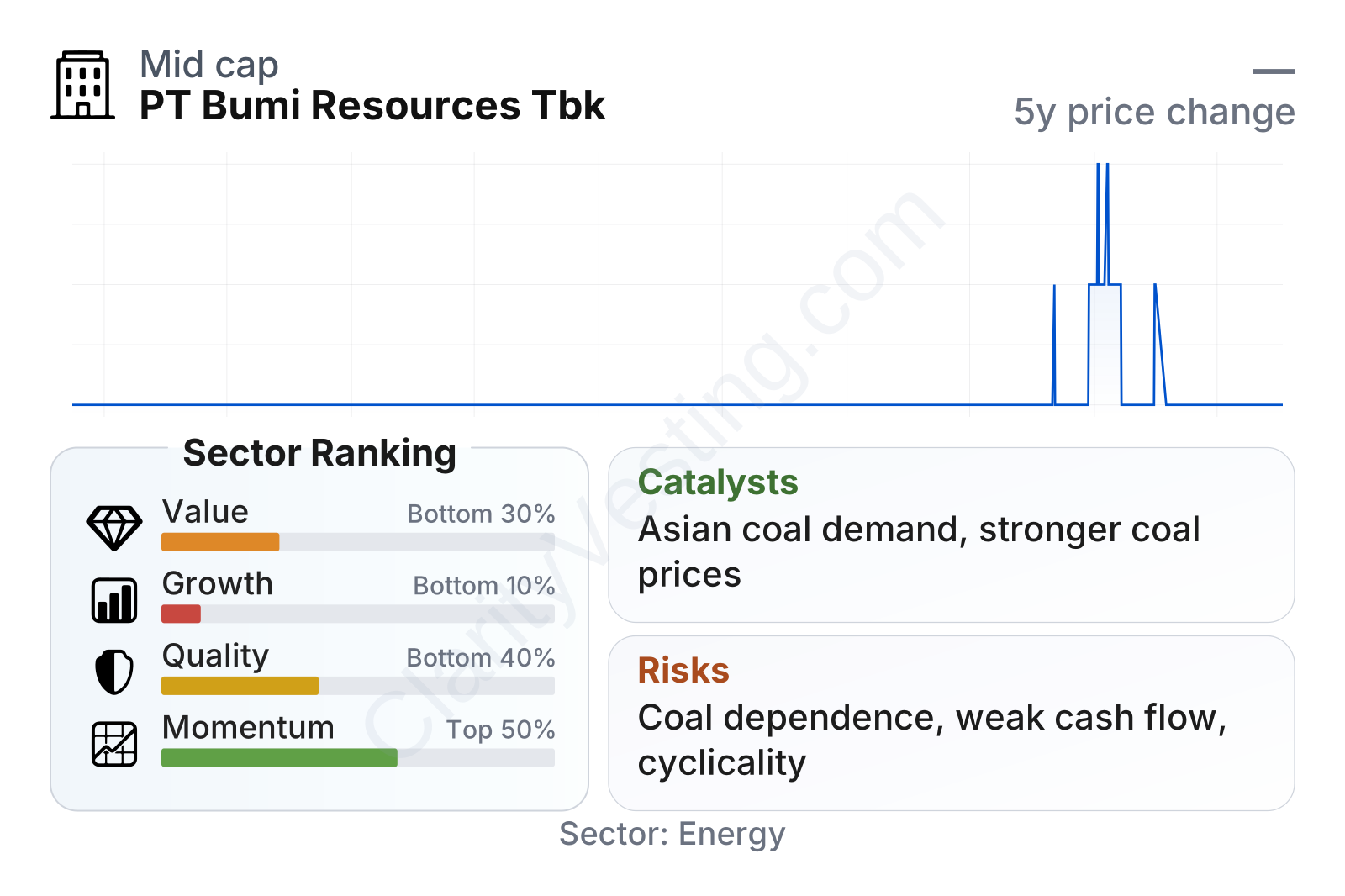
PBMRF is a mid-sized coal producer by market value, but its market profile remains unusual. The stock has been extremely volatile over the past several years, with very large swings from very low nominal price levels. In the latest factor snapshot, it ranks in the bottom 30% of the sector on value, bottom 40% on quality, bottom 10% on growth, and bottom 50% on momentum overall, even though some shorter-term price moves have been strong.
The table also shows a mixed fundamental picture. Debt to equity of about 44% is lower than the sector median, which is a positive sign after years of restructuring pressure. But profitability and cash generation are less convincing: profit margin is around 7% versus a sector median near 9%, and trailing free cash flow is negative. The price-to-book ratio is also far above the sector median, which makes the stock look demanding on an asset basis despite middling operating returns.
Growth
For long-term analysis, PBMRF sits in a sector with two very different time horizons. In the near to medium term, coal still matters across Asia, especially for power generation in countries where energy security, grid reliability, and cost remain priorities. That gives established Indonesian exporters ongoing relevance. Over the longer run, however, thermal coal faces structural pressure from decarbonization, renewable buildout, tighter environmental standards, and changing lender attitudes toward coal projects.
Bumi’s strategy makes the most sense if viewed as a cash-harvesting resource business rather than a high-visibility secular growth company. The company’s near-term growth levers are practical ones: maintaining production, managing costs, benefiting from stronger benchmark coal prices, and preserving access to export markets. If coal prices are favorable, earnings can improve quickly because the business is operationally leveraged to price.
Recent revenue growth has turned positive again, with the latest year-over-year pace running above the sector median after a period of decline and instability. That said, the longer pattern is uneven rather than steadily expanding. This is an important distinction: PBMRF can show bursts of growth, but those bursts tend to depend more on the commodity cycle than on a durable expansion model.
Cash generation is the more cautious part of the growth picture. Free cash flow has moved from strongly positive to negative again over the last few years, which suggests that accounting profit has not consistently translated into surplus cash. For a mining company, that can happen because of working-capital swings, capital spending, and price volatility, but it still reduces visibility.
A meaningful catalyst is any sustained period of stronger Asian coal pricing combined with disciplined production and lower financing pressure. Another potential support comes from Indonesia’s large role in global seaborne coal supply. When supply disruptions hit competitors or when regional buyers prioritize reliability, established Indonesian operators can benefit. In that sense, the company’s opportunity is less about transforming the energy system and more about remaining a relevant supplier within it for as long as coal demand stays resilient.
Risks
This article is for informational purposes only and does not constitute financial advice. Some content is AI-generated. See Disclaimer


