Stock Analysis · Parabilis Medicines Inc (PBLS)
Overview
Parabilis Medicines Inc is a biotechnology company developing medicines rather than selling established commercial products. Based on its public filings and corporate materials, the business is focused on discovering and advancing drug candidates, which means its value depends primarily on the progress of its research pipeline, clinical development, regulatory milestones, and potential partnership opportunities.
At this stage, the company does not appear to have recurring product sales. That is important for long-term readers because Parabilis is still operating as a development-stage biotech: cash is being spent now to try to build future drug assets that could eventually generate licensing income, milestone payments, or product revenue if any programs reach commercialization.
The current revenue mix is therefore unusually simple:
- Product revenue: approximately 0%. Public financial information indicates no commercialized product sales.
- Collaboration, licensing, or other operating revenue: approximately 0% in the latest annual figures shown here, suggesting that any partnership income was either absent or not meaningful in the most recent period.
- Financing-related cash sources: not revenue in the accounting sense, but for a company at this stage, capital raised from equity offerings, cash on hand, and balance sheet resources are often what fund operations until a drug candidate reaches a major milestone.
That profile makes Parabilis very different from a mature healthcare company. The near-term business is not about selling medicines at scale; it is about converting scientific research into assets that a larger pharmaceutical company might partner with, acquire, or eventually help bring to market.
The expense picture also shows where management is placing its bets. Research and development is by far the largest operating cost, with spending rising meaningfully from 2024 to 2025, while selling and administrative costs are much smaller. That is usually what investors expect from an early-stage biotech: most resources are going toward laboratories, preclinical work, trials, and platform development rather than marketing infrastructure.
The operating flow highlights a business with no current revenue and a cost base driven mainly by R&D. Losses widened as research spending increased, which is not unusual for a biotech trying to advance its pipeline, but it also means future value creation must come from clinical progress rather than present-day sales execution.
Key Figures
| Metric | Value | Sector ⓘ |
|---|---|---|
| Date | Oct 24, 2026 | |
| Context | ||
| Sector | Healthcare | |
| Industry | Biotechnology | |
| Market Cap ⓘ | $3.44B | |
| Beta ⓘ | N/A | |
Value (Cheapness) | ||
| P/E Ratio ⓘ | N/A | 25.42 |
| P/B Ratio ⓘ | 0.74 | 3.08 |
| FCF Yield ⓘ | -3.46% | 3.12% |
| Dividend Yield ⓘ | N/A | 1.85% |
| EBIT / EV ⓘ | -4.93% | 0.56% |
| PEG ⓘ | N/A | |
Growth (Business expansion) | ||
| Revenue Growth ⓘ | N/A | 7.50% |
| RPS Growth (5Y CAGR) ⓘ | N/A | 8.60% |
| EPS Growth (5Y CAGR) ⓘ | N/A | -17.73% |
| BVPS Growth (5Y CAGR) ⓘ | N/A | 3.72% |
| Margin Growth (5Y Trend) ⓘ | N/A | -0.57% |
| FCF Growth (5Y CAGR) ⓘ | N/A | 0.96% |
| DPS Growth (5Y CAGR) ⓘ | N/A | 6.69% |
Quality (Business durability) | ||
| ROIC (Latest) ⓘ | N/A | 3.17% |
| ROA (Latest) ⓘ | N/A | 2.98% |
| ROIC (5Y Median) ⓘ | N/A | 4.56% |
| ROA (5Y Median) ⓘ | N/A | 1.87% |
| Net Debt / EBIT (Latest) ⓘ | N/A | 1.34 |
| Net Debt / EBIT (5Y Median) ⓘ | N/A | 1.86 |
| Net Debt / EBITDA (Latest) ⓘ | N/A | 1.00 |
| Net Debt / Assets ⓘ | -88.45% | 5.06% |
| EBITDA / Interest ⓘ | N/A | 9.55 |
| Operating Margin (Latest) ⓘ | -116029.73% | 9.25% |
| Operating Margin (5Y Median) ⓘ | N/A | 7.33% |
| Debt to Equity (Latest) ⓘ | 4.53% | 26.68% |
| Profit Margin (Latest) ⓘ | N/A | 3.34% |
| Free Cash Flow (Latest) ⓘ | -$119.14M | |
Momentum (Price trend) | ||
| 3Y Return ⓘ | N/A | +51.61% |
| 12M Return (excl. last month) ⓘ | N/A | +19.90% |
| 6M Return ⓘ | N/A | +10.10% |
| Price vs. 200-Day MA ⓘ | N/A | +6.44% |
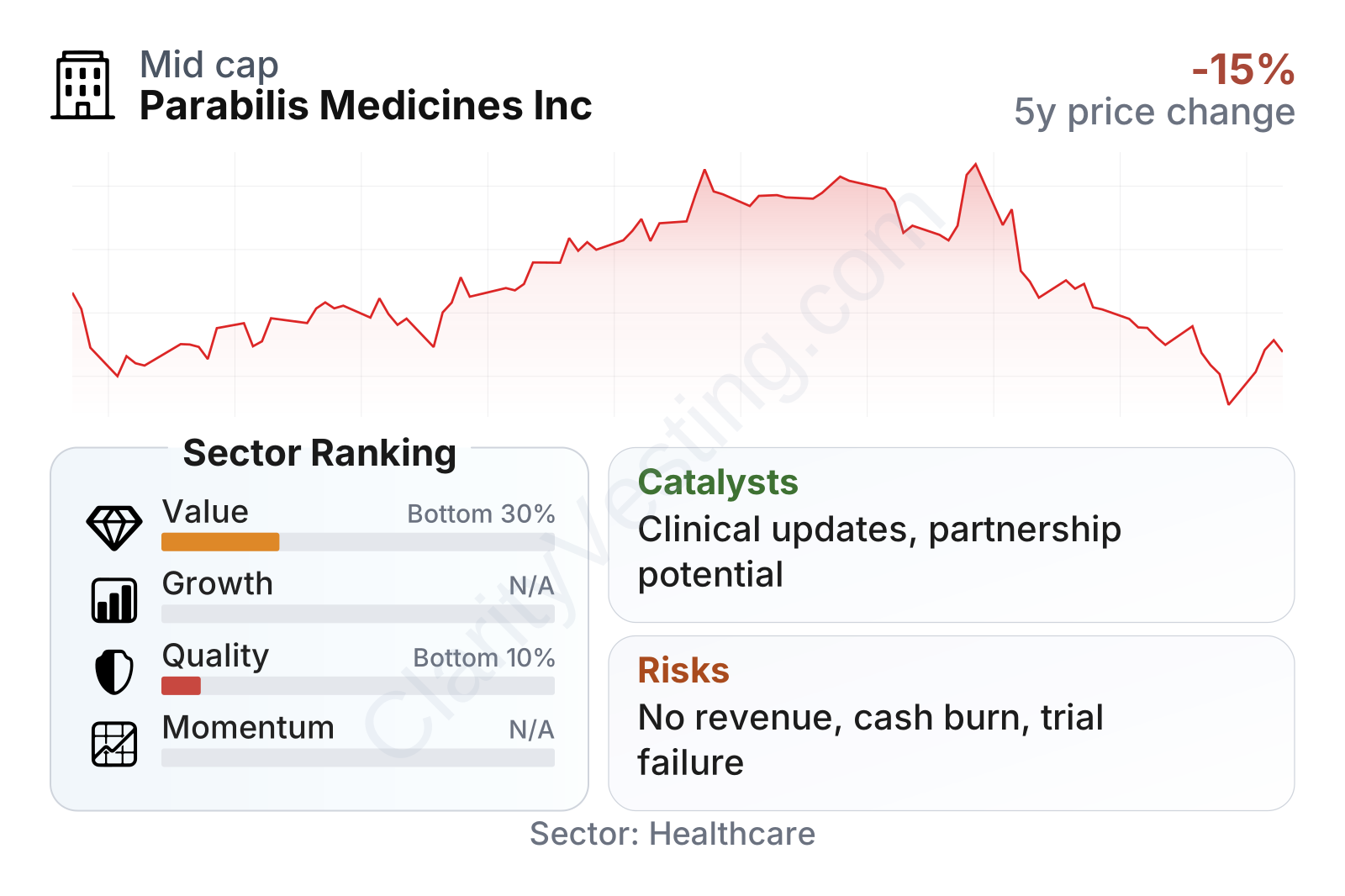
The metrics reflect a company that is hard to judge with traditional valuation tools. On value measures, Parabilis screens weakly because earnings and free cash flow are negative, which makes ratios tied to profitability less informative. Its price-to-book ratio sits below the sector median, but that alone does not automatically mean the shares are cheap; in biotech, a discount to book can also signal skepticism about whether research spending will turn into valuable approved assets.
On quality measures, the business ranks near the bottom of the healthcare peer group, mainly because there is no revenue base yet and operating losses are very large relative to current scale. At the same time, the balance sheet appears comparatively light on debt, with debt-to-equity well below the sector median and net cash characteristics showing the company is not heavily levered. That reduces financial strain, but it does not eliminate funding risk if development timelines extend.
The stock itself has moved up over the last few months, rising from the low 30s in June to the mid 30s by September. For a pre-revenue biotech, that kind of move often reflects changing expectations around pipeline progress, financing outlook, or strategic optionality rather than a shift in current operating performance.
Growth
Parabilis operates in biotechnology, a sector that can offer substantial long-term growth when a company has differentiated science in areas with meaningful unmet medical need. The broader industry still benefits from several durable tailwinds: large pharmaceutical companies need new drug candidates to replenish aging portfolios, regulators have shown continued willingness to review innovative therapies, and successful clinical assets can create very large economic value even before full commercialization.
For Parabilis specifically, the growth case depends less on current financial expansion and more on whether its pipeline can clear technical milestones. In companies like this, the most important catalysts usually include preclinical updates, entry into human trials, dose-escalation results, proof-of-concept data, regulatory designations, and business development agreements. Any one of those can materially change how the market values the company because they either reduce scientific uncertainty or increase the odds of outside funding through partnerships.
The company’s strategy appears logical for its stage of development. It is spending heavily on research rather than commercial overhead, which suggests management is focused on asset creation instead of trying to build a sales organization too early. If the underlying programs show strong data, this approach can be efficient because it preserves the option to out-license candidates or strike co-development deals before the very expensive late-stage commercialization phase.
One additional positive feature is that larger drugmakers remain active in scouting earlier-stage biotech innovation. That industry backdrop can create opportunity even for companies without approved products, provided the science is distinctive enough. In that setting, Parabilis does not need to become a fully integrated pharmaceutical company to create long-term value; it needs to produce convincing evidence that one or more of its programs deserve a higher probability of future success.
Risks
This article is for informational purposes only and does not constitute financial advice. Some content is AI-generated. See Disclaimer


