Stock Analysis · Pitney Bowes Inc (PBI)
Overview
Pitney Bowes is a long-established mailing and shipping company that now operates mainly as a technology-enabled logistics and commerce business. Its roots are in postage meters and mail equipment, but the company today is centered on helping businesses send parcels, manage shipping, and handle mailing operations. It serves small and mid-sized businesses, large enterprise clients, and government customers.
After several portfolio changes in recent years, the company is more focused than it used to be. Based on its latest annual reporting structure, revenue is mainly generated from mailing and shipping solutions, with a smaller contribution from presort mail services.
The main sources of revenue appear to be:
- SendTech Solutions: approximately 75% to 80% of revenue. This segment includes mailing equipment, shipping technology, postage, supplies, software, service, and financing-related revenue tied to customer equipment and mailing operations.
- Presort Services: approximately 20% to 25% of revenue. This business sorts large volumes of mail to help customers qualify for postal worksharing discounts and improve mailing efficiency.
This mix matters because it shows Pitney Bowes is no longer primarily a broad e-commerce logistics platform. It is increasingly a narrower company built around recurring mailing, shipping, and service relationships, with a meaningful installed base and long customer history. Revenue has trended lower over time, but the business mix has also become simpler and more cash-focused.
Over the last several years, total revenue has declined substantially, while operating expenses have come down even faster. That combination suggests management has been shrinking non-core activities and emphasizing profitability and cash generation over scale.
The business has become smaller, but the cost structure looks leaner than it did a few years ago. Gross profit remains meaningful relative to revenue, and the biggest visible improvement has come from lower operating expenses and better operating income after a difficult 2023.
Key Figures
| Metric | Value | Sector ⓘ |
|---|---|---|
| Date | Oct 17, 2026 | |
| Context | ||
| Sector | Industrials | |
| Industry | Integrated Freight & Logistics | |
| Market Cap ⓘ | $2.30B | |
| Beta ⓘ | 1.65 | |
Value (Cheapness) | ||
| P/E Ratio ⓘ | 13.62 | 22.10 |
| P/B Ratio ⓘ | N/A | 1.97 |
| FCF Yield ⓘ | 18.35% | 6.38% |
| Dividend Yield ⓘ | 2.12% | 1.94% |
| EBIT / EV ⓘ | 9.81% | 4.79% |
| PEG ⓘ | 0.60 | |
Growth (Business expansion) | ||
| Revenue Growth ⓘ | -2.30% | 9.30% |
| RPS Growth (5Y CAGR) ⓘ | -14.54% | 7.81% |
| EPS Growth (5Y CAGR) ⓘ | 51.22% | -13.06% |
| BVPS Growth (5Y CAGR) ⓘ | N/A | 6.14% |
| Margin Growth (5Y Trend) ⓘ | 13.11% | 0.88% |
| FCF Growth (5Y CAGR) ⓘ | 26.38% | 11.01% |
| DPS Growth (5Y CAGR) ⓘ | 11.01% | 9.48% |
Quality (Business durability) | ||
| ROIC (Latest) ⓘ | 21.11% | 10.84% |
| ROA (Latest) ⓘ | 5.97% | 5.41% |
| ROIC (5Y Median) ⓘ | 3.40% | 9.38% |
| ROA (5Y Median) ⓘ | 0.27% | 4.95% |
| Net Debt / EBIT (Latest) ⓘ | 5.26 | 2.08 |
| Net Debt / EBIT (5Y Median) ⓘ | 17.34 | 2.27 |
| Net Debt / EBITDA (Latest) ⓘ | 4.08 | 1.39 |
| Net Debt / Assets ⓘ | 62.62% | 19.28% |
| EBITDA / Interest ⓘ | 4.34 | 9.58 |
| Operating Margin (Latest) ⓘ | 19.25% | 10.50% |
| Operating Margin (5Y Median) ⓘ | 3.35% | 10.29% |
| Debt to Equity (Latest) ⓘ | -249.94% | 65.48% |
| Profit Margin (Latest) ⓘ | 10.04% | 6.67% |
| Free Cash Flow (Latest) ⓘ | $421.45M | |
Momentum (Price trend) | ||
| 3Y Return ⓘ | +411.09% | +61.68% |
| 12M Return (excl. last month) ⓘ | +56.52% | +12.58% |
| 6M Return ⓘ | +44.42% | 0.00% |
| Price vs. 200-Day MA ⓘ | +16.76% | +0.02% |
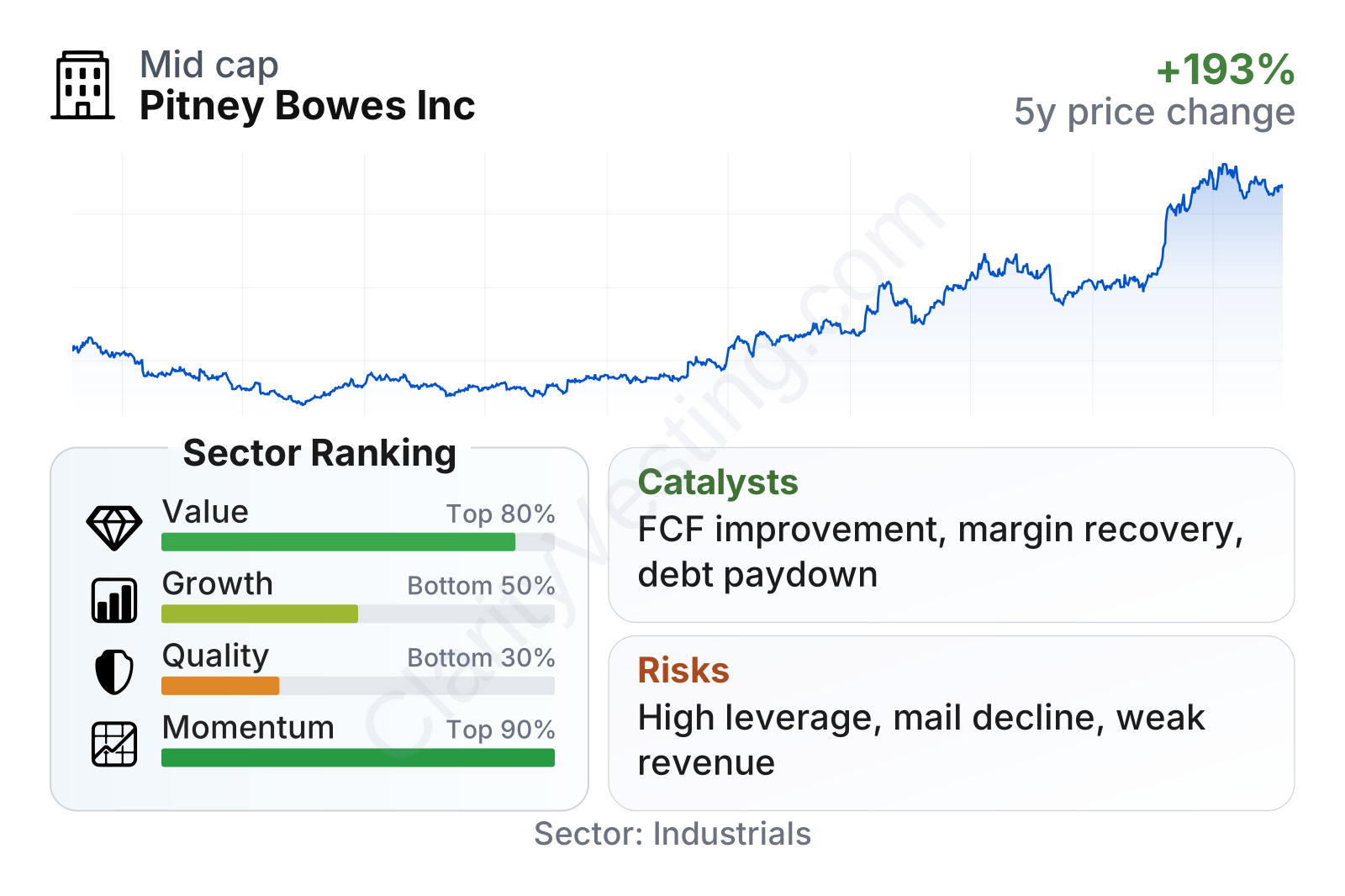
Pitney Bowes is a mid-sized company with a stock that has been very volatile. Recent market performance has been exceptionally strong relative to most industrial peers, but the fundamental profile is mixed. Valuation metrics look inexpensive versus the sector on earnings and cash flow, while growth metrics remain weak. Profitability has improved sharply, yet balance-sheet metrics still point to above-average financial risk.
Growth
Pitney Bowes operates in markets that are moving in two different directions. Traditional physical mail is a mature or declining area, which limits growth for part of the company. By contrast, shipping software, parcel management, and business mailing services still have relevance because companies continue to need cost control, compliance, and workflow tools for sending parcels and mail. This means the company is not in a pure growth industry, but it still participates in durable business functions that can produce steady cash flow if managed well.
The current strategy appears built more around improving economics than chasing headline expansion. Management has been simplifying the portfolio, cutting costs, and focusing on segments where Pitney Bowes already has customer relationships, service infrastructure, and brand recognition. That approach makes sense for a company coming out of a restructuring period, especially when scale alone did not translate into attractive returns in the past.
Revenue trends remain the main weak point. Sales have been negative year over year for an extended period, although the depth of the declines has eased from the steep drops seen during the company’s business transition. In other words, contraction has not fully stopped, but the pace appears more manageable than it was during the worst part of the reset.
The more encouraging sign is cash generation. Free cash flow has improved significantly and now stands far above the level seen a few years ago. That is important because for a mature company with limited top-line momentum, long-term value creation depends heavily on turning revenue into cash, protecting margins, and using that cash to reduce financial pressure.
A meaningful catalyst is continued execution on the simpler business model. If Pitney Bowes keeps expanding margins, sustaining free cash flow, and reducing leverage, the market can continue to view it less as a troubled legacy business and more as a stabilized cash-generating platform. Public company communications in 2026 have continued to emphasize operational discipline, debt management, and segment focus, which supports that thesis.
Risks
This article is for informational purposes only and does not constitute financial advice. Some content is AI-generated. See Disclaimer


