Stock Analysis · Prestige Brand Holdings Inc (PBH)
Overview
Prestige Consumer Healthcare, the operating business behind Prestige Brand Holdings, sells over-the-counter health and personal care products. Its portfolio is built around well-known consumer brands used for everyday needs such as eye care, cough and cold, pain relief, digestive health, oral care, and women’s health. Rather than relying on prescription drug development, the company mainly grows by managing mature brands, supporting retail distribution, and using marketing to keep those products relevant with consumers.
The business is organized primarily by geography, with revenue coming mostly from North America and a smaller international operation. Based on the latest annual filing, the revenue mix is approximately:
- North American OTC Healthcare: about 84% of revenue. This includes many of the company’s core over-the-counter remedies and self-care brands sold through major retailers and e-commerce channels.
- International OTC Healthcare: about 16% of revenue. This includes products sold mainly in Australia and certain other international markets.
At the brand level, Prestige does not depend on a single blockbuster product in the way many pharmaceutical companies do. Its sales are spread across a collection of consumer health names, which reduces single-product risk, although some categories such as eye care and cough-and-cold can still influence yearly performance.
The earnings profile is typical of a brand-management model: gross margins are strong, selling and administrative spending is relatively controlled, and cash conversion has historically been solid. Over the last several years, revenue stayed close to the $1.1 billion range, while profitability recovered after a one-time disruption in fiscal 2023 and then softened somewhat in fiscal 2026.
The business has remained highly profitable despite modest top-line growth. One notable pattern is that revenue has been fairly stable, while operating profit and net income have moved more than sales, showing that margins and non-operating items matter a lot for this company.
Key Figures
| Metric | Value | Sector ⓘ |
|---|---|---|
| Date | Oct 17, 2026 | |
| Context | ||
| Sector | Healthcare | |
| Industry | Drug Manufacturers - Specialty & Generic | |
| Market Cap ⓘ | $2.33B | |
| Beta ⓘ | 0.34 | |
Value (Cheapness) | ||
| P/E Ratio ⓘ | 13.82 | 24.79 |
| P/B Ratio ⓘ | 1.22 | 3.08 |
| FCF Yield ⓘ | 10.10% | 3.15% |
| Dividend Yield ⓘ | N/A | 1.94% |
| EBIT / EV ⓘ | 6.61% | 0.57% |
| PEG ⓘ | 1.51 | |
Growth (Business expansion) | ||
| Revenue Growth ⓘ | 6.50% | 7.45% |
| RPS Growth (5Y CAGR) ⓘ | 1.12% | 8.61% |
| EPS Growth (5Y CAGR) ⓘ | -34.09% | -17.81% |
| BVPS Growth (5Y CAGR) ⓘ | 5.71% | 3.72% |
| Margin Growth (5Y Trend) ⓘ | -2.52% | -0.62% |
| FCF Growth (5Y CAGR) ⓘ | -0.38% | 1.04% |
| DPS Growth (5Y CAGR) ⓘ | N/A | 6.77% |
Quality (Business durability) | ||
| ROIC (Latest) ⓘ | 6.60% | 3.24% |
| ROA (Latest) ⓘ | 4.29% | 3.01% |
| ROIC (5Y Median) ⓘ | 8.68% | 4.60% |
| ROA (5Y Median) ⓘ | 5.79% | 1.89% |
| Net Debt / EBIT (Latest) ⓘ | 7.04 | 1.34 |
| Net Debt / EBIT (5Y Median) ⓘ | 3.23 | 1.84 |
| Net Debt / EBITDA (Latest) ⓘ | 6.31 | 1.00 |
| Net Debt / Assets ⓘ | 43.22% | 5.45% |
| EBITDA / Interest ⓘ | 6.79 | 9.64 |
| Operating Margin (Latest) ⓘ | 25.37% | 9.27% |
| Operating Margin (5Y Median) ⓘ | 29.16% | 7.38% |
| Debt to Equity (Latest) ⓘ | 107.67% | 28.58% |
| Profit Margin (Latest) ⓘ | 15.57% | 3.59% |
| Free Cash Flow (Latest) ⓘ | $235.36M | |
Momentum (Price trend) | ||
| 3Y Return ⓘ | -18.42% | +42.80% |
| 12M Return (excl. last month) ⓘ | -25.87% | +18.50% |
| 6M Return ⓘ | -14.54% | +7.57% |
| Price vs. 200-Day MA ⓘ | -10.37% | +5.12% |
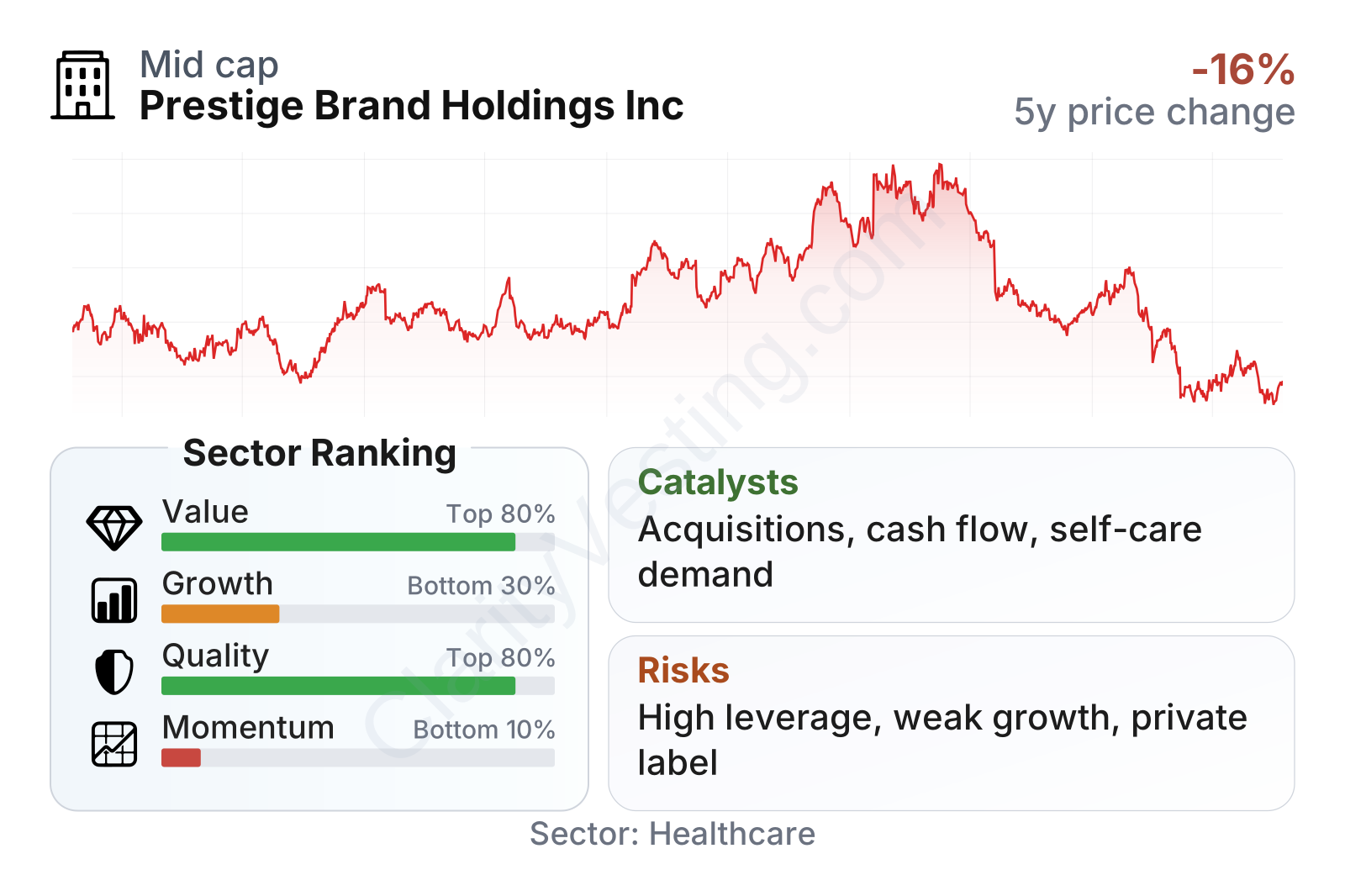
Prestige is a mid-sized healthcare company with unusually low share-price volatility for the sector, as reflected by a beta well below 1. On valuation and profitability measures, it screens better than many healthcare peers: earnings multiple, book multiple, cash flow yield, returns on capital, operating margin, and profit margin all look favorable relative to the sector median. The weak spot is growth and market performance. Revenue growth has been modest over time, earnings growth over five years has been poor, and recent share-price momentum has lagged the broader healthcare group by a wide margin.
Growth
Prestige operates in consumer self-care, a segment with attractive long-term characteristics even if it is not a fast-growth market. Aging populations, consumer preference for self-treatment, retailer support for recognized brands, and the convenience of e-commerce all support demand for over-the-counter products. This is generally steadier than many parts of healthcare because consumers keep buying cough, eye, digestive, and oral-care products in both strong and weak economies.
The company’s strategy is straightforward and sensible: protect established brands, widen distribution, adjust pricing when needed, improve category management, and selectively acquire brands that can generate dependable cash flow. This model does not usually produce explosive expansion, but it can work well over long periods when management buys assets at disciplined prices and steadily reduces debt afterward.
Recent sales growth has been inconsistent. Quarterly year-over-year revenue has moved between modest gains and declines, which suggests Prestige is not currently in a clean acceleration phase. The latest annual results also showed a revenue decline versus the prior year. That said, the business has still been able to maintain a relatively high level of profitability compared with most healthcare peers, which matters because it gives the company room to keep investing in brands and debt reduction.
Free cash flow is one of the more encouraging parts of the picture. It has remained solid and fairly stable, hovering around the mid-$200 million range in recent years. For a company with a mature brand portfolio, that is important because cash generation supports interest payments, debt repayment, possible bolt-on acquisitions, and shareholder returns without requiring breakthrough innovation.
A key catalyst for future growth is the company’s ability to use its cash flow for portfolio reshaping. Prestige has historically expanded through acquisitions, and that remains one of the clearest ways to improve growth beyond the low-single-digit pace of the base business. Another potential catalyst is continued expansion in categories where consumers show strong repeat behavior, especially eye care and other routine self-care products. International growth is also a smaller but relevant opportunity given the company’s still-limited exposure outside North America.
Recent company communications have also emphasized productivity, brand support, and debt management rather than dramatic transformation. That tone fits the underlying business: Prestige appears better positioned for steady compounding through disciplined execution than for a sudden breakout in sales.
Risks
This article is for informational purposes only and does not constitute financial advice. Some content is AI-generated. See Disclaimer


