Stock Analysis · PBF Energy Inc (PBF)
Overview
PBF Energy is an independent oil refiner and fuel supplier in the United States. In simple terms, it buys crude oil and other feedstocks, processes them in refineries, and sells finished petroleum products such as gasoline, diesel, jet fuel, heating oil, lubricants, and petrochemical-related outputs. The company also owns logistics assets through PBF Logistics, which support the movement, storage, and handling of crude oil and refined products. Its refinery system is spread across key U.S. regions, giving it access to several important fuel markets.
The business is driven mainly by refining margins, which are the difference between the cost of crude oil and the value of products sold. That means revenue can be very large even when profits are modest, because crude oil itself is a major pass-through cost. Based on company reporting, the main revenue sources are approximately:
- Gasoline and blendstocks: about 45% to 50% of revenue volume/value mix in most periods. This includes motor gasoline sold into wholesale and commercial channels.
- Distillates: about 25% to 30%. This group includes diesel, heating oil, and similar middle-distillate fuels.
- Other refined products: about 10% to 15%. This includes jet fuel, residual fuels, lubricants, and specialty outputs.
- Petrochemical and feedstock-related products: about 5% to 10%. This can include products such as propane, butane, asphalt, sulfur, petroleum coke, and other byproducts.
- Services, logistics, and other: typically a small single-digit share. This reflects terminaling, transportation, storage, and related activities.
PBF is not a large integrated oil major with upstream production and global chemicals operations. It is much more focused on refining and marketing. That narrower focus can create strong earnings when fuel markets are tight, but it also makes results more cyclical when margins weaken. Over the past several years, the company has shown just how dramatic that swing can be: revenue remained very large, while profitability moved from strong gains to losses and then partial recovery as market conditions changed.
The business mix shows a classic refiner profile: very high input costs, thin operating spreads, and profits that can change quickly from year to year. The biggest visible shift in recent years was the sharp move from exceptionally strong earnings in 2022 and 2023 to losses in 2024 and 2025, followed by signs of improvement more recently.
Key Figures
| Metric | Value | Sector ⓘ |
|---|---|---|
| Date | Oct 17, 2026 | |
| Context | ||
| Sector | Energy | |
| Industry | Oil & Gas Refining & Marketing | |
| Market Cap ⓘ | $10.81B | |
| Beta ⓘ | 0.17 | |
Value (Cheapness) | ||
| P/E Ratio ⓘ | 8.03 | 15.44 |
| P/B Ratio ⓘ | 1.73 | 1.73 |
| FCF Yield ⓘ | 6.87% | 8.20% |
| Dividend Yield ⓘ | 1.29% | 3.59% |
| EBIT / EV ⓘ | 14.98% | 7.46% |
| PEG ⓘ | 2.51 | |
Growth (Business expansion) | ||
| Revenue Growth ⓘ | 56.20% | 26.90% |
| RPS Growth (5Y CAGR) ⓘ | 3.52% | 6.90% |
| EPS Growth (5Y CAGR) ⓘ | -32.50% | -15.73% |
| BVPS Growth (5Y CAGR) ⓘ | 43.13% | 6.07% |
| Margin Growth (5Y Trend) ⓘ | -5.49% | 0.58% |
| FCF Growth (5Y CAGR) ⓘ | N/A | 1.86% |
| DPS Growth (5Y CAGR) ⓘ | 35.80% | 16.79% |
Quality (Business durability) | ||
| ROIC (Latest) ⓘ | 13.41% | 11.40% |
| ROA (Latest) ⓘ | 9.75% | 6.06% |
| ROIC (5Y Median) ⓘ | 10.05% | 10.30% |
| ROA (5Y Median) ⓘ | 2.09% | 5.42% |
| Net Debt / EBIT (Latest) ⓘ | 1.09 | 1.64 |
| Net Debt / EBIT (5Y Median) ⓘ | 0.11 | 1.83 |
| Net Debt / EBITDA (Latest) ⓘ | 0.76 | 1.08 |
| Net Debt / Assets ⓘ | 11.01% | 17.29% |
| EBITDA / Interest ⓘ | 11.73 | 9.64 |
| Operating Margin (Latest) ⓘ | 4.35% | 16.27% |
| Operating Margin (5Y Median) ⓘ | 2.37% | 20.39% |
| Debt to Equity (Latest) ⓘ | 39.25% | 54.76% |
| Profit Margin (Latest) ⓘ | 3.94% | 8.82% |
| Free Cash Flow (Latest) ⓘ | $742.80M | |
Momentum (Price trend) | ||
| 3Y Return ⓘ | +111.12% | +67.38% |
| 12M Return (excl. last month) ⓘ | +163.14% | +49.19% |
| 6M Return ⓘ | +132.16% | +7.07% |
| Price vs. 200-Day MA ⓘ | +77.78% | +9.56% |
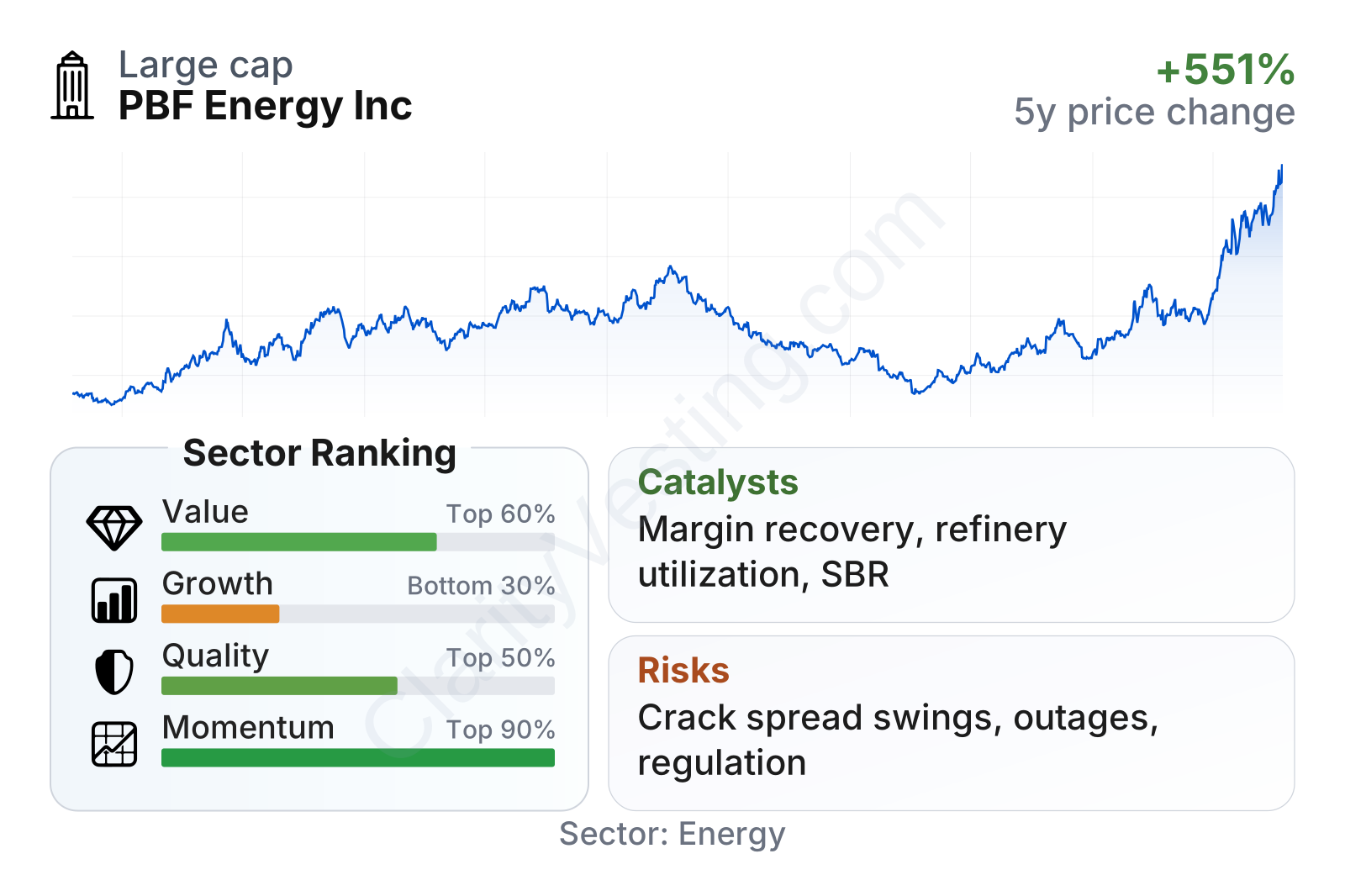
PBF sits in the mid-sized range within the energy sector. The valuation profile looks inexpensive on common measures, with earnings and book-based multiples below sector medians, while EBIT relative to enterprise value stands notably above the sector median. Quality is more mixed: returns on capital and asset efficiency are respectable, and leverage is lower than many peers, but margins remain well below the broader sector. Growth characteristics are the weakest area on the table because long-term earnings and margin trends have been uneven, even though recent year-over-year revenue growth has rebounded sharply. Price momentum, however, is exceptionally strong compared with most energy names.
The share price history also highlights how cyclical this company is. After climbing strongly through the refining upcycle, the stock fell hard when margins weakened, then recovered sharply again. That pattern is important for long-term readers because PBF is not a steady compounder; it is a business whose market value tends to move with refining conditions, balance-sheet confidence, and expectations for cash generation.
Growth
PBF operates in a sector that is mature rather than structurally fast-growing. Oil refining in the United States does not have the long runway of a young technology industry. Demand for gasoline can be pressured over time by efficiency gains and electric vehicles, while environmental rules can raise costs. However, that does not mean there are no growth drivers. Refining can still benefit from constrained industry capacity, regional supply shortages, export demand, and disciplined capital spending across the sector. In a market where very few new refineries are being built, existing well-located assets can become more valuable.
PBF’s strategy makes the most sense when viewed as optimization rather than expansion at any cost. Management has focused on improving refinery reliability, capturing better product margins, integrating logistics, and maintaining flexibility in crude sourcing. The company has also had exposure to renewable diesel through the St. Bernard Renewables joint venture, which gives it a way to participate in lower-carbon fuel markets, although that area is still smaller and less predictable than the core refining business.
Recent revenue growth has improved sharply after a long stretch of declines, which suggests that end-market conditions have become more supportive again. That said, for a refiner, rising revenue does not automatically mean stronger economics; the more important issue is whether product cracks and utilization rates support profits.
Cash generation has been highly volatile. PBF produced very strong free cash flow during the favorable part of the cycle, then moved into negative territory as profitability weakened and working-capital needs rose. For long-term analysis, the key takeaway is that the company can generate substantial cash in strong markets, but that cash is not yet stable enough to describe as consistently dependable from year to year.
A meaningful catalyst in the current setup is the possibility of stronger refining margins if industry supply stays tight, especially on the East Coast and West Coast where replacement capacity is difficult to build. Another potential support is improved performance from recently weaker assets if utilization and cost control continue to recover. Public company updates in 2026 have pointed to ongoing operational and commercial execution efforts rather than a dramatic shift in business model, which fits the nature of the industry.
Risks
This article is for informational purposes only and does not constitute financial advice. Some content is AI-generated. See Disclaimer


