Stock Analysis · Ping An Healthcare and Technology Company Limited (PANHF)
Overview
Ping An Healthcare and Technology Company Limited operates an online healthcare platform in China. It is best known for combining medical consultations, hospital referrals, health management services, and pharmacy-related services inside a digital ecosystem. The company is part of the broader Ping An group, which gives it access to a large insurance, financial services, and healthcare network.
Its business has gradually shifted away from pure traffic growth and toward services tied to medical needs, chronic disease management, enterprise clients, and coordination with insurers. In simple terms, the company aims to be a digital front door for healthcare: users can ask doctors for advice online, obtain treatment guidance, buy medicines or wellness products, and connect with offline care resources when needed.
Based on the company’s latest annual disclosures, revenue mainly comes from two broad lines:
- Integrated healthcare services: approximately 55% to 65% of revenue. This includes online consultations, family doctor and member services, referrals, health management solutions, and increasingly services sold to enterprise and insurance partners.
- Healthcare-related products and other services: approximately 35% to 45% of revenue. This includes pharmacy, wellness, and other health-related product sales delivered through its platform.
The mix matters because service revenue is generally more strategic than simple product distribution. It can support stronger user retention, more recurring demand, and better integration with insurers and corporate clients. Over the last few years, the company has also become much leaner, with selling and administrative expenses falling sharply while revenue stabilized and then recovered.
The long-term operating picture shows a clear restructuring pattern: revenue fell significantly from 2021 to 2023, but costs were reduced even faster. By 2024 and 2025, the company had returned to operating and net profitability, helped by tighter expense control and a healthier gross profit base.
Key Figures
| Metric | Value | Sector ⓘ |
|---|---|---|
| Date | Oct 17, 2026 | |
| Context | ||
| Sector | Healthcare | |
| Industry | Health Information Services | |
| Market Cap ⓘ | $1.71B | |
| Beta ⓘ | 1.08 | |
Value (Cheapness) | ||
| P/E Ratio ⓘ | 26.83 | 24.79 |
| P/B Ratio ⓘ | 0.17 | 3.08 |
| FCF Yield ⓘ | 35.94% | 3.15% |
| Dividend Yield ⓘ | N/A | 1.94% |
| EBIT / EV ⓘ | N/A | 0.57% |
| PEG ⓘ | 5.04 | |
Growth (Business expansion) | ||
| Revenue Growth ⓘ | -0.70% | 7.45% |
| RPS Growth (5Y CAGR) ⓘ | -21.06% | 8.61% |
| EPS Growth (5Y CAGR) ⓘ | -27.17% | -17.81% |
| BVPS Growth (5Y CAGR) ⓘ | -21.64% | 3.72% |
| Margin Growth (5Y Trend) ⓘ | N/A | -0.62% |
| FCF Growth (5Y CAGR) ⓘ | N/A | 1.04% |
| DPS Growth (5Y CAGR) ⓘ | N/A | 6.77% |
Quality (Business durability) | ||
| ROIC (Latest) ⓘ | 4.35% | 3.24% |
| ROA (Latest) ⓘ | 4.13% | 3.01% |
| ROIC (5Y Median) ⓘ | -2.64% | 4.60% |
| ROA (5Y Median) ⓘ | -1.92% | 1.89% |
| Net Debt / EBIT (Latest) ⓘ | -12.80 | 1.34 |
| Net Debt / EBIT (5Y Median) ⓘ | N/A | 1.84 |
| Net Debt / EBITDA (Latest) ⓘ | -9.31 | 1.00 |
| Net Debt / Assets ⓘ | -40.24% | 5.45% |
| EBITDA / Interest ⓘ | N/A | 9.64 |
| Operating Margin (Latest) ⓘ | 3.88% | 9.27% |
| Operating Margin (5Y Median) ⓘ | -6.95% | 7.38% |
| Debt to Equity (Latest) ⓘ | 0.29% | 28.58% |
| Profit Margin (Latest) ⓘ | 8.53% | 3.59% |
| Free Cash Flow (Latest) ⓘ | $615.30M | |
Momentum (Price trend) | ||
| 3Y Return ⓘ | -65.00% | +42.80% |
| 12M Return (excl. last month) ⓘ | -62.00% | +18.50% |
| 6M Return ⓘ | -47.90% | +7.57% |
| Price vs. 200-Day MA ⓘ | -38.24% | +5.12% |
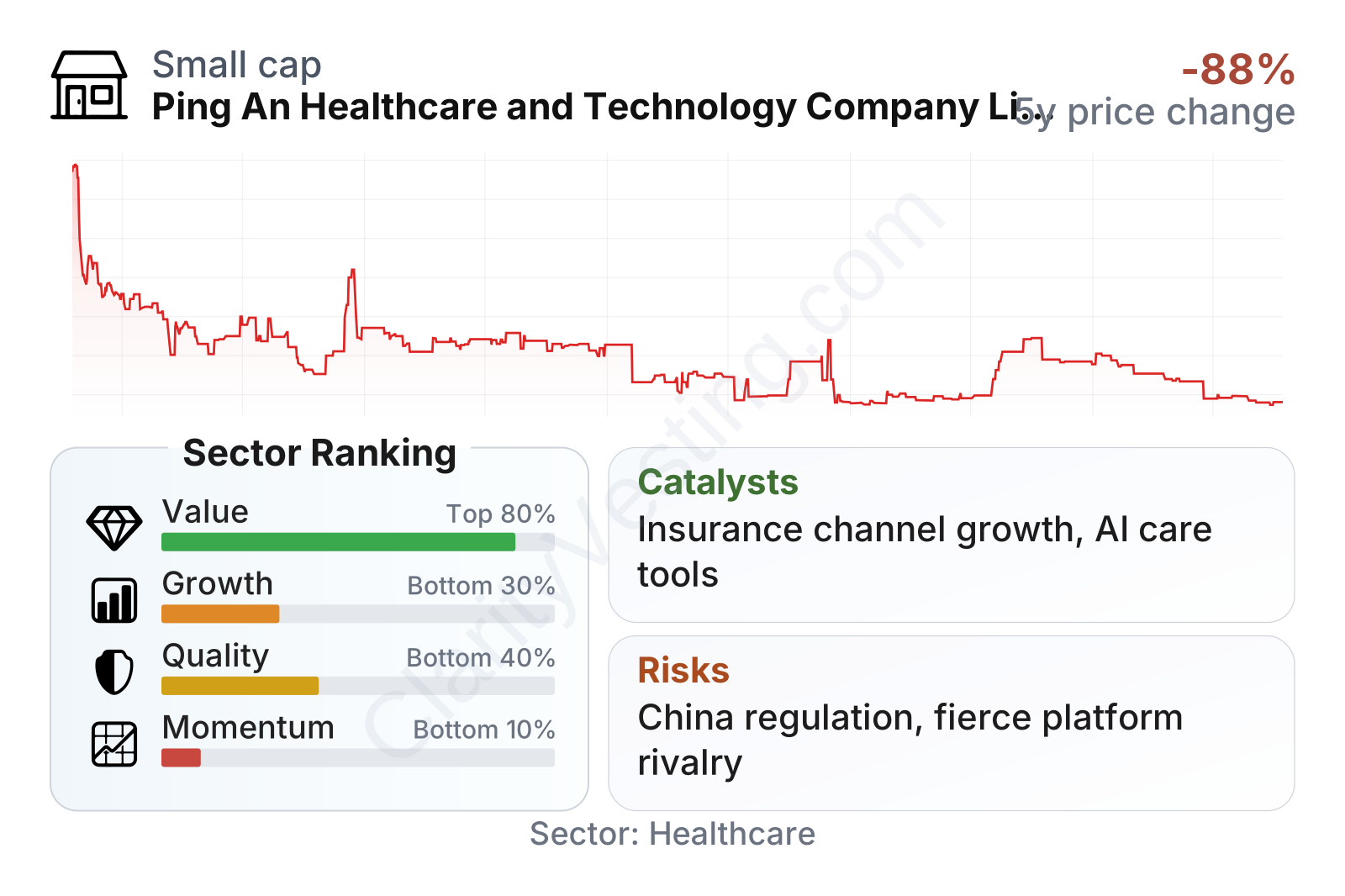
The current profile is unusual. On valuation, the shares screen cheaply on book value and very strongly on free cash flow yield, while the earnings multiple is close to the sector median. That combination usually signals that the market is still skeptical about how durable the recent profit improvement really is.
On quality, the balance sheet stands out positively. Debt is extremely low, and net cash is substantial enough for leverage ratios to appear negative, which is favorable. Profit margin is also above the sector median, even though operating margin remains below many peers. This suggests that the company has repaired its finances, but its operating model still needs to prove it can consistently generate stronger margins.
Growth and market performance are the weakest parts of the picture. Recent revenue growth has been slightly negative, the five-year record is poor, and the stock has sharply underperformed both over the past year and over a multi-year period. In other words, the business has become healthier faster than it has become convincingly growth-oriented.
Growth
Ping An Healthcare operates in a sector with favorable long-term demand drivers. China has an aging population, growing chronic disease burdens, uneven access to medical resources across regions, and strong policy interest in improving healthcare efficiency. Digital tools that reduce unnecessary hospital visits, support follow-up care, and connect patients with doctors fit naturally into that environment.
The company’s strategy also makes sense on paper. Rather than relying mainly on consumer app traffic, it has been emphasizing business-to-business and business-to-insurance channels. That is important because insurers and employers can bring recurring users at lower acquisition cost than direct consumer marketing. It also fits well with Ping An’s wider ecosystem, where insurance products, health management, and medical services can reinforce one another.
A meaningful catalyst is the company’s move toward integrated care models, especially family doctor services, elderly care coordination, chronic disease support, and enterprise health management. These are categories where demand can be recurring rather than one-off. If those services keep gaining share within the revenue mix, the business could become more stable and less dependent on lower-margin product sales.
Another encouraging sign is financial normalization. The company moved from sizable losses in earlier years to positive operating income and positive net income in 2024, and those gains improved further in 2025. Revenue growth in 2025 also turned positive again after several years of decline. That does not yet make it a high-growth company, but it does show that the turnaround has moved beyond cost cutting alone.
Recent company communications have also emphasized deeper use of artificial intelligence in consultation efficiency, doctor support tools, and service delivery. In healthcare, AI is rarely a stand-alone investment case, but it can improve doctor productivity, triage, and user engagement if deployed carefully. For Ping An Healthcare, the more important question is not whether AI sounds promising, but whether it lowers service cost and improves conversion inside its existing medical network.
Risks
This article is for informational purposes only and does not constitute financial advice. Some content is AI-generated. See Disclaimer


