Stock Analysis · Phibro Animal Health Corporation (PAHC)
Overview
Phibro Animal Health Corporation is an animal health company that develops, manufactures, and sells products used in livestock and poultry production. Its main role is to help farmers and animal producers improve animal nutrition, prevent disease, support growth, and manage herd or flock productivity. The business is tied more to food production economics than to household pet care, which makes it different from many larger animal health companies that lean heavily on companion animals.
The company reports across three business segments. Based on its latest annual filing for fiscal 2026, revenue is led by its animal health operations, while mineral nutrition and a much smaller chemicals business make up the rest.
- Animal Health: about 74% of fiscal 2026 revenue. This includes medicated feed additives, nutritional specialty products, vaccines, and other health products for poultry, swine, cattle, and aquaculture.
- Mineral Nutrition: about 22% of fiscal 2026 revenue. This segment sells trace minerals and related nutritional products used in animal feed.
- Performance Products: about 4% of fiscal 2026 revenue. This is the company’s smaller chemicals-related business.
Geographically, Phibro is also diversified, with business spread across the United States and international markets. That helps reduce reliance on any one farming region, but it also exposes results to currency movements, trade rules, and local disease patterns. One notable feature of the business mix is that revenue is built on repeat demand: animal producers need feed additives, minerals, and health products every production cycle, not just once.
The financial flow has improved meaningfully over the last two fiscal years. Revenue has expanded from just over $1.0 billion in fiscal 2024 to more than $1.5 billion in fiscal 2026, while operating income and net income recovered sharply after a weak 2024 period. Gross profit also widened, which suggests that the company was not growing only through volume, but also through a healthier earnings structure.
Key Figures
| Metric | Value | Sector ⓘ |
|---|---|---|
| Date | Oct 03, 2026 | |
| Context | ||
| Sector | Healthcare | |
| Industry | Drug Manufacturers - Specialty & Generic | |
| Market Cap ⓘ | $1.45B | |
| Beta ⓘ | 0.47 | |
Value (Cheapness) | ||
| P/E Ratio ⓘ | 14.71 | 24.06 |
| P/B Ratio ⓘ | 3.82 | 3.08 |
| FCF Yield ⓘ | 0.68% | 3.07% |
| Dividend Yield ⓘ | 1.35% | 2.05% |
| EBIT / EV ⓘ | 8.84% | 0.63% |
| PEG ⓘ | 1.68 | |
Growth (Business expansion) | ||
| Revenue Growth ⓘ | 4.80% | 7.50% |
| RPS Growth (5Y CAGR) ⓘ | 12.32% | 8.70% |
| EPS Growth (5Y CAGR) ⓘ | 25.11% | -18.20% |
| BVPS Growth (5Y CAGR) ⓘ | 9.75% | 3.95% |
| Margin Growth (5Y Trend) ⓘ | 3.22% | -0.58% |
| FCF Growth (5Y CAGR) ⓘ | N/A | 0.88% |
| DPS Growth (5Y CAGR) ⓘ | -0.28% | 6.80% |
Quality (Business durability) | ||
| ROIC (Latest) ⓘ | 12.40% | 3.29% |
| ROA (Latest) ⓘ | 6.91% | 3.02% |
| ROIC (5Y Median) ⓘ | 8.22% | 4.75% |
| ROA (5Y Median) ⓘ | 4.12% | 1.93% |
| Net Debt / EBIT (Latest) ⓘ | 3.93 | 1.33 |
| Net Debt / EBIT (5Y Median) ⓘ | 6.51 | 1.83 |
| Net Debt / EBITDA (Latest) ⓘ | 3.08 | 0.99 |
| Net Debt / Assets ⓘ | 48.45% | 5.33% |
| EBITDA / Interest ⓘ | 4.97 | 9.63 |
| Operating Margin (Latest) ⓘ | 12.18% | 9.25% |
| Operating Margin (5Y Median) ⓘ | 7.81% | 7.80% |
| Debt to Equity (Latest) ⓘ | 204.62% | 28.99% |
| Profit Margin (Latest) ⓘ | 6.57% | 3.60% |
| Free Cash Flow (Latest) ⓘ | $9.87M | |
Momentum (Price trend) | ||
| 3Y Return ⓘ | +200.21% | +37.48% |
| 12M Return (excl. last month) ⓘ | +4.81% | +20.85% |
| 6M Return ⓘ | -34.01% | +9.73% |
| Price vs. 200-Day MA ⓘ | -12.68% | +4.69% |
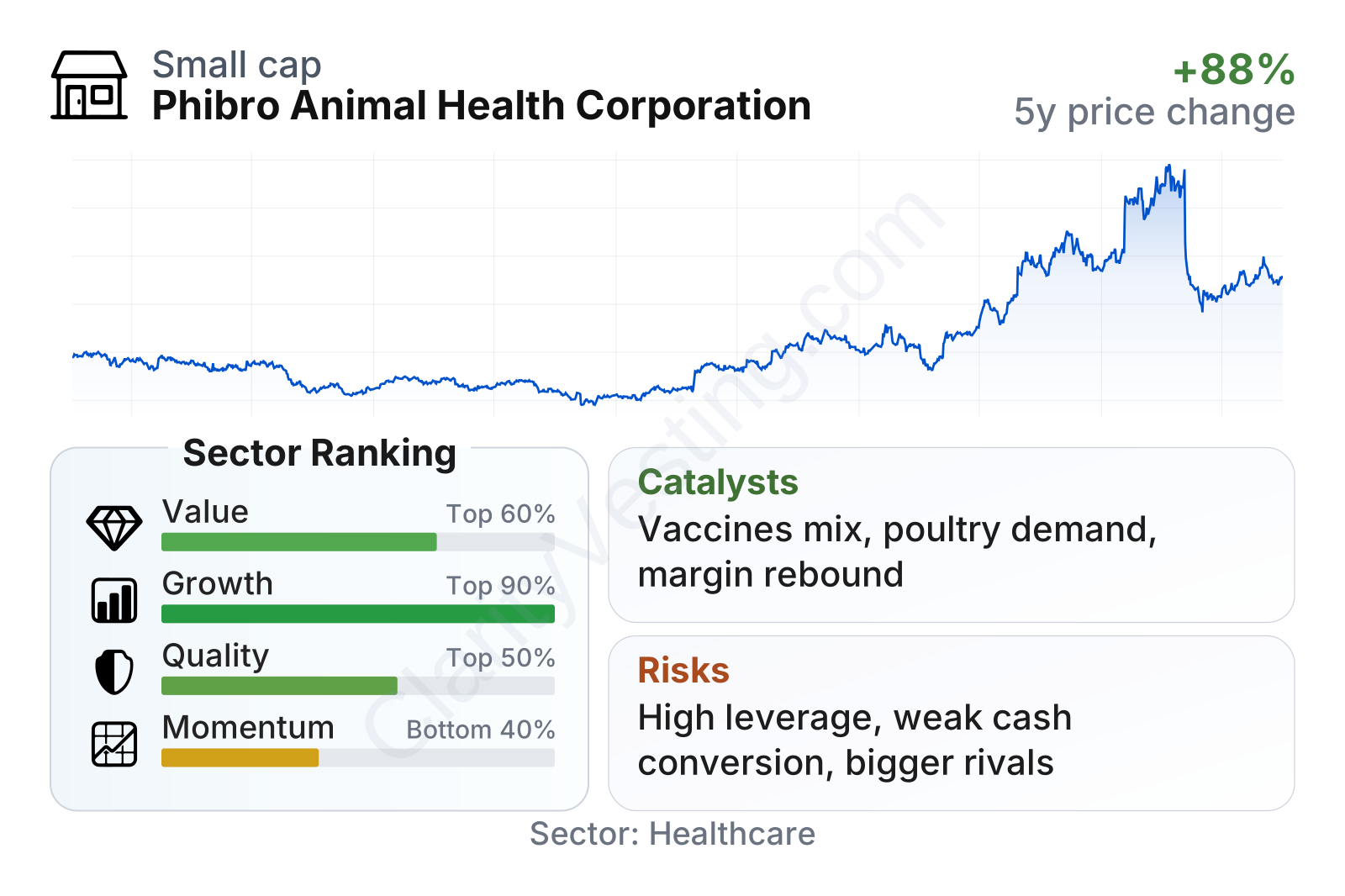
Phibro is a mid-sized company with a relatively low share-price volatility profile, as shown by a beta well below 1. The broader picture from the metrics is mixed but interesting: growth and profitability indicators rank well versus much of the healthcare sector, while balance sheet leverage is clearly heavier than average. Valuation multiples are not stretched on earnings, but cash generation looks modest relative to market value, which means the earnings recovery still needs to keep converting into stronger cash flow.
Growth
Animal health is generally a favorable long-term market because global demand for animal protein tends to rise over time, especially in poultry and aquaculture. Producers are under pressure to improve feed efficiency, animal survival, and productivity, and those needs support demand for specialty nutrition, health products, and vaccines. This does not make growth smooth every year, but it does create a durable underlying market.
Phibro’s strategy is coherent with that backdrop. The company is centered on production animals rather than pets, which gives it exposure to large agricultural volumes. Its portfolio spans feed additives, vaccines, and mineral nutrition, so it can sell multiple products into the same customer relationships. That type of commercial overlap can help strengthen distribution and support cross-selling.
Recent operating progress has been strong. Revenue growth accelerated sharply through fiscal 2025 before slowing back to a more normal pace in fiscal 2026. Even with that deceleration, the business is still larger and more profitable than it was two years earlier, suggesting that the recent improvement was not purely a one-quarter event.
Over a five-year view, growth metrics compare well with much of the sector. Revenue per share, earnings per share, book value per share, and margin trend all show above-median progress. That is especially relevant because the healthcare sector often contains many early-stage or unprofitable businesses, whereas Phibro’s expansion has come with established commercial operations and improving margins.
Cash flow is less smooth than revenue and earnings. Free cash flow turned negative in an earlier period, then recovered, then eased again more recently. That pattern suggests working capital swings, inventory needs, and operating timing can have a meaningful effect on annual cash conversion.
As for catalysts, recent company reporting points to continued momentum in the core animal health segment, including demand in poultry-related products and a better earnings base after the difficult fiscal 2024 period. The company has also highlighted progress in vaccines and specialty nutrition categories, which matter because these products can support better margins than more commodity-like offerings. If that mix keeps improving, future growth would not need to rely only on higher volumes.
Risks
This article is for informational purposes only and does not constitute financial advice. Some content is AI-generated. See Disclaimer