Stock Analysis · Plains GP Holdings LP (PAGP)
Overview
Plains GP Holdings LP is the publicly traded vehicle tied to Plains All American Pipeline, one of the large midstream energy operators in North America. In simple terms, the business helps move, store, and market crude oil and natural gas liquids. It operates pipelines, terminals, storage facilities, gathering systems, and logistics assets that connect oil-producing regions with refineries, export hubs, and other end markets.
The company’s business is less about drilling for oil and more about providing infrastructure and transportation services. That matters because midstream operators usually depend more on volumes moved through their systems than on the direct price of oil itself, although commodity prices still affect certain parts of the business.
Based on the company’s recent annual reporting structure, revenue is mainly generated from two operating segments.
- Crude Oil — about 85% to 90% of revenue: transportation by pipeline, gathering, terminaling, storage, and crude oil marketing activities. This is the core of the company and reflects Plains’ large footprint in major producing basins, especially the Permian.
- NGL — about 10% to 15% of revenue: natural gas liquids fractionation, storage, transportation, terminalling, and related marketing. This segment is smaller by revenue but still strategically important because NGL demand is tied to petrochemicals, exports, and industrial uses.
One important point for readers new to energy infrastructure: revenue can look very large for companies like Plains because commodity marketing passes through the income statement at high dollar values. That means revenue alone does not tell the full story. Cash flow, margins, leverage, and fee-based earnings are usually more useful for understanding the business.
The long-term appeal of Plains is tied to its large asset base, especially its crude oil network serving the Permian Basin, the most important U.S. oil-producing region. That gives the company a meaningful role in a part of the energy value chain that is difficult and expensive to replicate.
The business has produced tens of billions of dollars in annual revenue, but most of that is absorbed by product costs. The more important trend is that operating income has remained substantial through the cycle, while interest expense stays meaningful enough to keep balance-sheet discipline central to the equity case.
Key Figures
| Metric | Value | Sector ⓘ |
|---|---|---|
| Date | Oct 17, 2026 | |
| Context | ||
| Sector | Energy | |
| Industry | Oil & Gas Midstream | |
| Market Cap ⓘ | $6.31B | |
| Beta ⓘ | 0.52 | |
Value (Cheapness) | ||
| P/E Ratio ⓘ | 61.57 | 15.44 |
| P/B Ratio ⓘ | 3.33 | 1.73 |
| FCF Yield ⓘ | 41.57% | 8.20% |
| Dividend Yield ⓘ | 6.10% | 3.59% |
| EBIT / EV ⓘ | 13.26% | 7.46% |
| PEG ⓘ | 0.70 | |
Growth (Business expansion) | ||
| Revenue Growth ⓘ | 66.30% | 26.90% |
| RPS Growth (5Y CAGR) ⓘ | 0.76% | 6.90% |
| EPS Growth (5Y CAGR) ⓘ | N/A | -15.73% |
| BVPS Growth (5Y CAGR) ⓘ | -43.37% | 6.07% |
| Margin Growth (5Y Trend) ⓘ | 1.50% | 0.58% |
| FCF Growth (5Y CAGR) ⓘ | 8.43% | 1.86% |
| DPS Growth (5Y CAGR) ⓘ | 20.47% | 16.79% |
Quality (Business durability) | ||
| ROIC (Latest) ⓘ | 11.78% | 11.40% |
| ROA (Latest) ⓘ | 1.86% | 6.06% |
| ROIC (5Y Median) ⓘ | 15.22% | 10.30% |
| ROA (5Y Median) ⓘ | 0.58% | 5.42% |
| Net Debt / EBIT (Latest) ⓘ | 4.44 | 1.64 |
| Net Debt / EBIT (5Y Median) ⓘ | 4.60 | 1.83 |
| Net Debt / EBITDA (Latest) ⓘ | 2.83 | 1.08 |
| Net Debt / Assets ⓘ | 25.06% | 17.29% |
| EBITDA / Interest ⓘ | 4.86 | 9.64 |
| Operating Margin (Latest) ⓘ | 3.26% | 16.27% |
| Operating Margin (5Y Median) ⓘ | 3.31% | 20.39% |
| Debt to Equity (Latest) ⓘ | 546.52% | 54.76% |
| Profit Margin (Latest) ⓘ | 1.06% | 8.82% |
| Free Cash Flow (Latest) ⓘ | $2.62B | |
Momentum (Price trend) | ||
| 3Y Return ⓘ | +111.65% | +67.38% |
| 12M Return (excl. last month) ⓘ | +61.39% | +49.19% |
| 6M Return ⓘ | +19.95% | +7.07% |
| Price vs. 200-Day MA ⓘ | +14.46% | +9.56% |
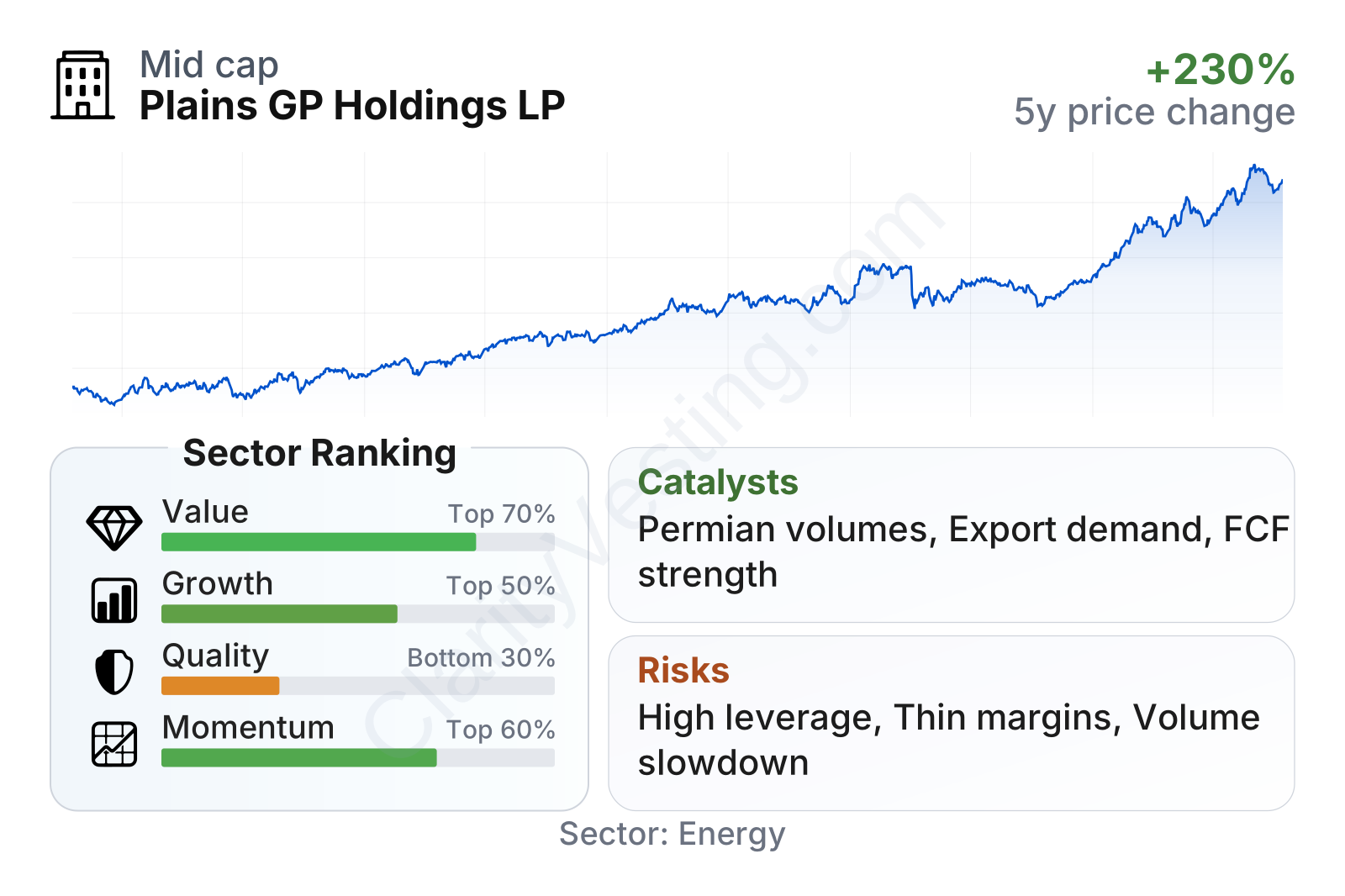
Plains is a mid-sized public company within energy infrastructure, and its shares have shown strong multi-year momentum with a relatively low beta, meaning the stock has been less volatile than many energy names. On valuation, the picture is mixed: the earnings multiple looks elevated, but cash-flow-based measures are much stronger, with free cash flow yield, dividend yield, and EBIT relative to enterprise value all standing above sector medians. The quality profile is weaker than it first appears because returns on capital are acceptable, but leverage and profitability ratios remain noticeably below many peers. Growth measures also need context: recent revenue growth rebounded sharply, yet longer-term per-share expansion has been modest.
Growth
The midstream sector is not a classic high-growth industry, but it can still expand steadily when it is connected to advantaged producing regions. Plains is positioned in exactly that part of the market. Its network is heavily exposed to the Permian Basin, where production growth has remained one of the main pillars of U.S. oil supply. As long as the Permian continues to produce growing volumes over time, transport, gathering, storage, and export-linked infrastructure should remain relevant.
Its strategy also makes industrial sense. Rather than chasing riskier upstream returns, Plains focuses on infrastructure where replacement costs are high and where existing connections create durable customer relationships. The company has also spent recent years simplifying the portfolio, emphasizing capital discipline, and supporting distributions and buybacks through cash generation rather than aggressive expansion.
Revenue growth has been uneven, which is normal for this industry because marketing revenue can rise or fall with commodity prices and trading activity. The recent rebound is encouraging, but it should not be read as a pure measure of structural growth. For Plains, the more important question is whether volumes, tariff-based earnings, and operating cash flow continue to trend in the right direction.
On that measure, the company looks more solid. Free cash flow has remained strong at more than $2 billion on a trailing basis, even after moving around from year to year. That supports debt reduction, distributions, and selective investments. For long-term analysis, this is a better sign than revenue alone because it shows the business is converting its infrastructure position into real cash.
A meaningful catalyst is export demand. U.S. crude and NGL infrastructure has become more valuable as North America sends more barrels to international markets, and Plains has assets connected to those flows. Another catalyst is continued efficiency and capital allocation discipline: when a mature midstream company can hold spending in check while volumes grow in core basins, equity value can improve even without dramatic revenue expansion.
Recent company updates have also pointed to ongoing optimization of its asset base and steady operational execution rather than headline-grabbing transformation. For a business like Plains, that can matter more than flashy growth announcements. Incremental improvements in utilization, tariffs, and cost control often drive better long-run outcomes than large acquisitions.
Risks
This article is for informational purposes only and does not constitute financial advice. Some content is AI-generated. See Disclaimer


