Stock Analysis · Pan African Resources PLC (PAFRF)
Overview
Pan African Resources PLC is a South Africa-focused gold producer. The group owns and operates a mix of underground mines, surface tailings retreatment operations, and related processing assets. In simple terms, it makes money by extracting gold from ore and by reprocessing old mine dumps and tailings to recover additional gold. This gives it exposure to both traditional mining and lower-risk recycling-style production from existing waste material.
The company’s business is concentrated in one commodity: gold. That makes the model easy to understand, but it also means results are closely tied to gold prices, operating performance, and conditions in South Africa.
Based on the company’s recent reporting structure, revenue is overwhelmingly generated by gold sales, with operations spread across several producing assets. Exact revenue by mine is not always presented as a clean sales split, but the operating base can be summarized as follows:
- Gold sales: approximately 100% of revenue. This includes gold produced from underground mining and from retreatment operations.
- Surface operations: these include assets such as Elikhulu and the newer Mogale project, where historic tailings are processed to recover residual gold.
- Underground operations: these include mines such as Barberton Mines and Evander Mines, where gold is extracted through conventional mining.
The business mix matters because surface retreatment projects can offer longer visible lives, lower geological risk, and often more predictable production than deep underground mining, while underground assets can provide stronger leverage when grades and gold prices are favorable.
Over the last several years, the company’s financial profile has strengthened sharply. Revenue and operating profit rose materially in the latest period, and the increase was not only driven by the gold price. Margin expansion suggests the group also benefited from operational improvements and a more favorable asset mix.
The profit flow has improved significantly since 2023. Revenue has accelerated, but even more importantly, operating income and net income expanded faster than costs, pointing to stronger margins. Interest expense also remained manageable relative to earnings, which supports the view that the recent jump in profitability was not purely financial engineering.
Key Figures
| Metric | Value | Sector ⓘ |
|---|---|---|
| Date | Oct 17, 2026 | |
| Context | ||
| Sector | Basic Materials | |
| Industry | Gold | |
| Market Cap ⓘ | $3.29B | |
| Beta ⓘ | 0.76 | |
Value (Cheapness) | ||
| P/E Ratio ⓘ | 8.81 | 16.90 |
| P/B Ratio ⓘ | 3.09 | 1.65 |
| FCF Yield ⓘ | N/A | 5.76% |
| Dividend Yield ⓘ | 2.97% | 2.13% |
| EBIT / EV ⓘ | 2.83% | 6.30% |
| PEG ⓘ | N/A | |
Growth (Business expansion) | ||
| Revenue Growth ⓘ | 90.90% | 11.10% |
| RPS Growth (5Y CAGR) ⓘ | 30.55% | 4.49% |
| EPS Growth (5Y CAGR) ⓘ | -0.54% | -13.47% |
| BVPS Growth (5Y CAGR) ⓘ | 35.20% | 5.51% |
| Margin Growth (5Y Trend) ⓘ | 17.00% | -1.54% |
| FCF Growth (5Y CAGR) ⓘ | N/A | 0.37% |
| DPS Growth (5Y CAGR) ⓘ | 61.83% | 6.08% |
Quality (Business durability) | ||
| ROIC (Latest) ⓘ | N/A | 9.26% |
| ROA (Latest) ⓘ | N/A | 4.91% |
| ROIC (5Y Median) ⓘ | 23.98% | 7.70% |
| ROA (5Y Median) ⓘ | 15.98% | 3.86% |
| Net Debt / EBIT (Latest) ⓘ | N/A | 1.40 |
| Net Debt / EBIT (5Y Median) ⓘ | 0.42 | 1.70 |
| Net Debt / EBITDA (Latest) ⓘ | N/A | 0.95 |
| Net Debt / Assets ⓘ | N/A | 13.69% |
| EBITDA / Interest ⓘ | N/A | 12.34 |
| Operating Margin (Latest) ⓘ | N/A | 13.20% |
| Operating Margin (5Y Median) ⓘ | 31.82% | 11.80% |
| Debt to Equity (Latest) ⓘ | N/A | 40.56% |
| Profit Margin (Latest) ⓘ | 30.89% | 6.43% |
| Free Cash Flow (Latest) ⓘ | N/A | |
Momentum (Price trend) | ||
| 3Y Return ⓘ | +858.28% | +68.89% |
| 12M Return (excl. last month) ⓘ | +77.35% | +30.21% |
| 6M Return ⓘ | -22.38% | -4.16% |
| Price vs. 200-Day MA ⓘ | -8.64% | -1.27% |
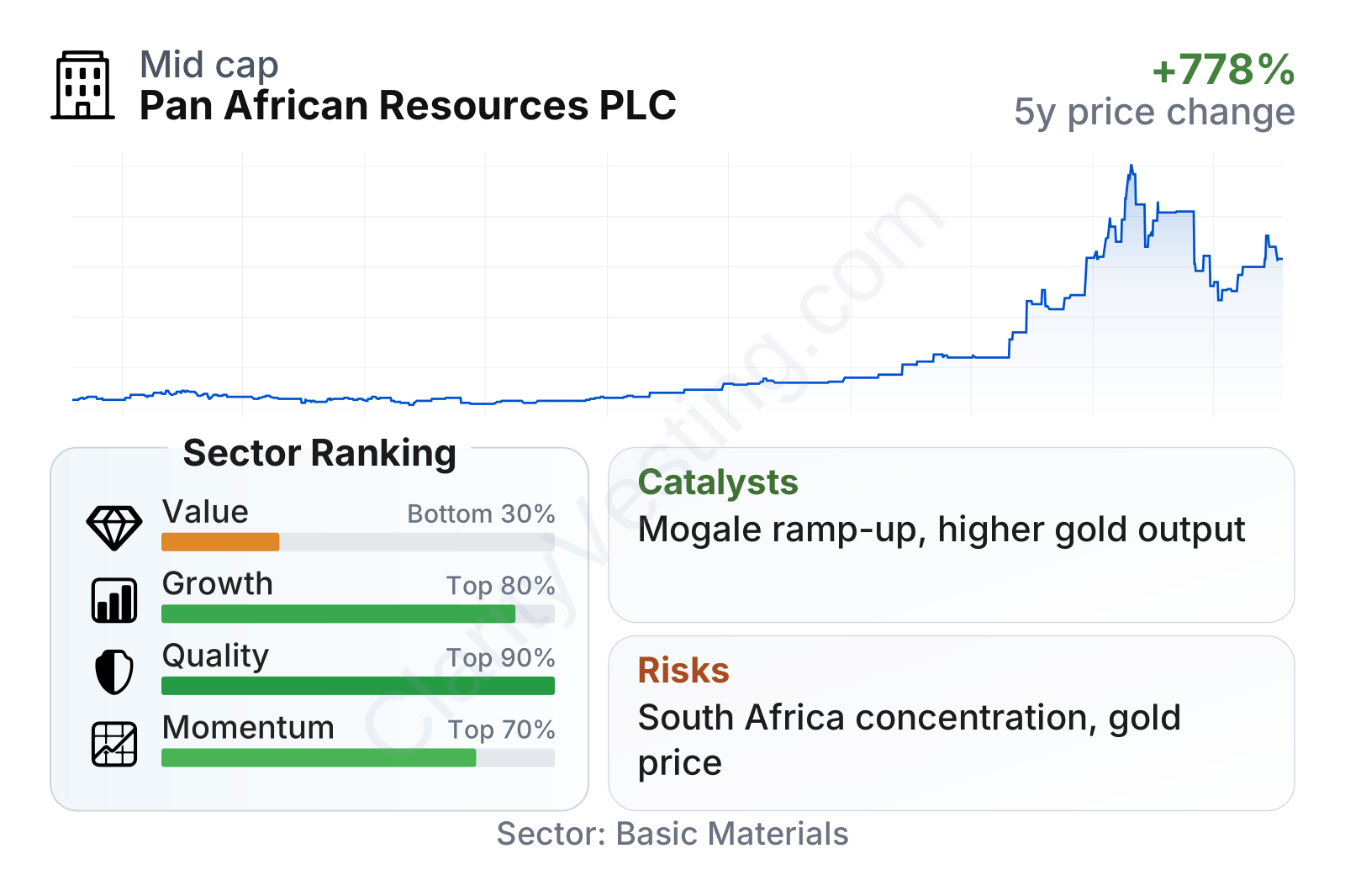
The overall picture is unusual in a good way: growth and quality rank well versus much of the gold sector, while valuation looks mixed rather than plainly cheap. Earnings-based valuation appears modest, with the P/E below the sector median, and the dividend yield is also above the sector median. On the other hand, the price-to-book ratio is richer than the sector median, which suggests the market is already giving credit for stronger assets, better returns, or improved future production.
Profitability stands out. The company’s profit margin is far above the sector median, and its long-term returns on capital and assets are also materially stronger than many peers. Balance-sheet leverage has historically been moderate, which is important in mining because operations are cyclical and capital needs can change quickly.
The share price performance has been very strong over three years and also over the last year excluding the most recent month, but the shorter-term pattern has been more volatile. The stock pulled back over six months and has traded below its 200-day average, which fits with how gold miners often behave after a sharp rerating.
Growth
Pan African operates in a sector with enduring relevance rather than rapid structural expansion. Gold demand is supported by jewelry, investment demand, and central-bank purchases, while producers can benefit when inflation, currency weakness, or geopolitical uncertainty support the metal price. That does not make gold a classic high-growth industry, but it can be a favorable backdrop for a low-cost and disciplined operator.
The company’s strategy is logical for future growth because it combines cash-generating producing mines with new projects that can extend mine life and broaden production. Its tailings retreatment focus is especially important. These projects typically avoid some of the geological uncertainty of underground mining and can be developed with a different risk-return profile. For a long-term business, that can improve visibility and smooth results.
Recent operating and financial momentum also supports the growth case. Revenue growth was far ahead of the sector median, and five-year growth in revenue per share and book value per share has been strong. Dividend growth has also been notable, which indicates that management has been willing to pass through some of the improved cash generation.
A key catalyst is production expansion from newer assets and optimization of the existing base. If newer retreatment projects ramp efficiently and underground mines continue to perform, the company could sustain a meaningfully larger production platform than it had a few years ago. Another catalyst is the gold price itself: because the cost base does not rise one-for-one with gold prices, stronger realized prices can have an outsized effect on profit.
The company has also pursued project development that fits its existing expertise and geography rather than moving into unfamiliar regions. That discipline matters. For a mid-sized miner, staying focused on known operating terrain can reduce execution mistakes and allow infrastructure, technical skills, and permitting experience to be reused across projects.
Risks
This article is for informational purposes only and does not constitute financial advice. Some content is AI-generated. See Disclaimer


