Stock Analysis · PACS Group Inc (PACS)
Overview
PACS Group Inc is a healthcare operator focused on post-acute care and long-term care services in the United States. In simple terms, it runs skilled nursing facilities and related care centers for patients who need rehabilitation, nursing support, or longer stays after a hospital visit, surgery, illness, or chronic condition. Its business is tied to an essential part of the healthcare system: caring for older adults and medically complex patients outside of acute-care hospitals.
The company’s revenue is generated primarily by patient care delivered through its facilities. Based on company filings and the structure of the skilled nursing industry, the revenue mix is heavily concentrated in facility-based healthcare services, with payment coming mostly from government programs and, to a smaller extent, managed care and private-pay sources.
- Skilled nursing and post-acute care services: approximately the vast majority of revenue. This includes short-term rehabilitation, nursing care, therapy services, and longer-stay resident care delivered at operating facilities.
- Medicaid reimbursement: typically the largest payor category for many nursing facility operators because it covers longer-term residents.
- Medicare reimbursement: generally the second-largest payor category, mainly tied to shorter-term post-acute rehabilitation after hospital discharge.
- Managed care, commercial insurers, and private-pay: a smaller share of revenue, depending on occupancy mix, regional contracts, and patient acuity.
PACS has expanded rapidly in recent years, and that shows clearly in its financial structure: revenue climbed from about $1.2 billion in 2021 to roughly $5.3 billion in 2025. Profitability, however, has not moved in a straight line. The business generated much higher scale over that period, but margins were pressured in 2024 before rebounding in 2025.
The business has become much larger very quickly, with operating income and net income recovering after a weaker 2024. That pattern suggests PACS is not a slow, steady operator; it is a fast-scaling healthcare platform where execution, reimbursement, labor costs, and acquisitions can materially change results from one year to the next.
Key Figures
| Metric | Value | Sector ⓘ |
|---|---|---|
| Date | Oct 10, 2026 | |
| Context | ||
| Sector | Healthcare | |
| Industry | Medical Care Facilities | |
| Market Cap ⓘ | $6.84B | |
| Beta ⓘ | -0.08 | |
Value (Cheapness) | ||
| P/E Ratio ⓘ | 24.97 | 24.79 |
| P/B Ratio ⓘ | 6.41 | 2.97 |
| FCF Yield ⓘ | 6.66% | 3.11% |
| Dividend Yield ⓘ | N/A | 2.04% |
| EBIT / EV ⓘ | 4.30% | 0.57% |
| PEG ⓘ | 1.03 | |
Growth (Business expansion) | ||
| Revenue Growth ⓘ | 9.10% | 7.35% |
| RPS Growth (5Y CAGR) ⓘ | 44.37% | 8.61% |
| EPS Growth (5Y CAGR) ⓘ | -10.82% | -18.43% |
| BVPS Growth (5Y CAGR) ⓘ | 148.62% | 3.94% |
| Margin Growth (5Y Trend) ⓘ | -1.57% | -0.61% |
| FCF Growth (5Y CAGR) ⓘ | N/A | 0.88% |
| DPS Growth (5Y CAGR) ⓘ | -11.97% | 6.74% |
Quality (Business durability) | ||
| ROIC (Latest) ⓘ | 22.25% | 3.34% |
| ROA (Latest) ⓘ | 4.77% | 2.95% |
| ROIC (5Y Median) ⓘ | N/A | 4.60% |
| ROA (5Y Median) ⓘ | 3.54% | 1.89% |
| Net Debt / EBIT (Latest) ⓘ | 7.49 | 1.36 |
| Net Debt / EBIT (5Y Median) ⓘ | 9.30 | 1.86 |
| Net Debt / EBITDA (Latest) ⓘ | 6.43 | 1.02 |
| Net Debt / Assets ⓘ | 54.57% | 5.85% |
| EBITDA / Interest ⓘ | 16.24 | 9.60 |
| Operating Margin (Latest) ⓘ | 7.42% | 9.19% |
| Operating Margin (5Y Median) ⓘ | 6.66% | 7.53% |
| Debt to Equity (Latest) ⓘ | 292.78% | 29.44% |
| Profit Margin (Latest) ⓘ | 4.85% | 3.52% |
| Free Cash Flow (Latest) ⓘ | $455.78M | |
Momentum (Price trend) | ||
| 3Y Return ⓘ | N/A | +34.80% |
| 12M Return (excl. last month) ⓘ | +285.78% | +19.33% |
| 6M Return ⓘ | +23.60% | +7.18% |
| Price vs. 200-Day MA ⓘ | +11.76% | +3.20% |
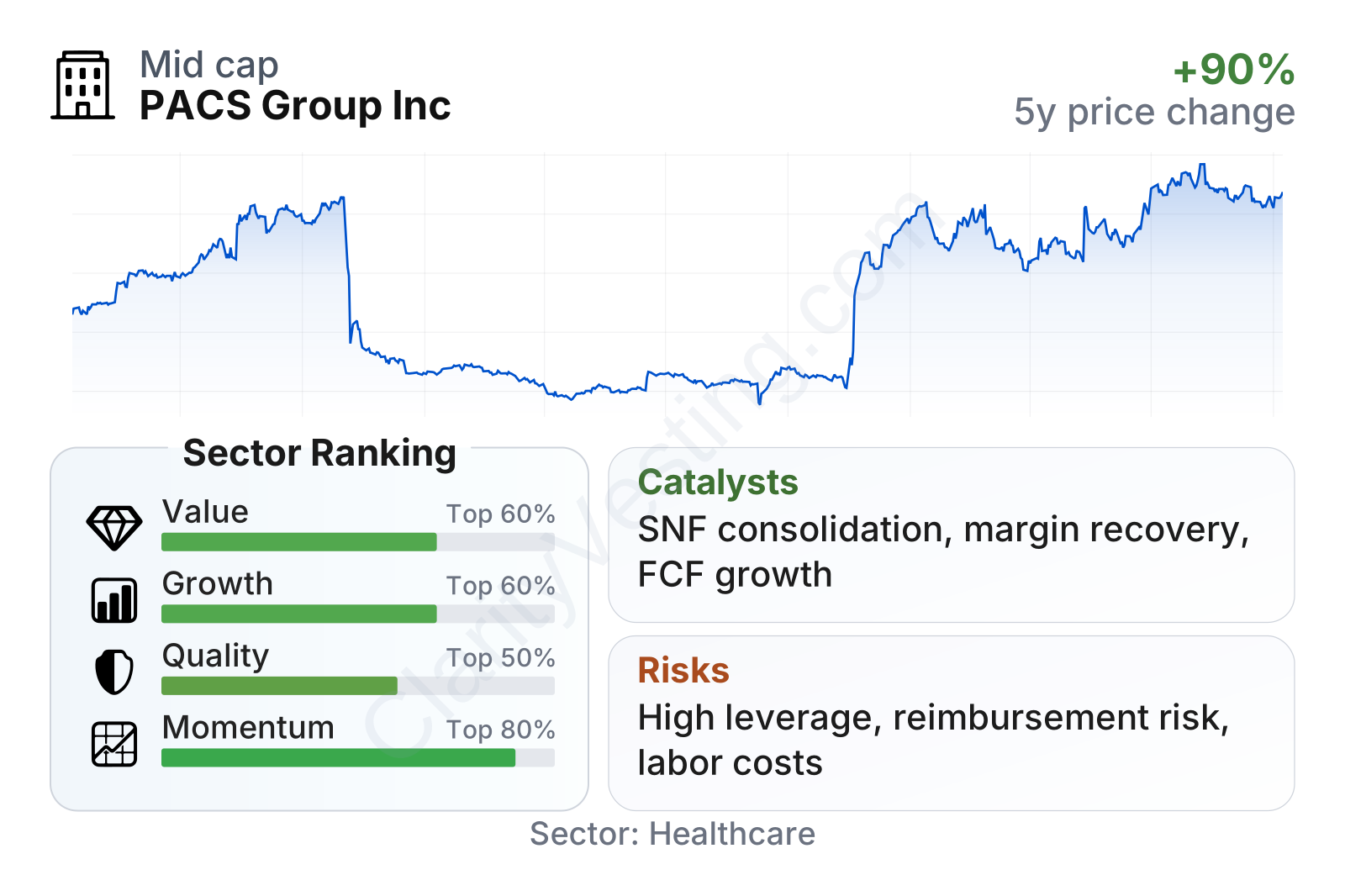
PACS is now a mid-sized public healthcare company by market value. The overall profile is mixed but interesting: valuation is close to the sector average on earnings, free cash flow generation looks strong relative to peers, and returns on capital are notably above sector norms. At the same time, leverage remains far heavier than the typical healthcare facility operator, which is one of the most important facts to keep in mind when reading the rest of the numbers.
Growth
PACS operates in a sector with long-term demand support. An aging U.S. population, high chronic disease prevalence, and the need to move patients out of costly hospitals all support demand for skilled nursing and rehabilitation capacity. This does not make growth automatic, but it does mean the underlying market has durable need if operators can manage labor, occupancy, and reimbursement effectively.
The company’s strategy also fits the sector’s economics. Skilled nursing remains fragmented in many states, which gives scaled operators room to grow through acquisitions, local density, and better facility-level management. PACS has already demonstrated that it can expand quickly, with revenue growth far above the broader sector over the last several years.
Recent growth has slowed from very high levels to a still-solid pace. Year-over-year revenue growth was above 30% through much of 2025, then eased to around 9% to 11% by the first half of 2026. That deceleration is not surprising after such a large expansion base. More important for long-term analysis is that growth remains positive and still modestly ahead of the sector median.
Cash generation has also improved meaningfully. Trailing free cash flow rose from roughly $190 million at the end of 2024 to around $380 million by early 2026, and the latest snapshot points to about $456 million. For a healthcare facility operator, that matters because cash can be used to support acquisitions, reduce debt, and absorb periods of reimbursement or labor pressure.
A meaningful catalyst is the company’s ability to keep converting scale into better margins. PACS already shows improving profit margin trends, and if occupancy, reimbursement mix, and operating discipline continue to improve, earnings can grow faster than revenue. Another important catalyst is industry consolidation: smaller operators often struggle with compliance, staffing, and financing, while larger platforms can spread overhead and negotiate more effectively.
Recent public disclosures also matter in another way: the company has gone through a period of volatility and then a sharp market recovery. That suggests the market is reassessing the company’s earnings power rather than treating it as a plain, low-growth nursing facility operator. For PACS, the central opportunity is clear: if it can keep growing while normalizing leverage and sustaining cash flow, its business profile could continue to improve.
Risks
This article is for informational purposes only and does not constitute financial advice. Some content is AI-generated. See Disclaimer