Stock Analysis · Plains All American Pipeline LP (PAA)
Overview
Plains All American Pipeline LP is a midstream energy company. In simple terms, it helps move, store, and market crude oil and natural gas liquids across North America. Its network includes pipelines, storage terminals, gathering systems, rail assets, trucks, and export connections. The business sits between oil producers and end markets such as refineries, petrochemical plants, and export facilities.
The company’s cash flow is driven much more by volumes moving through its system and contracted fees than by direct oil production. That matters for long-term analysis because midstream operators are usually less exposed to commodity price swings than producers, even though they are not immune to them.
Based on the company’s reporting structure, the main sources of revenue are approximately:
- Crude Oil segment: about 85% to 90% of total revenue. This includes pipeline transportation, terminaling, gathering, and crude oil marketing activities. It is the company’s core business and the main reason Plains is one of the largest crude-focused midstream operators in the U.S.
- NGL segment: about 10% to 15% of total revenue. This covers natural gas liquids logistics, fractionation, storage, transportation, and related marketing activities.
Those revenue percentages can look heavily weighted toward crude oil, but revenue alone does not tell the whole economic picture. Marketing activities can produce very large sales numbers with relatively thin margins, while fee-based transportation and storage often contribute more stable earnings and cash generation.
Over the last several years, the business has shown the typical profile of a large midstream operator: very high revenue, modest accounting margins, and meaningful operating cash generation. Revenue moved up and down with energy prices and market conditions, but operating income and net income have remained positive in most recent years, with a notable rebound in 2025 after a softer 2024.
The business model converts a narrow slice of huge revenue into profit, which is normal for crude logistics and marketing. What stands out more is the recovery in earnings after 2024 and the ability to keep generating sizable cash despite fluctuations in reported revenue.
Key Figures
| Metric | Value | Sector ⓘ |
|---|---|---|
| Date | Oct 17, 2026 | |
| Context | ||
| Sector | Energy | |
| Industry | Oil & Gas Midstream | |
| Market Cap ⓘ | $17.58B | |
| Beta ⓘ | 0.55 | |
Value (Cheapness) | ||
| P/E Ratio ⓘ | 21.48 | 15.44 |
| P/B Ratio ⓘ | 2.24 | 1.73 |
| FCF Yield ⓘ | 13.51% | 8.20% |
| Dividend Yield ⓘ | 6.67% | 3.59% |
| EBIT / EV ⓘ | 8.26% | 7.46% |
| PEG ⓘ | 2.35 | |
Growth (Business expansion) | ||
| Revenue Growth ⓘ | 66.30% | 26.90% |
| RPS Growth (5Y CAGR) ⓘ | 1.70% | 6.90% |
| EPS Growth (5Y CAGR) ⓘ | -11.60% | -15.73% |
| BVPS Growth (5Y CAGR) ⓘ | -14.94% | 6.07% |
| Margin Growth (5Y Trend) ⓘ | 1.69% | 0.58% |
| FCF Growth (5Y CAGR) ⓘ | 8.41% | 1.86% |
| DPS Growth (5Y CAGR) ⓘ | 16.50% | 16.79% |
Quality (Business durability) | ||
| ROIC (Latest) ⓘ | 9.70% | 11.40% |
| ROA (Latest) ⓘ | 9.65% | 6.06% |
| ROIC (5Y Median) ⓘ | 8.84% | 10.30% |
| ROA (5Y Median) ⓘ | 3.67% | 5.42% |
| Net Debt / EBIT (Latest) ⓘ | 3.60 | 1.64 |
| Net Debt / EBIT (5Y Median) ⓘ | 3.95 | 1.83 |
| Net Debt / EBITDA (Latest) ⓘ | 2.46 | 1.08 |
| Net Debt / Assets ⓘ | 25.93% | 17.29% |
| EBITDA / Interest ⓘ | 5.02 | 9.64 |
| Operating Margin (Latest) ⓘ | 4.04% | 16.27% |
| Operating Margin (5Y Median) ⓘ | 3.42% | 20.39% |
| Debt to Equity (Latest) ⓘ | 77.94% | 54.76% |
| Profit Margin (Latest) ⓘ | 5.29% | 8.82% |
| Free Cash Flow (Latest) ⓘ | $2.38B | |
Momentum (Price trend) | ||
| 3Y Return ⓘ | +103.74% | +67.38% |
| 12M Return (excl. last month) ⓘ | +60.27% | +49.19% |
| 6M Return ⓘ | +19.85% | +7.07% |
| Price vs. 200-Day MA ⓘ | +14.05% | +9.56% |
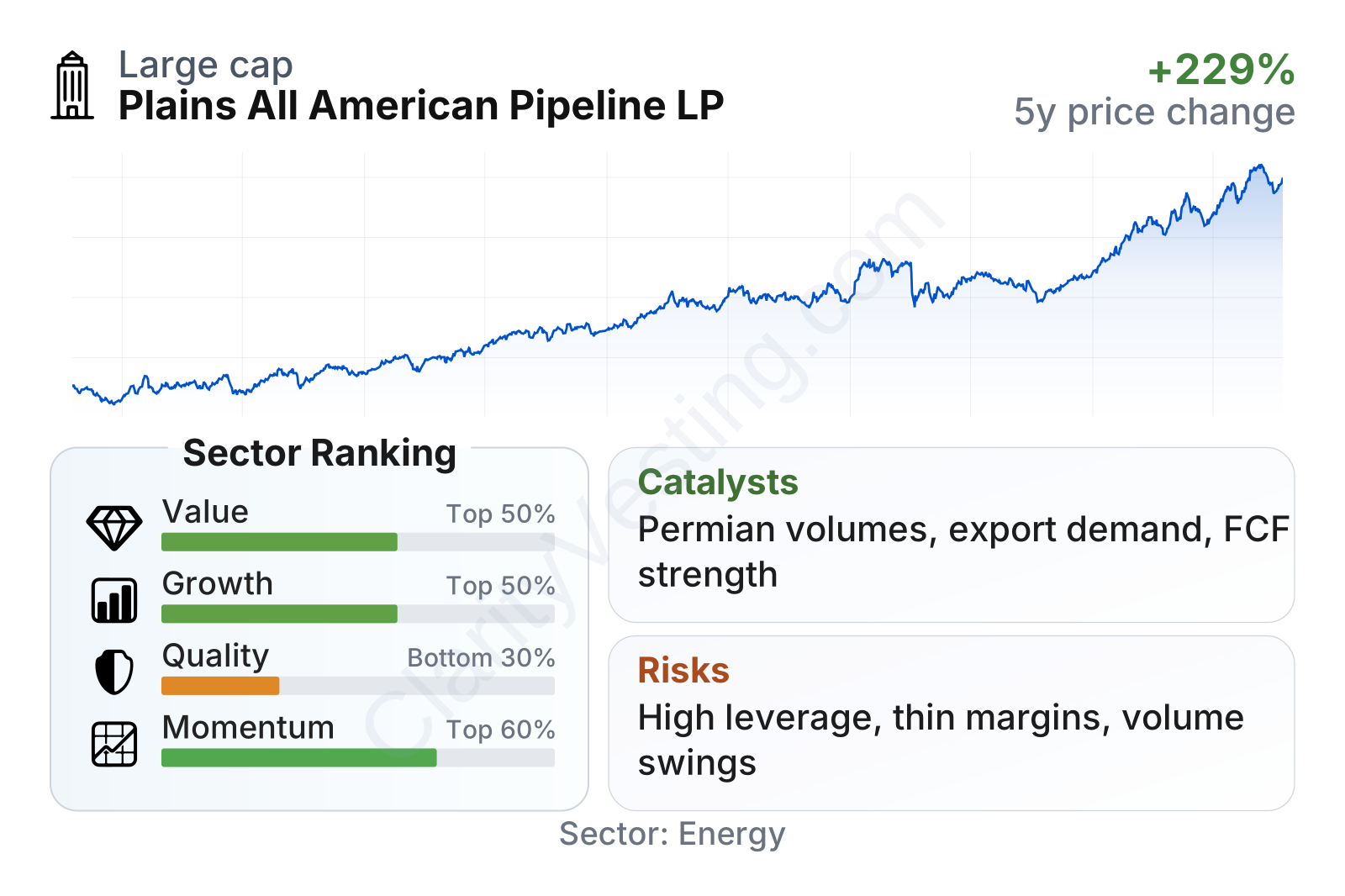
Plains is a large midstream company with a market value in the large-cap range for the partnership space and a below-market beta, which suggests the stock has historically been less volatile than the broader equity market. The stock’s multi-year price trend has been strong, with gains well ahead of the sector median over the last three years.
On valuation-related metrics, the picture is mixed. Traditional ratios such as P/E and price-to-book sit above the sector median, which points to a less cheap headline valuation than some peers. At the same time, cash-based measures look more favorable: free cash flow yield, dividend yield, and EBIT relative to enterprise value all compare well with the sector. In other words, the market is not treating Plains as a bargain on every metric, but its cash generation remains notable.
Growth metrics are also mixed but generally respectable. Recent revenue growth has accelerated sharply, and free cash flow growth over five years has outpaced the sector median. However, longer-term revenue per share growth has been modest, and book value per share has moved the wrong way over the same period. Quality is the weaker area in the table, mostly because leverage is higher than the sector median and margins are thinner.
Growth
Plains operates in a sector that is not a classic high-growth industry, but it remains strategically important. Oil and natural gas liquids still require extensive transportation, storage, and export infrastructure, especially in major producing regions such as the Permian Basin and Western Canada. That creates a durable role for large-scale midstream networks even in a slower-growth energy world.
The company’s strategy is centered on connecting advantaged production basins to demand centers and export outlets. That approach makes sense because producers in low-cost regions tend to keep shipping volumes even when prices weaken. Plains has repeatedly emphasized its crude oil system in the Permian, one of the most important oil-producing regions in North America, along with NGL infrastructure and export connectivity. For a midstream business, that geographic positioning is one of the clearest long-term growth levers.
Revenue growth has been volatile, which is normal for a company with significant marketing exposure, but the recent rebound is strong. That does not automatically mean a permanent step-up in profitability, yet it does show that activity levels and commercial conditions have improved meaningfully in the latest period.
Cash generation has been steadier than revenue. Free cash flow has remained above $2 billion in recent periods, which is a useful sign for a capital-intensive partnership. For long-term analysis, this is more important than headline revenue alone because it affects debt reduction capacity, distributions, and funding for expansion projects.
Recent company updates have also supported the growth case. Plains has continued to advance projects and commercial arrangements tied to Permian crude takeaway, NGL infrastructure, and export-related demand. The broad industry backdrop is favorable when U.S. production growth, Gulf Coast exports, and Canadian supply all need reliable transportation and storage capacity. These are not short-lived catalysts; they are structural drivers that can support utilization and fee-based earnings over time.
Risks
This article is for informational purposes only and does not constitute financial advice. Some content is AI-generated. See Disclaimer


