Stock Analysis · Bank Ozk (OZK)
Overview
Bank OZK is a regional bank headquartered in Arkansas. It gathers deposits from consumers and businesses, then lends that money out at higher rates, invests part of its balance sheet in securities, and earns fees from banking services. The bank operates through a branch network in several states, but its business model is broader than a typical local bank because it has built a national commercial real estate lending platform, especially in large construction and development projects.
For a bank, revenue is different from most other companies. The biggest driver is usually net interest income, which is the spread between what the bank earns on loans and securities and what it pays on deposits and other funding. Based on recent annual results, Bank OZK’s revenue mix appears heavily concentrated in interest-related income, while non-interest fees remain a smaller contributor.
Main revenue sources, from largest to smallest, are approximately:
- Net interest income: about 85% to 90%. This is the core banking engine and reflects income from real estate loans, consumer and commercial loans, and securities after funding costs.
- Service charges and deposit account fees: about 3% to 5%. This includes fees tied to customer accounts and transaction services.
- Mortgage banking, trust, and other banking fees: about 2% to 4%. This covers activities such as wealth-related services, loan servicing, and other banking-related charges.
- Other non-interest income: low single-digit share. This can include items such as gains on sales, card-related income, and miscellaneous banking revenues when present.
What stands out is not just the source of revenue, but where lending growth has historically come from. Bank OZK has leaned heavily on its Real Estate Specialties Group, which focuses on larger and often more complex commercial real estate lending opportunities. That specialization has helped the bank produce above-average asset growth over time, but it also makes the company more exposed to the health of property markets than many plain-vanilla regional banks.
Over the last several years, total revenue expanded strongly, while net income also grew, although at a much slower pace. That pattern suggests the bank has been able to keep building earning assets, but rising funding costs have absorbed part of the benefit.
The long-term picture is clear: Bank OZK has become a larger and more profitable lender than it was a few years ago, but the path has relied on managing a more specialized loan book in an industry where credit discipline matters more than raw growth.
Key Figures
| Metric | Value | Sector ⓘ |
|---|---|---|
| Date | Oct 03, 2026 | |
| Context | ||
| Sector | Financial Services | |
| Industry | Banks - Regional | |
| Market Cap ⓘ | $5.01B | |
| Beta ⓘ | 0.87 | |
Value (Cheapness) | ||
| P/E Ratio ⓘ | 7.58 | 12.60 |
| P/B Ratio ⓘ | 0.81 | 1.23 |
| FCF Yield ⓘ | 15.21% | 10.16% |
| Dividend Yield ⓘ | 3.94% | 2.96% |
| EBIT / EV ⓘ | N/A | 7.77% |
| PEG ⓘ | 2.76 | |
Growth (Business expansion) | ||
| Revenue Growth ⓘ | -2.10% | 9.50% |
| RPS Growth (5Y CAGR) ⓘ | 28.59% | 12.10% |
| EPS Growth (5Y CAGR) ⓘ | -11.03% | -9.45% |
| BVPS Growth (5Y CAGR) ⓘ | 10.04% | 5.01% |
| Margin Growth (5Y Trend) ⓘ | -30.14% | -4.07% |
| FCF Growth (5Y CAGR) ⓘ | 9.51% | 4.96% |
| DPS Growth (5Y CAGR) ⓘ | 13.87% | 8.79% |
Quality (Business durability) | ||
| ROIC (Latest) ⓘ | N/A | 9.60% |
| ROE (Latest) ⓘ | 11.18% | 13.84% |
| ROA (Latest) ⓘ | 1.66% | 1.53% |
| ROIC (5Y Median) ⓘ | 11.44% | 7.86% |
| ROE (5Y Median) ⓘ | 12.71% | 12.20% |
| ROA (5Y Median) ⓘ | 2.08% | 1.29% |
| Net Debt / EBIT (Latest) ⓘ | N/A | 0.91 |
| Net Debt / EBIT (5Y Median) ⓘ | -1.01 | 0.74 |
| Net Debt / EBITDA (Latest) ⓘ | -0.89 | 0.97 |
| Operating Margin (Latest) ⓘ | N/A | 22.12% |
| Operating Margin (5Y Median) ⓘ | 38.52% | 24.39% |
| Debt to Equity (Latest) ⓘ | 10.64% | 60.37% |
| Profit Margin (Latest) ⓘ | 44.53% | 26.62% |
| Free Cash Flow (Latest) ⓘ | $762.42M | |
Momentum (Price trend) | ||
| 3Y Return ⓘ | +45.12% | +89.23% |
| 12M Return (excl. last month) ⓘ | -4.20% | +17.35% |
| 6M Return ⓘ | +2.33% | +10.00% |
| Price vs. 200-Day MA ⓘ | -3.37% | +3.73% |
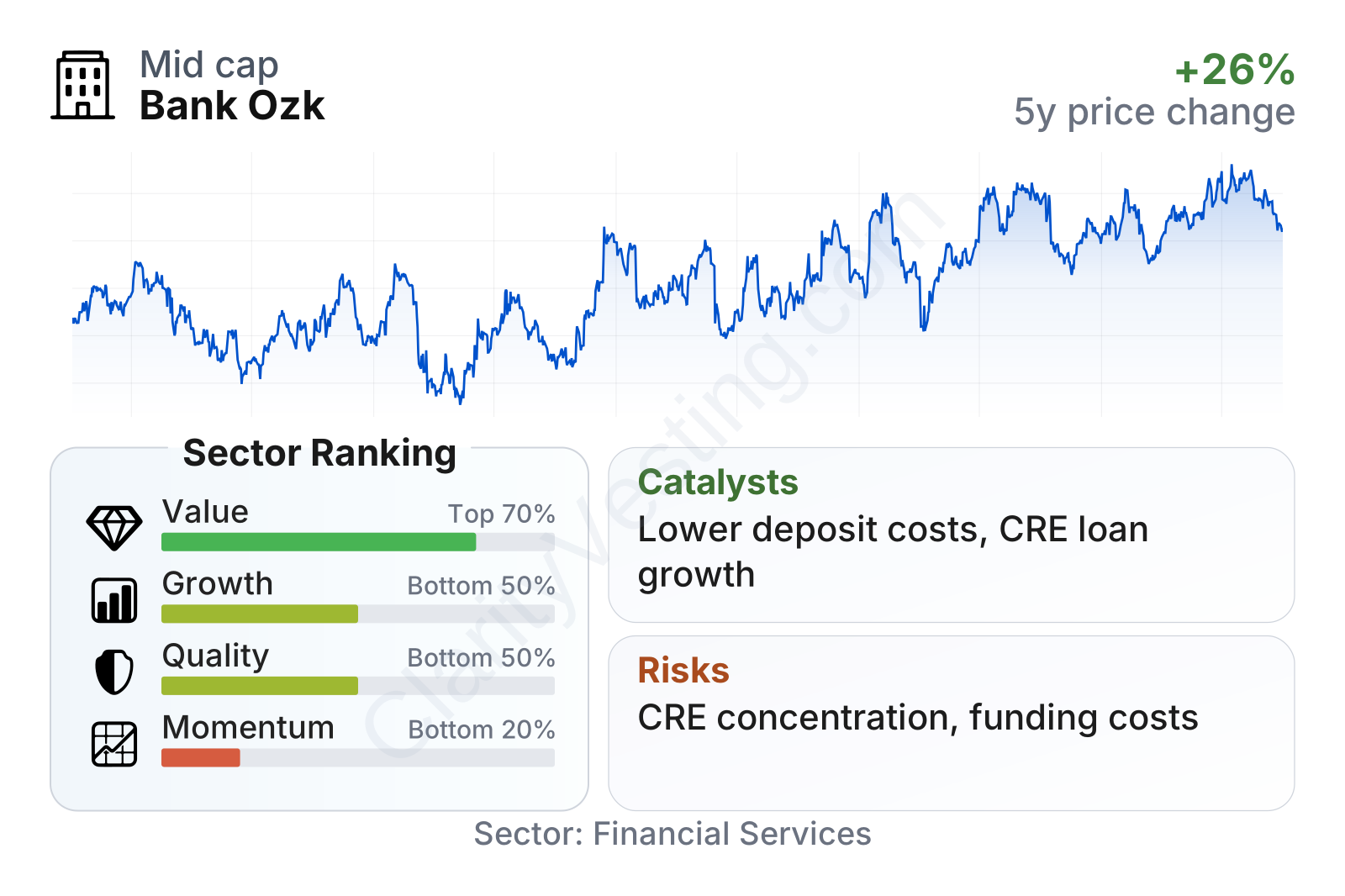
Bank OZK sits in the mid-sized range among U.S. regional banks and shows a mixed profile. On valuation, it screens cheaper than the sector on both earnings and book value, while its dividend yield is also above the industry median. On growth, the short-term picture is softer, with recent revenue slipping slightly year over year, but longer-term per-share expansion in revenue, book value, free cash flow, and dividends has been stronger than many peers.
Quality is more nuanced. Profit margin and asset efficiency are solid, and leverage appears conservative compared with much of the sector. However, recent return on equity is below the sector median, which matters because banks are often judged by how efficiently they turn shareholder capital into profit. Market performance has also lagged peers over the past year and over three years, which helps explain why the shares still trade at a discount.
Growth
Banking is not a classic high-growth sector, but it can still offer meaningful long-term expansion when a bank gains share, keeps credit losses under control, and grows deposits and loans at attractive spreads. Bank OZK operates in a mature industry, yet its niche in large real estate construction and development lending has historically given it a way to grow faster than many community and regional banks.
The company’s strategy makes sense if management continues to combine underwriting discipline with selective expansion. Its lending platform has allowed it to compete beyond its branch footprint, and that creates a larger addressable market than a standard branch-centered bank. In practical terms, Bank OZK is not trying to be the biggest consumer bank in the country; it is trying to be a very capable lender in areas where expertise and speed can matter more than sheer size.
Earnings per share moved up materially from 2021 through 2025, with growth slowing more recently rather than reversing. That is an important distinction for a bank: it suggests that profitability has held up despite a more difficult rate environment and higher funding costs. The broader challenge now is whether earnings can keep rising if commercial real estate demand stays uneven.
Book value per share has climbed steadily over the past five years. For banks, this is a key signal because book value represents the net worth built inside the institution over time. A rising book value usually points to retained earnings, balance-sheet expansion, and resilience, especially when it is not being driven by aggressive leverage.
A major catalyst is the possibility of lower short-term interest rates eventually easing deposit competition. If deposit costs stabilize or fall faster than loan yields, net interest margin could improve. Another catalyst is continued loan production in higher-yielding categories, provided credit quality remains firm. Bank OZK has also shown an ability to keep increasing its dividend over time, which reflects management confidence in recurring earnings power.
Recent company results and public communications have continued to emphasize loan growth, stable credit quality, and capital strength. In a regional banking landscape where some banks are still digesting balance-sheet stress from the 2023 turmoil, that relative stability can itself be an opportunity if the bank keeps winning business from weaker competitors.
Risks
This article is for informational purposes only and does not constitute financial advice. Some content is AI-generated. See Disclaimer