Stock Analysis · Oxford Instruments plc (OXINF)
Overview
Oxford Instruments plc is a British maker of high-performance tools used in scientific research and advanced manufacturing. Its products help customers measure, analyze, and manufacture materials at very small scales, often in demanding environments such as very low temperatures, high magnetic fields, or vacuum conditions. The company sells to academic laboratories, industrial research teams, semiconductor customers, and manufacturers working in areas such as materials analysis, nanotechnology, quantum technologies, and advanced electronics.
Since the group reshaped its portfolio in recent years, its business is centered on two operating segments: Materials & Characterization and Advanced Technologies. In simple terms, one side of the company helps customers inspect and understand materials, while the other provides specialist systems and components used in demanding scientific and industrial processes.
Based on the latest annual reporting for the year ended March 31, 2026, revenue sources are approximately distributed as follows:
- Materials & Characterization: about 74% of revenue. This segment includes microscopy-related tools, analysis systems, and instruments used to study structure and composition of materials.
- Advanced Technologies: about 26% of revenue. This segment includes cryogenic systems, superconducting and magnetic technologies, and other specialist solutions used in research and industrial applications.
Geographically, Oxford Instruments is internationally diversified, with sales spread across Europe, North America, and Asia. That matters because demand is linked to global research spending, semiconductor investment, and industrial capital expenditure rather than to one single country.
The business model combines instrument sales, aftermarket service, and recurring support activity. Instrument makers like Oxford Instruments often benefit from a long installed base because customers need maintenance, upgrades, accessories, and software support after the original purchase.
The recent financial flow shows a business that grew steadily through fiscal 2025 before a weaker fiscal 2026. Revenue pulled back, but profitability recovered from the unusually low earnings level seen in fiscal 2025. Research and development spending remained meaningful, which is important in a specialist instrumentation market where product relevance depends on technical performance rather than price alone.
Key Figures
| Metric | Value | Sector ⓘ |
|---|---|---|
| Date | Oct 24, 2026 | |
| Context | ||
| Sector | Technology | |
| Industry | Scientific & Technical Instruments | |
| Market Cap ⓘ | $2.14B | |
| Beta ⓘ | 1.03 | |
Value (Cheapness) | ||
| P/E Ratio ⓘ | 37.63 | 29.68 |
| FCF Yield ⓘ | 3.86% | 4.28% |
| Dividend Yield ⓘ | 0.60% | 1.30% |
| EBIT / EV ⓘ | N/A | 2.70% |
| PEG ⓘ | N/A | |
Growth (Business expansion) | ||
| Revenue Growth ⓘ | -0.60% | 15.80% |
| RPS Growth (5Y CAGR) ⓘ | 3.98% | 8.56% |
| EPS Growth (5Y CAGR) ⓘ | -9.56% | -11.54% |
| Margin Growth (5Y Trend) ⓘ | 1.77% | 0.46% |
| FCF Growth (5Y CAGR) ⓘ | 8.41% | 9.76% |
| DPS Growth (5Y CAGR) ⓘ | 1.76% | 7.79% |
Quality (Business durability) | ||
| ROIC (Latest) ⓘ | 19.34% | 9.38% |
| ROIC (5Y Median) ⓘ | 13.15% | 8.32% |
| Net Debt / EBIT (Latest) ⓘ | -0.62 | 0.52 |
| Net Debt / EBIT (5Y Median) ⓘ | -0.98 | 0.46 |
| Net Debt / EBITDA (Latest) ⓘ | -0.44 | 0.28 |
| Net Debt / Assets ⓘ | -11.30% | 3.44% |
| EBITDA / Interest ⓘ | 42.07 | 13.20 |
| Operating Margin (Latest) ⓘ | 11.00% | 9.70% |
| Operating Margin (5Y Median) ⓘ | 15.05% | 8.51% |
| Debt to Equity (Latest) ⓘ | 13.08% | 33.40% |
| Profit Margin (Latest) ⓘ | 11.39% | 7.14% |
| Free Cash Flow (Latest) ⓘ | $82.63M | |
Momentum (Price trend) | ||
| 3Y Return ⓘ | +72.28% | +55.43% |
| 12M Return (excl. last month) ⓘ | +34.83% | +10.33% |
| 6M Return ⓘ | +28.54% | +7.97% |
| Price vs. 200-Day MA ⓘ | +17.54% | +5.41% |
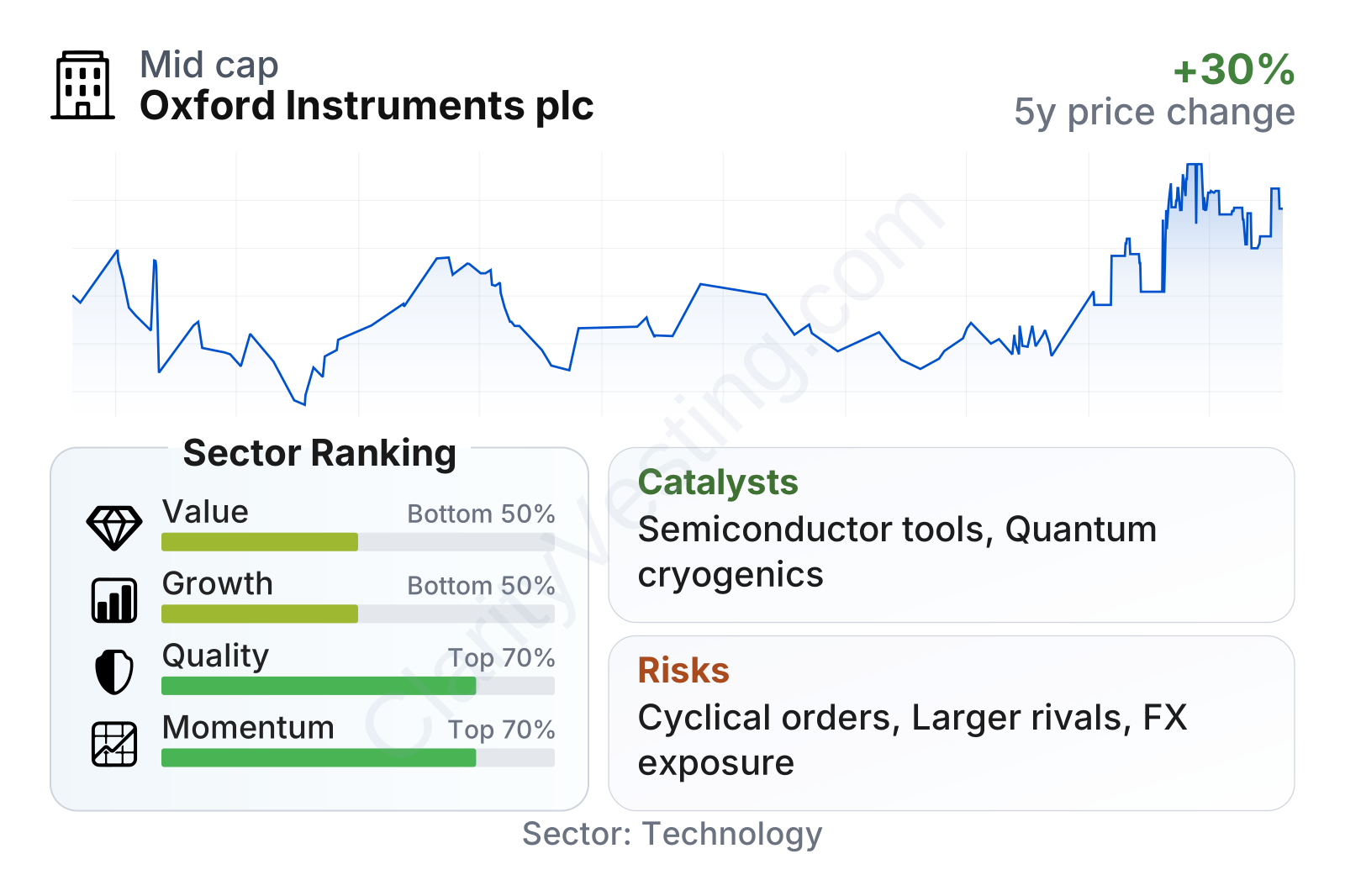
Oxford Instruments sits in an interesting middle ground. On quality, the company stands out more than on headline growth or valuation. Returns on invested capital are clearly above the sector median, profit margins are healthy, and the balance sheet appears conservative with net cash rather than heavy leverage. Free cash flow generation is solid for a company of its size. On the other hand, recent revenue growth has been weak compared with the broader technology instrument universe, and the shares do not screen as cheap on earnings multiples. Market performance has been mixed over longer periods, although the stock has shown stronger momentum over the past year than much of the sector.
Growth
Oxford Instruments operates in markets that benefit from long-term structural demand. Semiconductor complexity keeps rising, advanced materials are becoming more important across electronics and energy applications, and quantum research continues to attract funding from governments and industry. These are favorable end markets because they require specialized measurement, imaging, and low-temperature technologies that are difficult to replace with general-purpose equipment.
The company’s strategy also makes industrial sense. Management has been focusing the portfolio on businesses where Oxford Instruments has stronger technical depth and better margin potential. That type of focus can improve execution, reduce complexity, and direct research spending toward areas where the company already has customer relationships and installed equipment in the field.
A notable positive sign in the latest annual reporting is that, despite lower fiscal 2026 revenue than in fiscal 2025, the company remained profitable, cash generative, and financially strong. That resilience matters because capital equipment businesses often go through uneven ordering cycles. A company with a net cash position and good interest coverage has more flexibility to continue investing through weaker periods.
There are also clear external catalysts. Semiconductor and advanced packaging investment can drive demand for characterization and process-related tools. Quantum computing and quantum sensing research support demand for cryogenic and low-temperature systems. Materials science spending in batteries, magnets, and next-generation electronics can also create opportunities across both major divisions. None of these markets are guaranteed to grow smoothly every year, but they are supported by multi-year technology roadmaps rather than short-lived consumer trends.
Recent company updates have also emphasized order intake and strategic focus areas tied to these advanced technology themes. For a specialist instruments company, sustained order activity is often a better leading indicator than one single year of revenue because delivery timing can shift between periods.
Risks
This article is for informational purposes only and does not constitute financial advice. Some content is AI-generated. See Disclaimer


