Stock Analysis · Otter Tail Corporation (OTTR)
Overview
Otter Tail Corporation is a diversified company built around a regulated electric utility and a group of manufacturing businesses. The company is based in the Upper Midwest and is best known for Otter Tail Power Company, which generates, transmits, and distributes electricity to customers in Minnesota, North Dakota, and South Dakota. Alongside that utility operation, Otter Tail also owns manufacturing businesses that produce plastic pipe and custom metal components used in industrial and construction markets.
This mix matters because it gives the company two different earnings engines. The utility side tends to be steadier and supported by regulated returns on approved investments, while the manufacturing side can add stronger upside when industrial demand is healthy. In recent years, the utility business has become the anchor of the group, while manufacturing has remained meaningful but more cyclical.
Based on the company’s recent reporting structure, revenue is mainly generated from the following sources:
- Electric utility: approximately 45% to 50% of revenue. This includes retail electricity sales, wholesale power sales, and related energy services through Otter Tail Power.
- Manufacturing: approximately 50% to 55% of revenue. This mainly includes plastic pipe products through Northern Pipe Products and metal components and fabrication through BTD Manufacturing and related operations.
At the profit level, the utility segment often carries more weight than its revenue share suggests because regulated electricity operations can be more resilient than manufacturing during weaker industrial periods. Over the last several years, total revenue has stayed in a fairly narrow range around the low-$1 billion level, but operating income and net income improved materially versus 2021 before moderating more recently. That pattern suggests better business quality than a simple top-line reading might imply, although 2025 appears to show pressure on gross profit and financing costs.
Key Figures
| Metric | Value | Sector ⓘ |
|---|---|---|
| Date | Oct 03, 2026 | |
| Context | ||
| Sector | Industrials | |
| Industry | Conglomerates | |
| Market Cap ⓘ | $3.74B | |
| Beta ⓘ | 0.43 | |
Value (Cheapness) | ||
| P/E Ratio ⓘ | 19.13 | 22.45 |
| P/B Ratio ⓘ | 1.97 | 1.98 |
| FCF Yield ⓘ | -5.78% | 6.31% |
| Dividend Yield ⓘ | 2.49% | 1.96% |
| EBIT / EV ⓘ | 5.71% | 4.81% |
| PEG ⓘ | 2.01 | |
Growth (Business expansion) | ||
| Revenue Growth ⓘ | 0.40% | 9.10% |
| RPS Growth (5Y CAGR) ⓘ | 1.99% | 7.75% |
| EPS Growth (5Y CAGR) ⓘ | -16.88% | -13.59% |
| BVPS Growth (5Y CAGR) ⓘ | 16.87% | 6.22% |
| Margin Growth (5Y Trend) ⓘ | 7.40% | 0.72% |
| FCF Growth (5Y CAGR) ⓘ | 13.30% | 10.98% |
| DPS Growth (5Y CAGR) ⓘ | 7.75% | 9.48% |
Quality (Business durability) | ||
| ROIC (Latest) ⓘ | 7.63% | 10.92% |
| ROA (Latest) ⓘ | 5.31% | 5.41% |
| ROIC (5Y Median) ⓘ | 13.36% | 9.21% |
| ROA (5Y Median) ⓘ | 8.75% | 4.94% |
| Net Debt / EBIT (Latest) ⓘ | 3.42 | 2.07 |
| Net Debt / EBIT (5Y Median) ⓘ | 1.81 | 2.28 |
| Net Debt / EBITDA (Latest) ⓘ | 2.56 | 1.43 |
| Net Debt / Assets ⓘ | 21.31% | 19.27% |
| EBITDA / Interest ⓘ | 7.14 | 9.53 |
| Operating Margin (Latest) ⓘ | 19.74% | 10.50% |
| Operating Margin (5Y Median) ⓘ | 28.33% | 10.27% |
| Debt to Equity (Latest) ⓘ | 67.49% | 65.48% |
| Profit Margin (Latest) ⓘ | 14.83% | 6.62% |
| Free Cash Flow (Latest) ⓘ | -$216.23M | |
Momentum (Price trend) | ||
| 3Y Return ⓘ | +24.69% | +58.56% |
| 12M Return (excl. last month) ⓘ | +10.50% | +15.63% |
| 6M Return ⓘ | +1.59% | +4.19% |
| Price vs. 200-Day MA ⓘ | +0.84% | +0.93% |
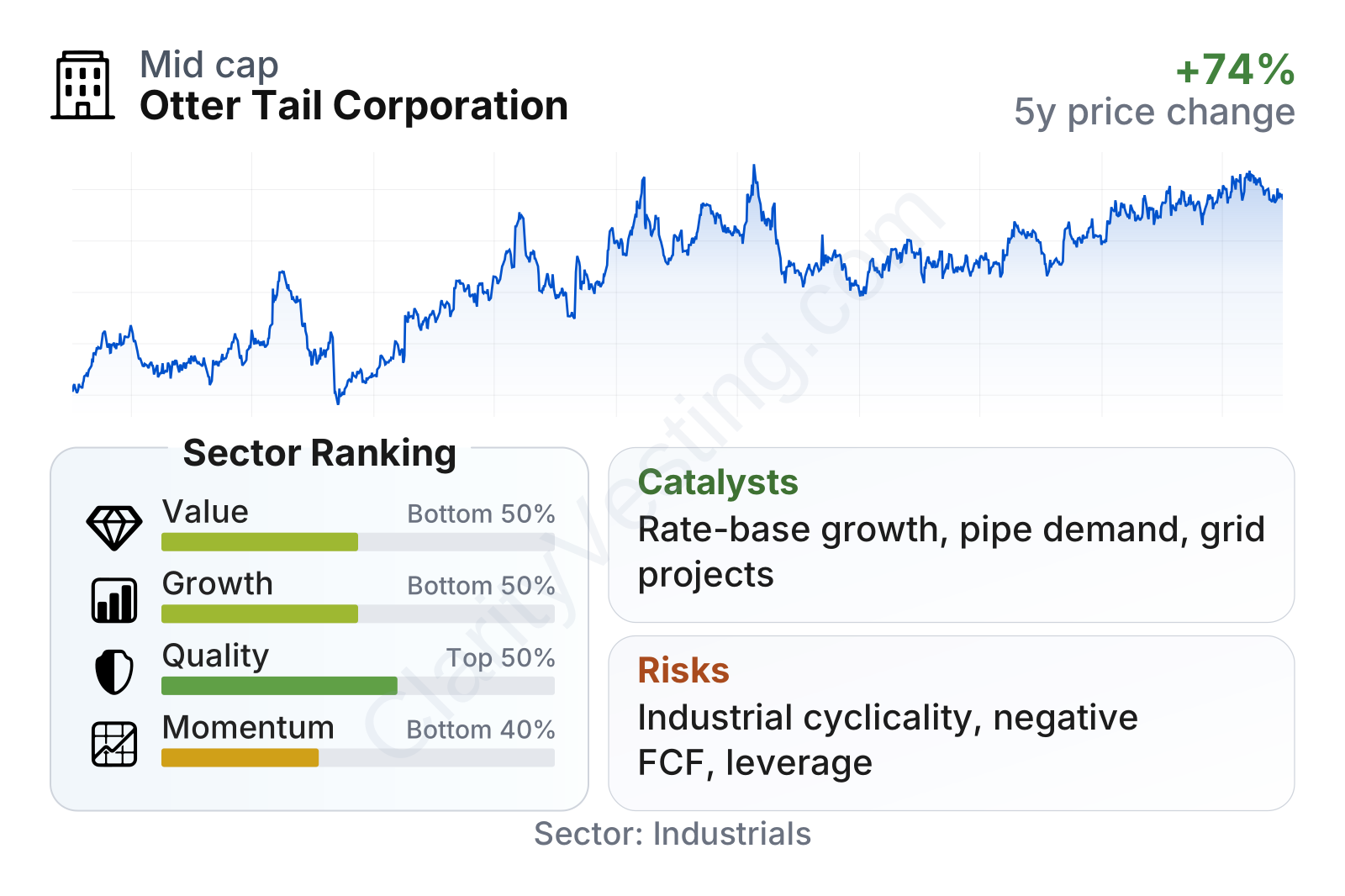
Otter Tail is a mid-sized company with a market value around the mid-single-digit billions of dollars and a relatively low beta near 0.4, which points to lower share-price volatility than many industrial stocks. The factor profile is mixed. Quality remains above the sector median, supported by operating margins and long-term returns on capital that have historically been strong. Growth ranks below the sector median, reflecting a recent slowdown in revenue expansion and a weaker five-year earnings trend. Value is also mixed: the earnings multiple is below the sector median, but free cash flow is currently negative, which weakens the picture. Momentum has been softer than the broader sector even though the stock has still trended upward over several years.
Growth
Otter Tail operates in two sectors with different growth characteristics. Regulated electricity is usually not a high-growth industry, but it can deliver steady expansion when a utility invests in generation, transmission, and grid upgrades that regulators allow into its rate base. Manufacturing is more cyclical, but it can grow faster during favorable periods for construction, infrastructure, and industrial production. This combination gives Otter Tail a practical long-term strategy: stable utility investment on one side, selective industrial upside on the other.
The utility strategy appears logical for future growth. Otter Tail Power has continued investing in transmission, generation resources, and system reliability. Those projects can support earnings growth over time because regulated utilities generally earn returns on approved capital spending. In plain terms, when the company builds useful long-life energy infrastructure and regulators allow recovery, that can gradually expand profit even if customer growth is modest.
Recent revenue growth has been uneven. The company posted very strong growth in 2021 and early 2022, then moved through a period of declines and stabilization, with only minimal year-over-year growth by mid-2026. That suggests the company is no longer benefiting from the unusually favorable conditions that lifted results earlier in the cycle. For long-term analysis, this makes it important to focus less on short-term sales swings and more on whether utility investments and manufacturing capacity can support the next phase of earnings expansion.
Cash generation adds another important layer. Free cash flow was positive for several years and then turned negative more recently. For a utility-heavy business, this is not automatically alarming, because large capital spending programs often push free cash flow below zero for a period. Still, it means current growth is being funded with more balance-sheet pressure than before, and the payoff from these investments needs to show up in future regulated earnings and operating performance.
A notable catalyst is the company’s exposure to long-duration utility infrastructure spending in the Upper Midwest, including transmission and generation needs tied to reliability and resource planning. Another is manufacturing exposure to construction-related end markets, especially plastic pipe, where demand can benefit from municipal, agricultural, and infrastructure activity. The company has also emphasized disciplined capital allocation and dividend growth over time, which helps frame expansion as measured rather than overly aggressive.
Recent company updates have also highlighted ongoing capital investment plans at the utility and continued focus on operational execution across manufacturing subsidiaries. For a business like Otter Tail, major upside usually comes less from sudden breakthroughs and more from rate-base growth, project completion, and margin resilience across the industrial units.
Risks
This article is for informational purposes only and does not constitute financial advice. Some content is AI-generated. See Disclaimer