Stock Analysis · Otis Worldwide Corp (OTIS)
Overview
Otis Worldwide Corp is one of the largest elevator and escalator companies in the world. It designs, manufactures, installs, and services elevators, escalators, and moving walkways for residential, commercial, and infrastructure buildings. For long-term analysis, the most important point is that Otis is not only a seller of new equipment. A large part of its business comes from maintaining and modernizing equipment already installed in buildings, which creates recurring revenue and usually makes results steadier than a pure construction business.
Its business is generally organized into two main operating streams:
- Service: approximately 58% to 60% of revenue in recent years. This includes maintenance contracts, repairs, and modernization of existing elevators and escalators. This is the most recurring and usually the most profitable part of the company.
- New Equipment: approximately 40% to 42% of revenue. This includes the sale and installation of new elevators, escalators, and moving walkways in newly built or substantially renovated projects.
Geographically, Otis is broadly diversified across the Americas, Europe, the Middle East, Africa, and Asia-Pacific, which helps reduce dependence on any single country. The company also benefits from a very large installed base of units already operating worldwide. That matters because every elevator placed in service can generate maintenance and modernization work over many years, sometimes decades.
From a business model perspective, Otis combines a cyclical activity, new equipment tied to construction demand, with a more defensive one, service tied to building operation and safety requirements. That combination is one of the central reasons the company attracts attention as a long-duration industrial franchise.
The financial structure has been relatively stable in recent years: revenue has stayed around the mid-$14 billion range, while gross profit and operating income have remained resilient. Net income improved meaningfully in 2024 before easing in 2025, showing that the company can protect profitability even when top-line growth is not dramatic.
Key Figures
| Metric | Value | Sector ⓘ |
|---|---|---|
| Date | Oct 24, 2026 | |
| Context | ||
| Sector | Industrials | |
| Industry | Specialty Industrial Machinery | |
| Market Cap ⓘ | $27.43B | |
| Beta ⓘ | 0.86 | |
Value (Cheapness) | ||
| P/E Ratio ⓘ | 18.53 | 22.29 |
| P/B Ratio ⓘ | N/A | 1.98 |
| FCF Yield ⓘ | 6.24% | 6.26% |
| Dividend Yield ⓘ | 2.39% | 1.92% |
| EBIT / EV ⓘ | 6.71% | 4.83% |
| PEG ⓘ | 2.22 | |
Growth (Business expansion) | ||
| Revenue Growth ⓘ | 7.30% | 9.30% |
| RPS Growth (5Y CAGR) ⓘ | 2.55% | 7.76% |
| EPS Growth (5Y CAGR) ⓘ | -12.84% | -13.17% |
| BVPS Growth (5Y CAGR) ⓘ | N/A | 6.13% |
| Margin Growth (5Y Trend) ⓘ | 0.09% | 0.74% |
| FCF Growth (5Y CAGR) ⓘ | -2.44% | 10.79% |
| DPS Growth (5Y CAGR) ⓘ | 15.89% | 9.41% |
Quality (Business durability) | ||
| ROIC (Latest) ⓘ | 69.05% | 10.75% |
| ROA (Latest) ⓘ | 13.83% | 5.41% |
| ROIC (5Y Median) ⓘ | 54.15% | 9.37% |
| ROA (5Y Median) ⓘ | 12.60% | 4.95% |
| Net Debt / EBIT (Latest) ⓘ | 3.52 | 2.04 |
| Net Debt / EBIT (5Y Median) ⓘ | 2.97 | 2.27 |
| Net Debt / EBITDA (Latest) ⓘ | 3.27 | 1.39 |
| Net Debt / Assets ⓘ | 72.01% | 19.27% |
| EBITDA / Interest ⓘ | 11.70 | 9.58 |
| Operating Margin (Latest) ⓘ | 15.32% | 10.49% |
| Operating Margin (5Y Median) ⓘ | 14.76% | 10.30% |
| Debt to Equity (Latest) ⓘ | -153.90% | 64.82% |
| Profit Margin (Latest) ⓘ | 10.17% | 6.67% |
| Free Cash Flow (Latest) ⓘ | $1.71B | |
Momentum (Price trend) | ||
| 3Y Return ⓘ | -1.47% | +67.77% |
| 12M Return (excl. last month) ⓘ | -23.65% | +12.05% |
| 6M Return ⓘ | -7.15% | 0.00% |
| Price vs. 200-Day MA ⓘ | -5.02% | +0.67% |
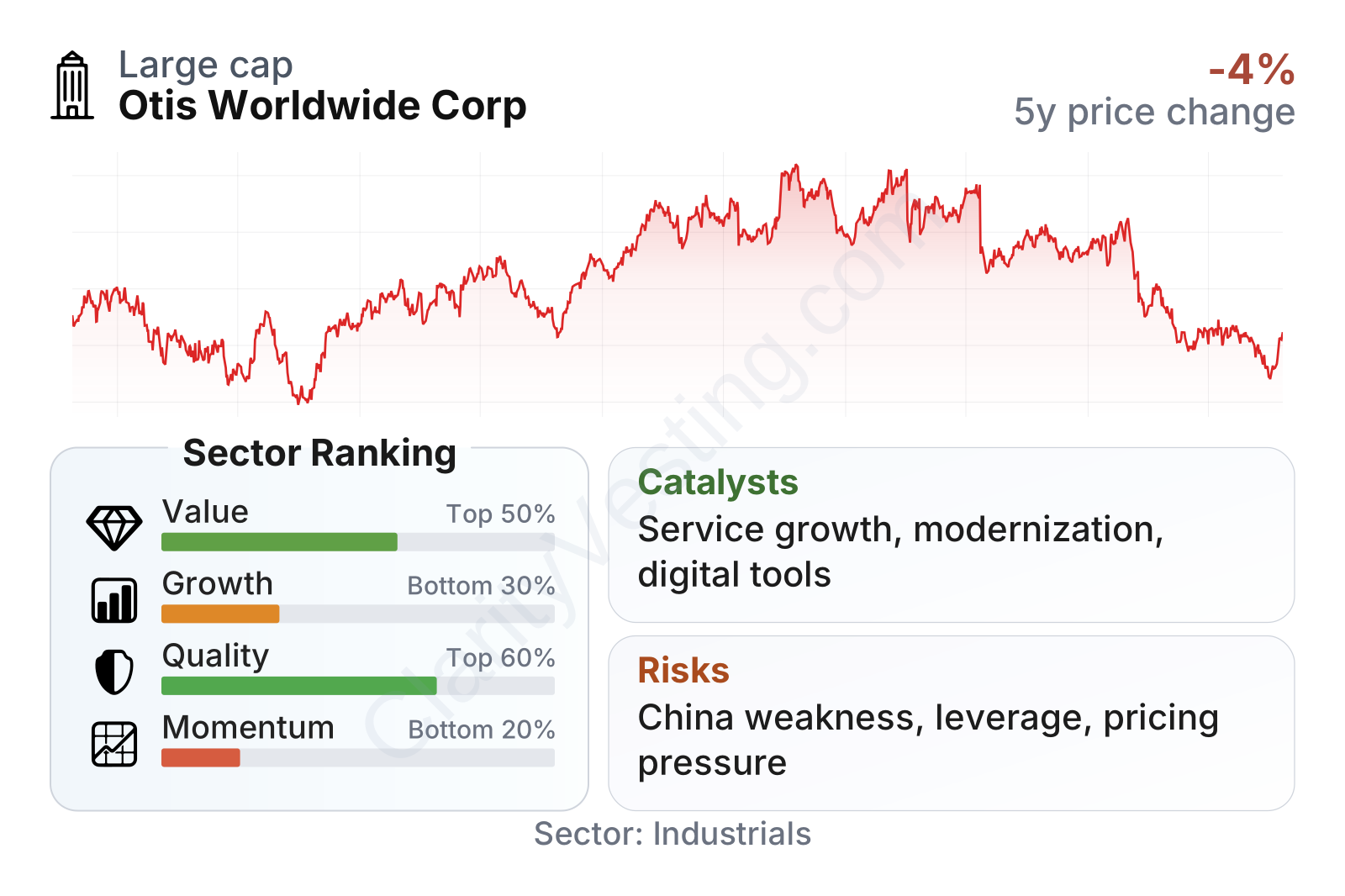
Otis is a large industrial company with a market value around the mid-$20 billion range and a share price pattern that has weakened over the last year after reaching higher levels in 2024 and 2025. In the factor summary, value looks somewhat more favorable than the sector average, quality remains solid, but growth and market momentum are weaker. The picture is that of a mature, cash-generative business rather than a fast-expanding industrial name.
Growth
The elevator and escalator sector has structural support from long-term urbanization, aging buildings, stricter safety standards, energy-efficiency upgrades, and the need to maintain vertical transportation systems in dense cities. This is not usually a high-growth industry, but it can be a durable one. Otis is especially exposed to the attractive part of that setup because service and modernization needs continue even when new construction slows.
Its strategy makes sense for future growth because it is centered on expanding its service portfolio, keeping customers connected through digital tools, and using its installed base as a source of recurring business. The installed base is a key asset: once equipment is in operation, maintenance relationships can last a long time, and modernization demand often follows as equipment ages or building owners seek better efficiency and performance.
Recent revenue growth has not been explosive, but the trend improved into 2026, moving back into positive mid-single-digit territory after a more uneven period. That suggests the company still has room to grow through pricing, service expansion, and selective new equipment demand even in a mixed construction backdrop.
Cash generation has also improved. Free cash flow has climbed from the low-$1 billion range a few years ago toward roughly $1.7 billion more recently. For a mature industrial company, this matters a great deal because strong cash conversion supports debt service, dividends, buybacks, and reinvestment without requiring aggressive balance-sheet expansion.
A relevant catalyst in recent years has been the push toward smart, connected elevators and predictive maintenance. Otis has invested in digital service capabilities that help monitor equipment, reduce downtime, and improve technician efficiency. Another favorable driver is modernization demand in older buildings, particularly where energy efficiency and reliability are becoming more important. These trends may not create sudden spikes in growth, but they can steadily improve the mix toward higher-value recurring work.
Risks
This article is for informational purposes only and does not constitute financial advice. Some content is AI-generated. See Disclaimer