Stock Analysis · Össur hf (OSSFF)
Overview
Össur hf is an Iceland-based medical device company focused on helping people with mobility challenges live more active lives. Its products are mainly used by people who have lost a limb, live with osteoarthritis or other joint problems, or need external support and bracing after injury or surgery. The business is built around prosthetics, bracing and supports, and patient-care services connected to fitting and follow-up.
The company’s revenue is primarily generated from two large product categories, with a smaller contribution from patient-care services and other activities. Based on recent annual reporting, the mix is approximately as follows:
- Prosthetics: about 57% to 60% — artificial limbs and related components such as microprocessor knees, liners, feet, and other advanced mobility solutions.
- Bracing & Supports: about 35% to 38% — knee braces, osteoarthritis solutions, injury supports, and other non-invasive orthopedic products.
- Patient Care and other revenue: about 4% to 7% — clinical fitting, follow-up services, and smaller ancillary activities.
Geographically, Össur sells internationally, with North America and Europe representing its most important markets. That global footprint matters because reimbursement systems, hospital relationships, clinic networks, and local distribution can all influence demand.
Over the last several years, the business has shown a clear pattern: revenue has risen steadily, gross profit has expanded, and operating income has recovered after a softer 2022. Research and development spending has also increased over time, which fits a medical technology company that depends on product innovation rather than commodity manufacturing.
The financial flow also suggests a business with solid gross profitability and improving earnings conversion, although interest expense remains meaningful enough to deserve attention because of the company’s debt load.
Key Figures
| Metric | Value | Sector ⓘ |
|---|---|---|
| Date | Oct 17, 2026 | |
| Context | ||
| Sector | Healthcare | |
| Industry | Medical Devices | |
| Market Cap ⓘ | $1.92B | |
| Beta ⓘ | 0.46 | |
Value (Cheapness) | ||
| P/E Ratio ⓘ | 20.57 | 24.79 |
| P/B Ratio ⓘ | 2.12 | 3.08 |
| FCF Yield ⓘ | 6.64% | 3.15% |
| Dividend Yield ⓘ | N/A | 1.94% |
| EBIT / EV ⓘ | 6.29% | 0.57% |
| PEG ⓘ | N/A | |
Growth (Business expansion) | ||
| Revenue Growth ⓘ | 11.30% | 7.45% |
| RPS Growth (5Y CAGR) ⓘ | 7.34% | 8.61% |
| EPS Growth (5Y CAGR) ⓘ | 0.63% | -17.81% |
| BVPS Growth (5Y CAGR) ⓘ | 8.91% | 3.72% |
| Margin Growth (5Y Trend) ⓘ | -0.07% | -0.62% |
| FCF Growth (5Y CAGR) ⓘ | 12.66% | 1.04% |
| DPS Growth (5Y CAGR) ⓘ | 5.48% | 6.77% |
Quality (Business durability) | ||
| ROIC (Latest) ⓘ | N/A | 3.24% |
| ROA (Latest) ⓘ | 5.47% | 3.01% |
| ROIC (5Y Median) ⓘ | 7.76% | 4.60% |
| ROA (5Y Median) ⓘ | 4.67% | 1.89% |
| Net Debt / EBIT (Latest) ⓘ | 3.12 | 1.34 |
| Net Debt / EBIT (5Y Median) ⓘ | 3.81 | 1.84 |
| Net Debt / EBITDA (Latest) ⓘ | 2.15 | 1.00 |
| Net Debt / Assets ⓘ | 25.34% | 5.45% |
| EBITDA / Interest ⓘ | 9.57 | 9.64 |
| Operating Margin (Latest) ⓘ | 14.21% | 9.27% |
| Operating Margin (5Y Median) ⓘ | 13.18% | 7.38% |
| Debt to Equity (Latest) ⓘ | 58.00% | 28.58% |
| Profit Margin (Latest) ⓘ | 9.54% | 3.59% |
| Free Cash Flow (Latest) ⓘ | $127.79M | |
Momentum (Price trend) | ||
| 3Y Return ⓘ | +4.26% | +42.80% |
| 12M Return (excl. last month) ⓘ | -5.73% | +18.50% |
| 6M Return ⓘ | +9.04% | +7.57% |
| Price vs. 200-Day MA ⓘ | +1.74% | +5.12% |
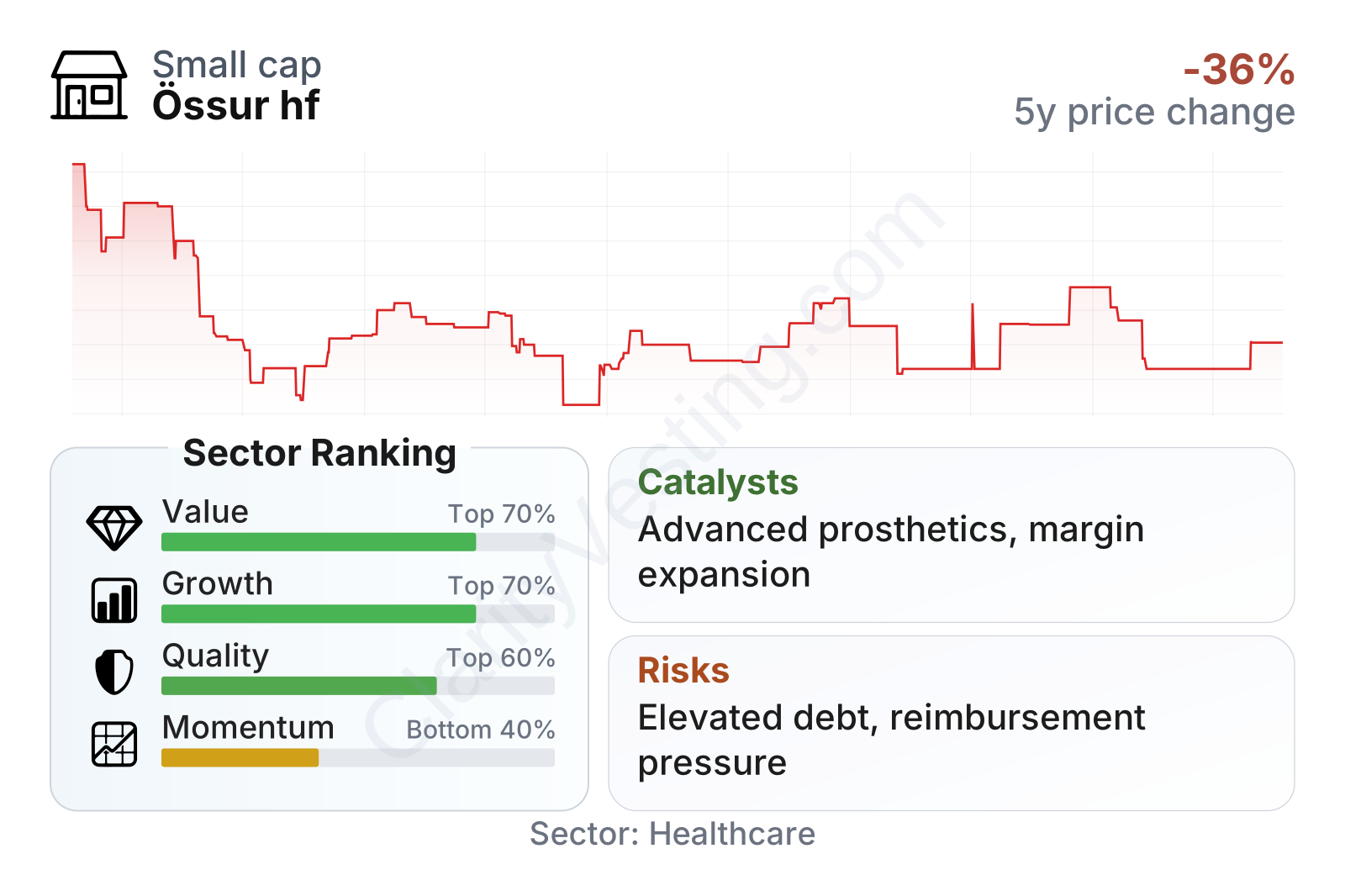
Össur sits in the mid-cap range and has shown relatively low share-price volatility, with a beta well below 1. In broad terms, the company looks stronger than much of the healthcare equipment group on profitability and cash generation, while its market performance has lagged. The factor summary points in that direction: value and growth are above average for the sector, quality is also favorable, but momentum is weak. That combination usually means the market has recognized operational progress only partially so far.
The share price history reflects this gap. The stock is still well below its 2021 highs even though the business has moved forward on sales, margins, and free cash flow. That disconnect is important for valuation, especially in a sector where many peers trade on expected future growth rather than current cash returns.
Growth
Össur operates in a healthcare niche with favorable long-term demand drivers. Aging populations support demand for osteoarthritis and bracing products, while rising diabetes and vascular disease contribute to long-term prosthetics needs. On top of that, better technology is expanding what users expect from mobility devices, especially in premium prosthetics where performance, comfort, and digital features can justify higher prices.
The company’s strategy also fits these trends. It focuses on specialized products where engineering, clinical evidence, reimbursement know-how, and practitioner relationships matter. That is generally a sensible approach because it creates switching costs and reduces the risk of pure price competition. Össur has also invested in bionic and microprocessor-enabled prosthetics, an area where technology can support both differentiation and premium pricing.
Revenue growth has been consistently positive again after the uneven period in 2022. Recent year-over-year gains in the low-double-digit range are stronger than the sector median, suggesting that demand and execution have both improved. That matters because sustained growth in medical devices often depends on a mix of new products, pricing, reimbursement access, and share gains rather than one-off volume spikes.
Cash generation has improved materially as well. Free cash flow has climbed from a much lower level a few years ago to more than $100 million on a trailing basis, and the five-year growth rate is far ahead of the sector median. For a long-term view, that is one of the more encouraging signals: it suggests earnings are being translated into cash instead of remaining tied up in accounting adjustments.
A notable catalyst is the continued adoption of advanced prosthetic systems, especially products designed to improve stability, gait, and user confidence. Another is the company’s ability to expand in patient-care pathways and deepen relationships with clinics and practitioners. If new product cycles continue to land well and reimbursement remains supportive in key markets, Össur has room to outgrow broader medical device demand.
Recent company reporting has also pointed to ongoing organic growth and margin discipline rather than dependence on a single transformational event. That tends to be less dramatic, but for a medical device company it can be a healthier basis for compounding over time.
Risks
This article is for informational purposes only and does not constitute financial advice. Some content is AI-generated. See Disclaimer


