Stock Analysis · Oshkosh Corporation (OSK)
Overview
Oshkosh Corporation is a U.S. industrial manufacturer that builds specialty vehicles and equipment for commercial, municipal, emergency, military, and access-related uses. Rather than competing as a mass-market automaker, the company focuses on mission-critical products where durability, customization, and service support matter more than volume. Its businesses include aerial work platforms, fire apparatus, refuse collection vehicles, concrete mixers, airport ground support equipment, and defense vehicles.
Revenue is spread across several operating segments, which helps reduce reliance on any single end market, although some areas remain cyclical. Based on the company’s latest annual reporting structure, the main sources of revenue are approximately:
- Access: about 44% of revenue. This segment is centered on JLG-branded aerial work platforms and telehandlers used in construction, industrial maintenance, and equipment rental fleets.
- Vocational: about 31% of revenue. This includes Pierce fire trucks, McNeilus refuse and recycling vehicles, Oshkosh concrete mixers, and airport products.
- Defense: about 25% of revenue. This business produces tactical wheeled vehicles, trailers, vehicle bodies, and sustainment services for the U.S. military and allied customers.
That mix shows why Oshkosh is not a simple construction-equipment company. It has exposure to infrastructure and non-residential construction through Access, recurring municipal and public-safety demand through Vocational, and long-cycle government programs through Defense.
The long-term financial pattern has been uneven but constructive. Revenue expanded from roughly $7.7 billion in 2021 to above $10.4 billion in 2025, while profitability recovered strongly after the margin pressure seen in 2022. The business still carries manufacturing cost exposure, but the recent structure looks more resilient than it did a few years ago.
The broad trend points to a company that has grown sales and rebuilt earnings after a difficult inflationary period. Gross profit and operating income improved meaningfully from 2022 lows, even though 2025 eased slightly from 2024’s peak.
Key Figures
| Metric | Value | Sector ⓘ |
|---|---|---|
| Date | Oct 24, 2026 | |
| Context | ||
| Sector | Industrials | |
| Industry | Farm & Heavy Construction Machinery | |
| Market Cap ⓘ | $8.21B | |
| Beta ⓘ | 1.26 | |
Value (Cheapness) | ||
| P/E Ratio ⓘ | 15.22 | 22.29 |
| P/B Ratio ⓘ | 1.88 | 1.98 |
| FCF Yield ⓘ | 14.00% | 6.26% |
| Dividend Yield ⓘ | 1.69% | 1.92% |
| EBIT / EV ⓘ | 9.00% | 4.83% |
| PEG ⓘ | 6.51 | |
Growth (Business expansion) | ||
| Revenue Growth ⓘ | 6.70% | 9.30% |
| RPS Growth (5Y CAGR) ⓘ | 8.84% | 7.76% |
| EPS Growth (5Y CAGR) ⓘ | 3.67% | -13.17% |
| BVPS Growth (5Y CAGR) ⓘ | 13.36% | 6.13% |
| Margin Growth (5Y Trend) ⓘ | 5.23% | 0.74% |
| FCF Growth (5Y CAGR) ⓘ | 23.03% | 10.79% |
| DPS Growth (5Y CAGR) ⓘ | 11.14% | 9.41% |
Quality (Business durability) | ||
| ROIC (Latest) ⓘ | 11.56% | 10.75% |
| ROA (Latest) ⓘ | 5.59% | 5.41% |
| ROIC (5Y Median) ⓘ | 14.84% | 9.37% |
| ROA (5Y Median) ⓘ | 6.64% | 4.95% |
| Net Debt / EBIT (Latest) ⓘ | 0.86 | 2.04 |
| Net Debt / EBIT (5Y Median) ⓘ | 0.74 | 2.27 |
| Net Debt / EBITDA (Latest) ⓘ | 0.66 | 1.39 |
| Net Debt / Assets ⓘ | 6.96% | 19.27% |
| EBITDA / Interest ⓘ | 8.70 | 9.58 |
| Operating Margin (Latest) ⓘ | 7.69% | 10.49% |
| Operating Margin (5Y Median) ⓘ | 9.09% | 10.30% |
| Debt to Equity (Latest) ⓘ | 24.36% | 64.82% |
| Profit Margin (Latest) ⓘ | 5.24% | 6.67% |
| Free Cash Flow (Latest) ⓘ | $1.15B | |
Momentum (Price trend) | ||
| 3Y Return ⓘ | +60.36% | +67.77% |
| 12M Return (excl. last month) ⓘ | +9.23% | +12.05% |
| 6M Return ⓘ | -8.98% | 0.00% |
| Price vs. 200-Day MA ⓘ | -7.21% | +0.67% |
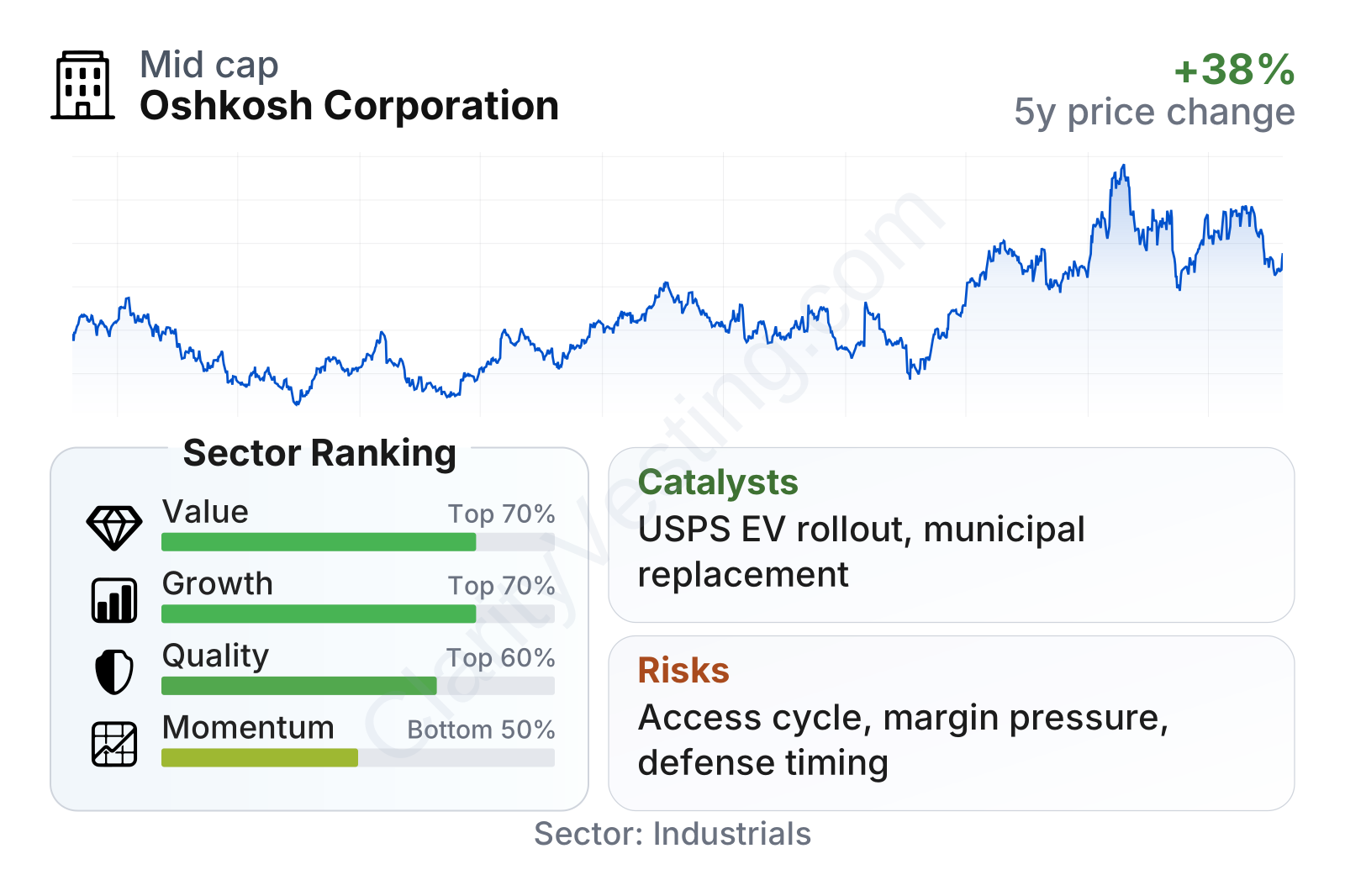
Oshkosh is a mid-to-large industrial company with a stock that has been more volatile than the broader market, as shown by a beta above 1. The quality and growth profile looks solid rather than exceptional: returns on capital are slightly above sector medians, leverage is comfortably below many peers, and free cash flow generation has improved sharply. The weaker area is recent share-price momentum, which has lagged much of the industrial sector even as fundamental valuation remains lower than sector norms.
Growth
Oshkosh operates in several markets that still have long-term support. Access equipment benefits from infrastructure work, warehouse and industrial maintenance, and fleet replacement by rental companies. Vocational products are tied to municipal budgets, public safety, waste collection, and airport activity. Defense depends on procurement cycles, but military modernization and autonomous programs can create multi-year demand visibility when contracts are secured.
The company’s strategy is coherent because it leans into specialized vehicles where customers often care about uptime, product performance, and after-sales support. That tends to be a better place to compete than commoditized heavy equipment. Oshkosh has also been investing in electrification, automation, and smart connected products, which could matter as municipalities, contractors, and defense customers modernize fleets.
Revenue growth has clearly cooled from the strong rebound period of 2023 and 2024, and 2025 included several soft quarters. Even so, growth returned to positive territory more recently, with the latest year-over-year pace back in the mid-single digits. That points to a business that may be moving out of a digestion phase rather than one facing a structural contraction.
Cash generation is one of the more encouraging developments. Free cash flow moved from negative territory in 2023 and 2024 to strongly positive more recently, reaching well above $800 million on a trailing basis and about $1.15 billion in the latest metrics snapshot. For a manufacturer with cyclical exposure, that kind of rebound matters because it supports reinvestment, debt control, acquisitions, and shareholder returns without depending heavily on external financing.
A notable catalyst is Oshkosh’s position in U.S. Postal Service next-generation delivery vehicle production, including battery-electric units, which gives the company exposure to fleet electrification at scale. In defense, the company continues to pursue tactical vehicle and sustainment opportunities, while in Vocational it benefits from replacement demand for aging municipal fleets. These are not all fast-growth markets, but they can support durable demand over long periods.
Risks
This article is for informational purposes only and does not constitute financial advice. Some content is AI-generated. See Disclaimer


