Stock Analysis · Oscar Health Inc (OSCR)
Overview
Oscar Health is a health insurance company focused on individuals, families, and small businesses in the United States. It sells health plans, mainly through the Affordable Care Act marketplace, and builds much of its customer experience around digital tools, member support, and care navigation. In simple terms, Oscar tries to make health insurance easier to use by combining insurance coverage with technology-driven service.
The business is still centered on insurance underwriting rather than software sales. Most of its revenue comes from premiums paid for health coverage, while a smaller portion comes from commissions and service-related arrangements tied to its platform and partnerships.
Based on recent company reporting, Oscar’s revenue sources can be summarized as follows:
- Insurance premiums: about 95% to 98% of total revenue. This includes monthly premiums from members enrolled in individual, small group, and other insurance products.
- Investment income: about 1% to 3%. This comes from interest and returns generated on the company’s cash and invested assets.
- Services and other revenue: typically below 3%. This includes fees, commissions, and revenue tied to Oscar’s technology and administrative capabilities, including platform-related arrangements when applicable.
One important business reality is that Oscar’s top line can grow quickly when membership rises, but profitability depends heavily on medical costs staying under control. In health insurance, revenue growth alone is not enough; the company must also price risk accurately and manage claims expenses well.
The long-term operating picture has improved meaningfully compared with the company’s earlier years. Revenue has expanded from under $2 billion in 2021 to above $11 billion in 2025, showing that Oscar has moved from a niche player to a much larger national marketplace insurer. At the same time, results have remained somewhat uneven, which is typical for insurers that are still scaling.
The multi-year flow of revenue and expenses shows a business that has grown fast but remains very sensitive to claims and administrative costs. Oscar crossed into profitability in 2024, then slipped back to a net loss in 2025 as expenses rose faster than operating income, highlighting how narrow the margin for error can be in this business.
Key Figures
| Metric | Value | Sector ⓘ |
|---|---|---|
| Date | Oct 24, 2026 | |
| Context | ||
| Sector | Healthcare | |
| Industry | Healthcare Plans | |
| Market Cap ⓘ | $10.32B | |
| Beta ⓘ | 2.47 | |
Value (Cheapness) | ||
| P/E Ratio ⓘ | 25.93 | 25.42 |
| P/B Ratio ⓘ | 5.42 | 3.08 |
| FCF Yield ⓘ | 41.99% | 3.12% |
| Dividend Yield ⓘ | N/A | 1.85% |
| EBIT / EV ⓘ | 10.48% | 0.56% |
| PEG ⓘ | N/A | |
Growth (Business expansion) | ||
| Revenue Growth ⓘ | 70.40% | 7.50% |
| RPS Growth (5Y CAGR) ⓘ | 42.77% | 8.60% |
| EPS Growth (5Y CAGR) ⓘ | N/A | -17.73% |
| BVPS Growth (5Y CAGR) ⓘ | -16.72% | 3.72% |
| Margin Growth (5Y Trend) ⓘ | N/A | -0.57% |
| FCF Growth (5Y CAGR) ⓘ | N/A | 0.96% |
| DPS Growth (5Y CAGR) ⓘ | N/A | 6.69% |
Quality (Business durability) | ||
| ROIC (Latest) ⓘ | 34.88% | 3.17% |
| ROA (Latest) ⓘ | 6.49% | 2.98% |
| ROIC (5Y Median) ⓘ | -24.08% | 4.56% |
| ROA (5Y Median) ⓘ | -7.94% | 1.87% |
| Net Debt / EBIT (Latest) ⓘ | -6.02 | 1.34 |
| Net Debt / EBIT (5Y Median) ⓘ | N/A | 1.86 |
| Net Debt / EBITDA (Latest) ⓘ | -5.75 | 1.00 |
| Net Debt / Assets ⓘ | -32.46% | 5.06% |
| EBITDA / Interest ⓘ | 35.12 | 9.55 |
| Operating Margin (Latest) ⓘ | 3.95% | 9.25% |
| Operating Margin (5Y Median) ⓘ | -4.02% | 7.33% |
| Debt to Equity (Latest) ⓘ | 21.03% | 26.68% |
| Profit Margin (Latest) ⓘ | 3.60% | 3.34% |
| Free Cash Flow (Latest) ⓘ | $4.33B | |
Momentum (Price trend) | ||
| 3Y Return ⓘ | +569.08% | +51.61% |
| 12M Return (excl. last month) ⓘ | +65.78% | +19.90% |
| 6M Return ⓘ | +102.68% | +10.10% |
| Price vs. 200-Day MA ⓘ | +43.68% | +6.44% |
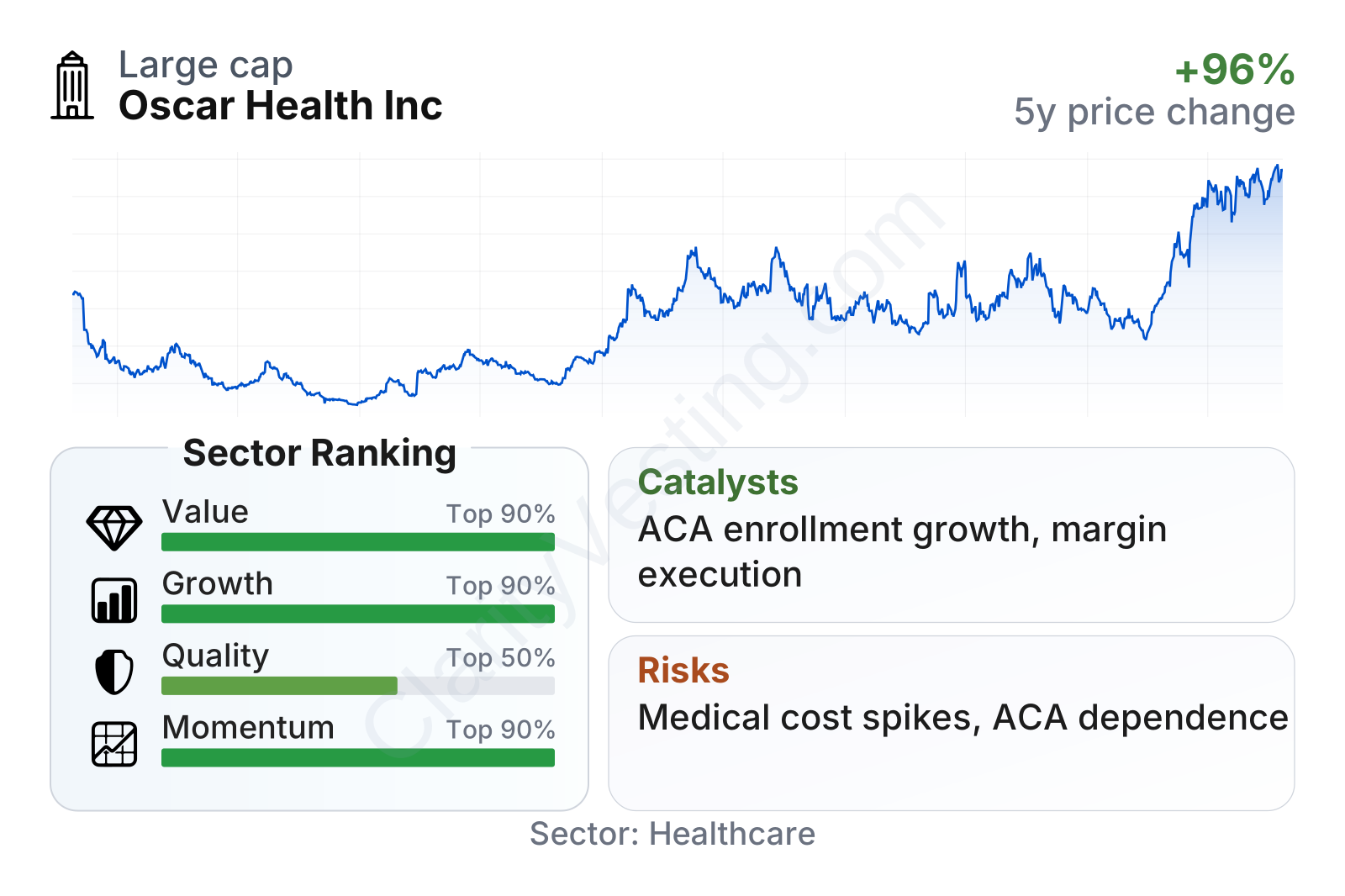
Oscar is now a mid-sized public company with a market value a little above $9 billion, but its share price behavior remains volatile, with a beta above 2. That means the stock has tended to move much more sharply than the broader market. The stock’s rebound since the lows of 2022 has been dramatic, which reflects much better operating execution and a shift from heavy losses toward more credible profitability.
The broader metric profile is strong in some areas and mixed in others. Growth and market momentum rank near the top of the healthcare sector, while quality is closer to the middle. Valuation metrics are not stretched on earnings compared with the sector median, but the price-to-book ratio sits above the sector median, suggesting the market is placing a premium on future improvement rather than on current balance sheet value alone.
A particularly notable point is cash generation. Free cash flow is unusually strong relative to the company’s market value, and the balance sheet remains conservatively financed. That combination gives Oscar more flexibility than many younger healthcare companies that depend on outside capital to fund growth.
Growth
Oscar operates in a healthcare segment that still has room to expand, especially in the individual and small-group insurance markets where consumers increasingly expect digital service, transparent plan management, and easier care coordination. Health insurance is not a new industry, but parts of it remain inefficient and unpopular with customers, which creates space for challengers with a better operating model.
Oscar’s strategy for future growth is fairly straightforward and logical: expand membership, improve pricing discipline, use technology to lower administrative friction, and deepen relationships through platform and care-navigation capabilities. The company has spent years building infrastructure that is meant to support a larger member base without costs rising at the same pace.
The revenue trend has been exceptionally strong. Recent year-over-year growth has remained far above the healthcare sector median, and the latest pace moved back above 70%. That suggests Oscar is still gaining scale rather than entering a mature phase. Over a five-year period, revenue per share growth has also far outpaced the sector, reinforcing the idea that expansion has not come only from issuing more shares.
Cash generation is another encouraging development. Free cash flow moved from negative territory a few years ago to strongly positive levels more recently, which can matter a lot in insurance because it gives management more room to invest in technology, support capital requirements, and absorb operational volatility. Strong free cash flow does not eliminate insurance risk, but it improves resilience.
A major catalyst for Oscar is the continued growth and stability of the ACA marketplace. The company is particularly exposed to that channel, and favorable enrollment trends can translate directly into higher premium revenue. Another catalyst is execution: if Oscar keeps improving its medical loss performance and administrative efficiency, even modest margin gains could have a meaningful impact because the revenue base is now much larger than it was a few years ago.
Recent company communications have also pointed to continued membership growth and stronger operating performance in 2026, which helps explain why the market has re-rated the stock sharply upward. The company’s progress from persistent losses toward more consistent profitability is the core opportunity the market is watching.
Risks
This article is for informational purposes only and does not constitute financial advice. Some content is AI-generated. See Disclaimer


