Stock Analysis · Old Second Bancorp Inc (OSBC)
Overview
Old Second Bancorp is a regional bank holding company based in Illinois. Through Old Second National Bank, it provides everyday banking services to consumers, small businesses, commercial clients, and local communities. Its business is centered on gathering deposits and turning those funds into loans, while also earning fees from treasury services, wealth management, card activity, and other banking services.
For a bank like Old Second, revenue does not come from selling physical products. It mainly comes from the spread between what it earns on loans and securities and what it pays on deposits and other funding, plus service-related fees. Based on recent annual reporting, the revenue mix is approximately:
- Net interest income: about 80% to 85% — income from commercial loans, commercial real estate loans, residential mortgages, consumer lending, and the securities portfolio, after funding costs.
- Wealth management and trust fees: about 5% to 7% — investment management, fiduciary, retirement, and related advisory services.
- Service charges and deposit-related fees: about 4% to 6% — account fees, treasury management, and transaction services.
- Card, interchange, and other banking fees: about 3% to 5% — debit card activity, ATM-related items, and miscellaneous customer fees.
- Mortgage banking, securities gains, and other noninterest income: usually low and more variable — this can move meaningfully from year to year depending on rate conditions and balance sheet management.
Geographically, Old Second is still a community-oriented bank rather than a national player. That matters for long-term analysis: performance depends heavily on the health of the Illinois and broader Chicagoland economy, local business activity, deposit competition, and credit quality in its lending markets.
The multi-year income flow shows a business that has expanded materially since 2021. Revenue has increased strongly, but higher funding costs and higher operating expenses have absorbed part of that growth, so earnings have not risen in a straight line.
Key Figures
| Metric | Value | Sector ⓘ |
|---|---|---|
| Date | Oct 17, 2026 | |
| Context | ||
| Sector | Financial Services | |
| Industry | Banks - Regional | |
| Market Cap ⓘ | $1.25B | |
| Beta ⓘ | 0.77 | |
Value (Cheapness) | ||
| P/E Ratio ⓘ | 14.07 | 12.26 |
| P/B Ratio ⓘ | 1.43 | 1.23 |
| FCF Yield ⓘ | 11.29% | 10.40% |
| Dividend Yield ⓘ | 1.09% | 3.02% |
| EBIT / EV ⓘ | 8.08% | 8.14% |
| PEG ⓘ | 1.51 | |
Growth (Business expansion) | ||
| Revenue Growth ⓘ | 22.70% | 9.35% |
| RPS Growth (5Y CAGR) ⓘ | 12.61% | 12.19% |
| EPS Growth (5Y CAGR) ⓘ | -9.47% | -9.53% |
| BVPS Growth (5Y CAGR) ⓘ | -46.00% | 4.99% |
| Margin Growth (5Y Trend) ⓘ | 8.26% | -3.86% |
| FCF Growth (5Y CAGR) ⓘ | 41.94% | 4.81% |
| DPS Growth (5Y CAGR) ⓘ | 11.13% | 8.79% |
Quality (Business durability) | ||
| ROIC (Latest) ⓘ | 7.75% | 9.49% |
| ROE (Latest) ⓘ | 10.45% | 13.90% |
| ROA (Latest) ⓘ | 1.34% | 1.55% |
| ROIC (5Y Median) ⓘ | 9.25% | 7.86% |
| ROE (5Y Median) ⓘ | 10.24% | 12.17% |
| ROA (5Y Median) ⓘ | 1.28% | 1.30% |
| Net Debt / EBIT (Latest) ⓘ | 3.32 | 0.96 |
| Net Debt / EBIT (5Y Median) ⓘ | 1.59 | 0.73 |
| Net Debt / EBITDA (Latest) ⓘ | 3.09 | 0.92 |
| Operating Margin (Latest) ⓘ | 29.60% | 22.30% |
| Operating Margin (5Y Median) ⓘ | 33.60% | 24.63% |
| Debt to Equity (Latest) ⓘ | 51.91% | 58.56% |
| Profit Margin (Latest) ⓘ | 27.07% | 26.57% |
| Free Cash Flow (Latest) ⓘ | $141.43M | |
Momentum (Price trend) | ||
| 3Y Return ⓘ | +90.65% | +88.33% |
| 12M Return (excl. last month) ⓘ | +43.45% | +19.38% |
| 6M Return ⓘ | +15.38% | +4.75% |
| Price vs. 200-Day MA ⓘ | +12.16% | +3.50% |
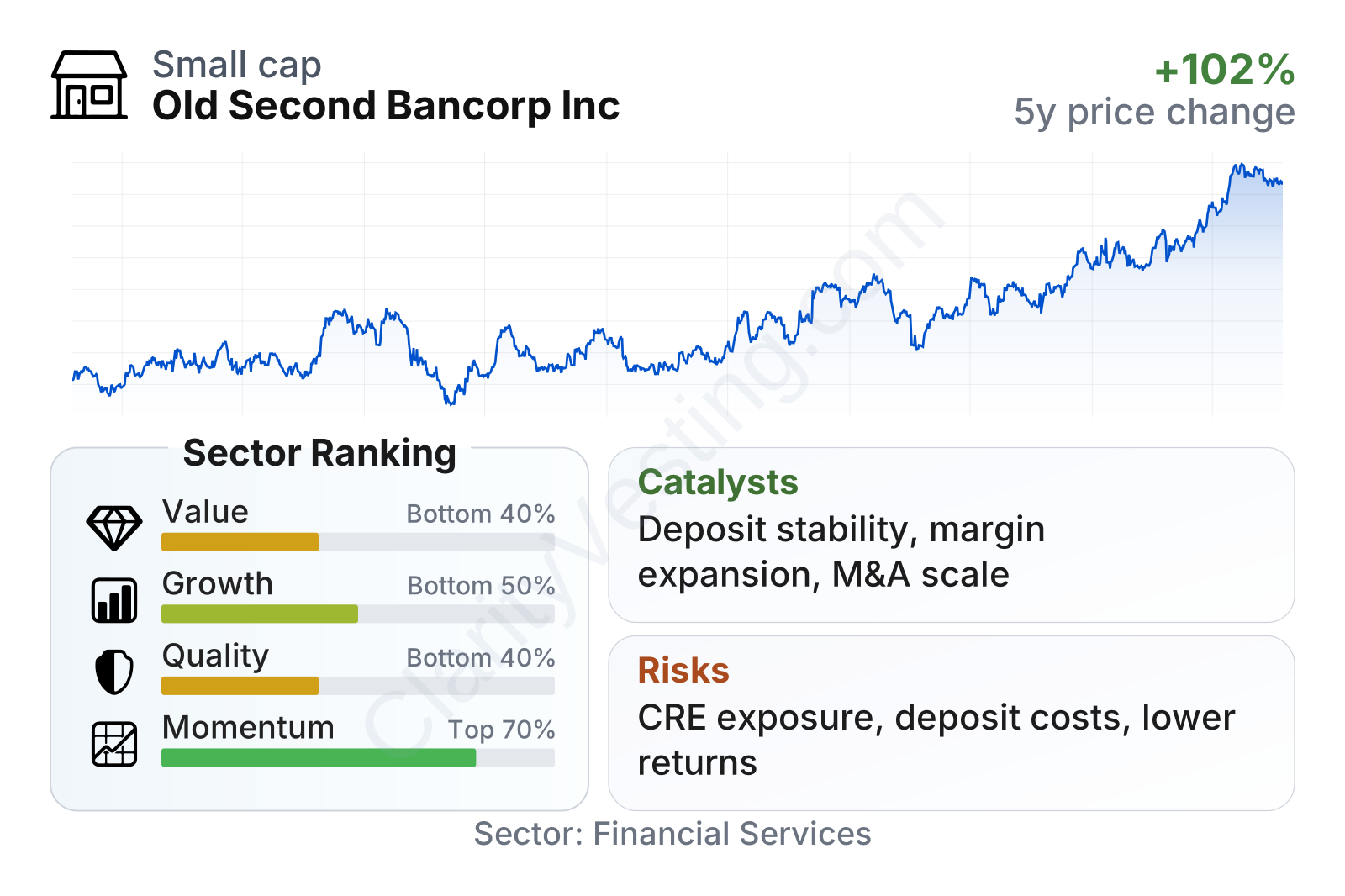
Old Second is a smaller regional bank by market value, with relatively low share-price volatility compared with the broader market, as shown by its beta near 0.7. On valuation, it screens slightly richer than the regional bank median on both earnings and book value multiples, while its dividend yield is clearly lower than the sector median. On growth, recent revenue expansion has been strong, but the broader profile is mixed because per-share earnings growth over five years has been weak and book value per share has a distorted long-term comparison. Quality measures are also mixed: profitability remains solid, but current return on equity and return on assets sit below many peers. Price momentum has been better than the sector median over the last several months and the last year.
Growth
Banking is not a high-growth industry in the same way as software or semiconductors, but well-run regional banks can still grow steadily over long periods through loan expansion, deposit gathering, acquisitions, and market share gains in attractive local areas. Old Second operates in a mature sector, yet its market still offers room for consolidation and customer capture, especially among businesses that value local relationships and direct decision-making.
Its strategy appears straightforward and sensible for a regional bank: expand commercial and consumer relationships in its footprint, keep building noninterest-bearing and lower-cost deposits where possible, maintain credit discipline, and add scale that spreads compliance and technology costs across a larger base. This is especially important in banking, where regulation and digital infrastructure are expensive for smaller institutions.
The company also has an acquisition angle in its recent history, which has helped lift its scale. That can be a meaningful long-term catalyst if integration is handled well and acquired deposits and loans remain stable. Another potential tailwind is the interest-rate cycle. If deposit costs stabilize while earning-asset yields remain healthy, margins can improve. If rates fall gradually, that may also support credit quality and loan demand, though the exact effect depends on how fast asset yields reprice compared with deposits.
Earnings per share show that the company has recovered well from earlier levels and has been operating at a meaningfully higher earnings base than in 2021, even if the path has not been perfectly smooth. That suggests Old Second has become a larger and more profitable institution than it was a few years ago.
Book value per share has moved upward in recent years after an unusual earlier reading, which is a useful sign for a bank because book value reflects the capital base supporting future lending and loss absorption. A rising book value generally supports long-term financial flexibility, provided asset quality remains sound.
A notable recent opportunity is the company’s ability to benefit from continued normalization after the U.S. regional banking stress of 2023. Banks that kept depositor confidence and maintained profitability have had a chance to attract customers looking for stability without moving to the very largest national banks. Old Second’s recent share-price strength suggests the market has recognized some of that resilience.
Risks
This article is for informational purposes only and does not constitute financial advice. Some content is AI-generated. See Disclaimer


