Stock Analysis · Orora Limited (ORRAF)
Overview
Orora Limited is a packaging company with operations centered on beverage packaging, distribution, and related packaging solutions. The group has historically served customers in sectors such as beer, wine, spirits, non-alcoholic beverages, food, and industrial products. Its role in the supply chain is fairly easy to understand: it provides bottles, cans, closures, cartons, labels, and other packaging items that customers need to get products to market.
The business changed materially after the sale of Orora’s global packaging distribution business, which made the company more focused on beverage-related packaging in Australia. That shift reduced total revenue compared with earlier years, but it also simplified the business and made the remaining operations easier to follow. The current profile is therefore narrower than it was a few years ago, with performance now tied more directly to beverage packaging demand, manufacturing efficiency, and customer volumes in Australia and nearby markets.
Based on the latest annual reporting structure, revenue is now primarily generated from the Australasian beverage packaging segment and related specialty packaging activities. Precise sub-segment percentages are not always broken out in a way that allows a fully detailed split across every product category, but the broad revenue picture is clear:
- Australasian beverage packaging and closures: the large majority of revenue, estimated at more than 80%. This includes glass bottles, aluminum cans, closures, and related products supplied mainly to beverage producers.
- Specialty and related packaging solutions: estimated at less than 20%. This includes adjacent packaging activities, services, and other product lines connected to beverage and consumer packaging customers.
The income flow also shows an important transition. Revenue fell sharply after the divestment of non-core operations, but the remaining business still produces meaningful operating profit and cash flow. At the same time, recent reported net income was heavily affected by large non-cash charges, which makes headline earnings look much weaker than operating performance alone would suggest.
The long-term pattern is a business that became much smaller in reported sales after portfolio changes, while preserving a positive operating base. Gross profit remains substantial relative to the new scale, but the gap between operating income and net income widened recently because of below-the-line charges rather than a collapse in core trading.
Key Figures
| Metric | Value | Sector ⓘ |
|---|---|---|
| Date | Nov 21, 2026 | |
| Context | ||
| Sector | Consumer Cyclical | |
| Industry | Packaging & Containers | |
| Market Cap ⓘ | $1.28B | |
| Beta ⓘ | 0.38 | |
Value (Cheapness) | ||
| P/E Ratio ⓘ | N/A | 17.13 |
| P/B Ratio ⓘ | N/A | 2.72 |
| FCF Yield ⓘ | 9.75% | 7.52% |
| Dividend Yield ⓘ | 5.95% | 2.43% |
| EBIT / EV ⓘ | 14.48% | 7.11% |
| PEG ⓘ | N/A | |
Growth (Business expansion) | ||
| Revenue Growth ⓘ | 3.40% | 5.30% |
| RPS Growth (5Y CAGR) ⓘ | -20.15% | 8.77% |
| EPS Growth (5Y CAGR) ⓘ | -16.10% | -11.05% |
| BVPS Growth (5Y CAGR) ⓘ | 18.54% | 5.47% |
| Margin Growth (5Y Trend) ⓘ | 3.68% | -0.16% |
| FCF Growth (5Y CAGR) ⓘ | N/A | 5.66% |
| DPS Growth (5Y CAGR) ⓘ | -8.71% | 9.76% |
Quality (Business durability) | ||
| ROIC (Latest) ⓘ | N/A | 11.36% |
| ROA (Latest) ⓘ | 7.97% | 5.53% |
| ROIC (5Y Median) ⓘ | 8.89% | 10.58% |
| ROA (5Y Median) ⓘ | 6.59% | 5.35% |
| Net Debt / EBIT (Latest) ⓘ | 1.69 | 2.11 |
| Net Debt / EBIT (5Y Median) ⓘ | 3.09 | 2.24 |
| Net Debt / EBITDA (Latest) ⓘ | 0.92 | 1.51 |
| Net Debt / Assets ⓘ | 14.89% | 21.74% |
| EBITDA / Interest ⓘ | 5.34 | 9.63 |
| Operating Margin (Latest) ⓘ | 8.88% | 9.20% |
| Operating Margin (5Y Median) ⓘ | 6.83% | 9.64% |
| Debt to Equity (Latest) ⓘ | 60.00% | 74.26% |
| Profit Margin (Latest) ⓘ | -27.70% | 5.47% |
| Free Cash Flow (Latest) ⓘ | $125.01M | |
Momentum (Price trend) | ||
| 3Y Return ⓘ | -17.77% | +15.79% |
| 12M Return (excl. last month) ⓘ | -14.53% | -0.63% |
| 6M Return ⓘ | -17.48% | +1.17% |
| Price vs. 200-Day MA ⓘ | -1.54% | +0.36% |
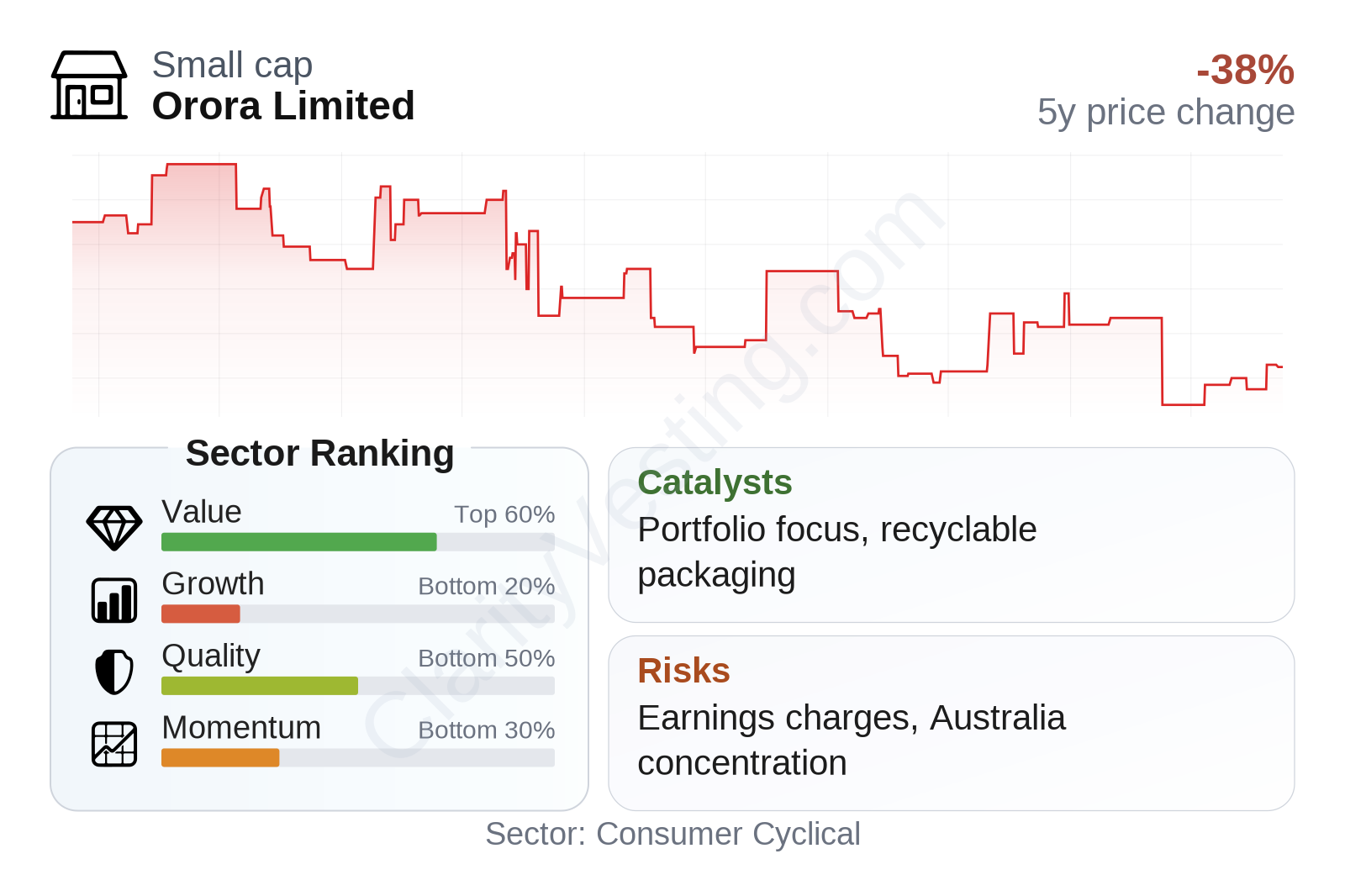
Orora currently sits in a mixed position. On valuation measures, it screens cheaper than many peers: the earnings multiple is below the sector median, price-to-book is notably lower, and cash generation relative to market value looks strong. The company also offers an above-sector dividend yield, although payout durability matters more than the headline rate. On growth and market performance, the picture is weaker. Recent revenue growth has been modest, longer-term revenue per share has contracted, and share-price momentum has lagged the broader sector by a wide margin. Financial leverage looks manageable rather than stretched, with debt ratios below sector medians, but profitability measures are clouded by the recent net loss.
Growth
Packaging is not usually a high-growth industry, but it can be a durable one. Demand for beverage containers, closures, and transport packaging tends to track population, consumption, premiumization trends, and shifts in packaging formats. That means the sector is more defensive than many consumer-linked industries, even if it does not often produce rapid expansion.
For Orora, the core growth question is less about entering a brand-new market and more about whether a more focused portfolio can lift margins, improve plant utilization, and win additional customer volumes. That strategy is logical. A simplified business can direct capital toward areas where Orora already has manufacturing know-how, established customer relationships, and scale in beverage packaging. This is particularly relevant in glass and cans, where production efficiency, logistics, and service reliability matter a great deal.
Recent annual revenue growth has been positive but not especially strong, and it remains below the sector median. That suggests the company is still in a transition phase rather than in a clear acceleration cycle. Even so, there are visible potential catalysts. A more focused Australasian packaging platform could benefit from stronger beverage volumes, product mix improvements, and operational benefits from capital investments. The sale of the distribution business also created a cleaner structure, making future performance easier to assess and potentially improving management focus.
A recent development that matters is the company’s continued repositioning after its portfolio reshaping. In practical terms, this creates an opportunity if management can convert the leaner structure into steadier margins and better returns on capital. Another possible tailwind is the ongoing preference for recyclable packaging formats such as glass and metal, which fit Orora’s product set well, even though the pace of that demand shift can vary by category and customer.
Risks
This article is for informational purposes only and does not constitute financial advice. Some content is AI-generated. See Disclaimer