Stock Analysis · Orient Overseas Limited (OROVF)
Overview
Orient Overseas Limited is a container shipping and logistics group best known through its liner brand, OOCL. The company moves manufactured goods and consumer products across global trade routes using container vessels, and it also provides related logistics and terminal activities. In simple terms, it earns money by transporting cargo by sea and by offering services around that transport, such as inland logistics, cargo handling, and terminal support.
The business is heavily centered on container shipping. Based on the company’s recent annual reporting structure, revenue is mainly generated from liner and logistics operations, while terminal and other activities represent a much smaller contribution.
- Liner and logistics: approximately 95% to 98% of revenue. This includes ocean freight, bunker and surcharge collections, container transport, inland logistics, and supply-chain related services.
- Terminal and other activities: approximately 2% to 5% of revenue. This includes terminal operations and smaller ancillary business lines.
That concentration matters because it means the company’s results are driven mostly by freight rates, cargo volumes, shipping capacity, fuel costs, and trade flows between major economies. The business can produce very strong cash generation in favorable shipping markets, but earnings can also move sharply when rates normalize.
Over the last several years, revenue and profit have clearly shown that cyclicality. Sales surged during the post-pandemic shipping boom, then fell back as freight markets cooled, before stabilizing at a level still above many pre-boom periods. Even after this normalization, the company has remained profitable, which is an important sign of resilience in a volatile industry.
The long-term pattern is easy to read: extraordinary profitability in 2021 and 2022 was followed by a sharp reset in 2023, then a recovery in 2024 and a softer but still profitable 2025. That suggests Orient Overseas is no longer operating at peak-cycle conditions, yet it still converts a meaningful share of revenue into earnings and cash.
Key Figures
| Metric | Value | Sector ⓘ |
|---|---|---|
| Date | Oct 03, 2026 | |
| Context | ||
| Sector | Industrials | |
| Industry | Marine Shipping | |
| Market Cap ⓘ | $12.10B | |
| Beta ⓘ | 1.35 | |
Value (Cheapness) | ||
| P/E Ratio ⓘ | 8.00 | 22.45 |
| P/B Ratio ⓘ | 0.87 | 1.98 |
| FCF Yield ⓘ | 18.54% | 6.31% |
| Dividend Yield ⓘ | 5.29% | 1.96% |
| EBIT / EV ⓘ | 50.57% | 4.81% |
| PEG ⓘ | N/A | |
Growth (Business expansion) | ||
| Revenue Growth ⓘ | 6.10% | 9.10% |
| RPS Growth (5Y CAGR) ⓘ | -13.37% | 7.75% |
| EPS Growth (5Y CAGR) ⓘ | 126.02% | -13.59% |
| BVPS Growth (5Y CAGR) ⓘ | 7.78% | 6.22% |
| Margin Growth (5Y Trend) ⓘ | -32.00% | 0.72% |
| FCF Growth (5Y CAGR) ⓘ | -55.89% | 10.98% |
| DPS Growth (5Y CAGR) ⓘ | -22.71% | 9.48% |
Quality (Business durability) | ||
| ROIC (Latest) ⓘ | N/A | 10.92% |
| ROA (Latest) ⓘ | 22.19% | 5.41% |
| ROIC (5Y Median) ⓘ | 21.26% | 9.21% |
| ROA (5Y Median) ⓘ | 15.51% | 4.94% |
| Net Debt / EBIT (Latest) ⓘ | -0.10 | 2.07 |
| Net Debt / EBIT (5Y Median) ⓘ | -1.56 | 2.28 |
| Net Debt / EBITDA (Latest) ⓘ | -0.07 | 1.43 |
| Net Debt / Assets ⓘ | -2.17% | 19.27% |
| EBITDA / Interest ⓘ | 165.71 | 9.53 |
| Operating Margin (Latest) ⓘ | 18.00% | 10.50% |
| Operating Margin (5Y Median) ⓘ | 24.62% | 10.27% |
| Debt to Equity (Latest) ⓘ | 9.17% | 65.48% |
| Profit Margin (Latest) ⓘ | 12.85% | 6.62% |
| Free Cash Flow (Latest) ⓘ | $2.24B | |
Momentum (Price trend) | ||
| 3Y Return ⓘ | +72.98% | +58.56% |
| 12M Return (excl. last month) ⓘ | +0.97% | +15.63% |
| 6M Return ⓘ | +5.51% | +4.19% |
| Price vs. 200-Day MA ⓘ | +14.67% | +0.93% |
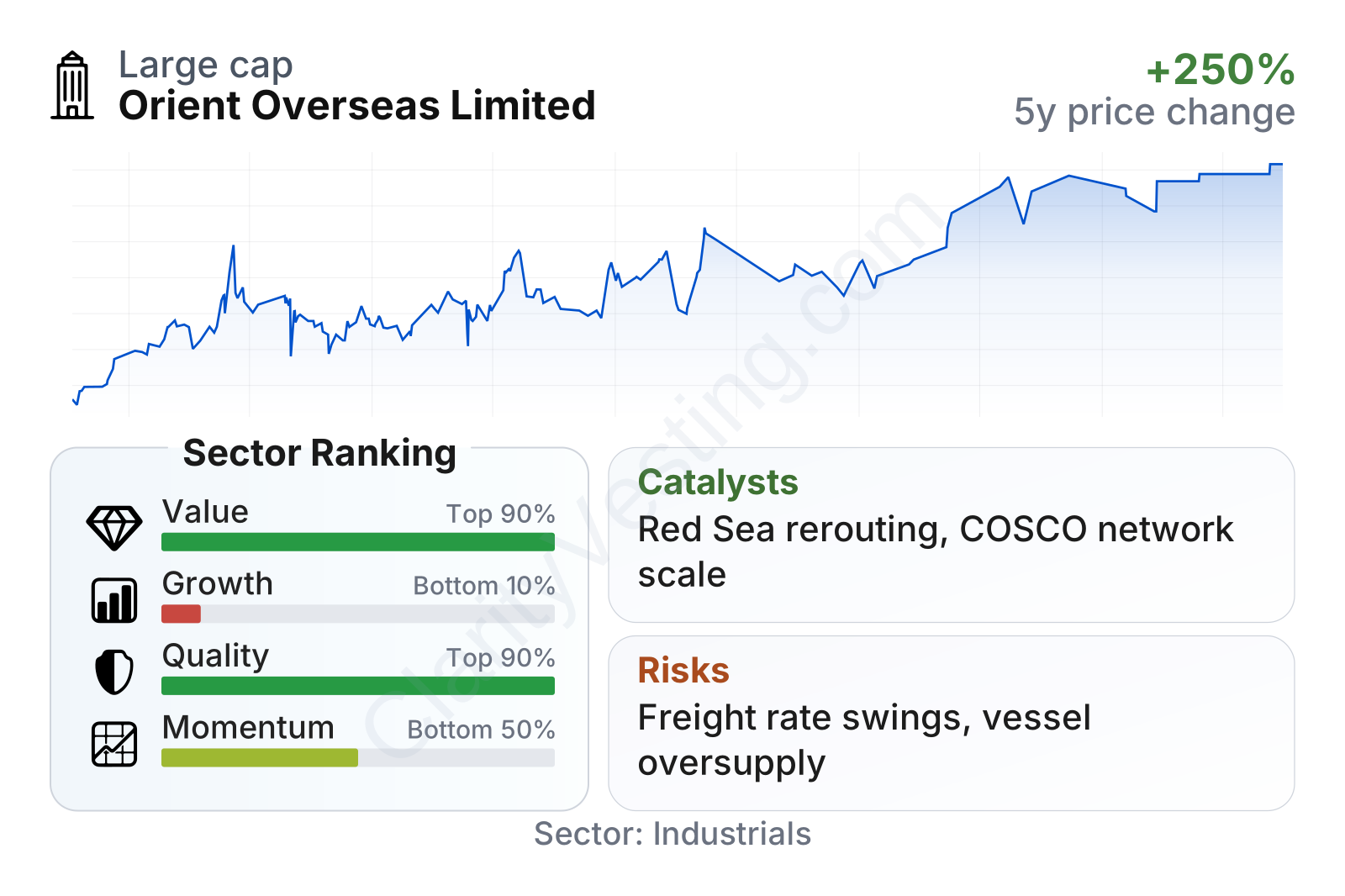
Orient Overseas is a large shipping company with a market value in the low tens of billions of dollars, and the stock tends to move more than the broader market, which is common for cyclical transport names. The most striking part of the current profile is the combination of strong quality and low balance-sheet strain. Profitability metrics remain well above sector norms, leverage is very low, and the company still generates substantial free cash flow. On traditional valuation measures, it screens cheaper than much of the industrials universe, although that needs to be interpreted carefully because shipping earnings can change quickly from year to year.
The weaker area is growth. Recent annual revenue growth has been positive but not exceptional, and the longer multi-year revenue and free-cash-flow trends are still distorted by the post-pandemic boom and subsequent normalization. In other words, the company looks financially solid today, but its reported growth profile is not as smooth or predictable as businesses in steadier industries.
Growth
Container shipping remains tied to a sector with long-term relevance: global trade. As long as manufacturers, retailers, and commodity-linked supply chains rely on cross-border movement of goods, large liner operators will remain essential infrastructure. That said, this is not a straight-line growth market. Demand follows consumer spending, industrial production, inventory cycles, and geopolitical trade patterns, while supply depends on how many new ships the industry adds.
Orient Overseas’ strategy is sensible for this environment. The group combines ocean transport with logistics services, which helps it participate in more of the supply chain than pure vessel operators. It also benefits from operating a recognized global brand in OOCL and from being part of the COSCO Shipping group structure, which adds scale, network reach, and procurement advantages. Those links can be especially useful when customers prefer carriers with broad service coverage and reliable sailing networks.
One of the most important medium-term catalysts is supply-chain restructuring. Companies continue to diversify sourcing across Asia and other regions, which can create new routing patterns and support demand for flexible global carriers. Another potential tailwind is port and network disruption: while disruption is not healthy for the industry as a whole, it can temporarily tighten effective shipping capacity and lift freight rates for established operators with available vessels and customer relationships.
A second catalyst is fleet efficiency. Across the industry, larger and more fuel-efficient ships are becoming more important as environmental rules tighten and fuel economics matter more. A company with disciplined capital allocation, access to modern vessels, and scale within major east-west routes can defend margins better than smaller peers. For Orient Overseas, this does not guarantee rapid expansion, but it supports the case for remaining relevant as industry standards rise.
Recent industry conditions also point to an opportunity. Freight markets have remained sensitive to route disruptions in the Red Sea and related network detours, which increase sailing times and absorb capacity. For liner operators, that can support revenue and vessel utilization even when underlying trade growth is only moderate. The main question is durability: these benefits can fade if disruptions ease or if new vessel supply becomes too large.
Risks
This article is for informational purposes only and does not constitute financial advice. Some content is AI-generated. See Disclaimer