Stock Analysis · Ormat Technologies Inc (ORA)
Overview
Ormat Technologies is a renewable energy company focused mainly on geothermal power. In simple terms, it develops, owns, and operates power plants that use heat from underground resources to generate electricity. It also sells equipment used in geothermal and recovered-energy projects, and it has built a fast-growing energy storage business centered on battery facilities. The company operates in the United States and internationally, giving it a mix of utility-like recurring revenue and project-driven revenue.
Its business is usually presented in three main segments. Based on the latest annual mix, the revenue breakdown is approximately:
- Electricity segment: about 70% to 75% — sales of electricity generated from Ormat-owned geothermal, solar, and recovered-energy power plants under long-term contracts or market-based arrangements.
- Product segment: about 15% to 20% — sale of geothermal and recovered-energy equipment, engineering, procurement, and related services to third parties.
- Energy Storage segment: about 10% to 15% — battery storage capacity and energy services, mainly in the U.S. power market.
This mix matters for long-term analysis. The electricity business tends to be steadier because power plants can generate contracted cash flow over many years, while the product business can be lumpier because equipment orders arrive project by project. Energy storage is smaller today, but it is becoming a more important growth lever as grids need more flexibility to balance intermittent renewable power.
The longer-term financial pattern is also clear: revenue has risen steadily in recent years, but costs and interest expense have climbed as the company has expanded and financed new assets. That helps explain why sales growth has not translated into equally strong improvement in current profitability.
Revenue has moved up consistently over the past five years, approaching the $1 billion mark by 2025. However, gross profit has been much flatter, showing that a larger share of revenue is being absorbed by operating costs. Another noticeable trend is rising interest expense, which has become a more meaningful drag on earnings as the asset base has grown.
Key Figures
| Metric | Value | Sector ⓘ |
|---|---|---|
| Date | Oct 17, 2026 | |
| Context | ||
| Sector | Utilities | |
| Industry | Utilities - Renewable | |
| Market Cap ⓘ | $5.60B | |
| Beta ⓘ | 0.90 | |
Value (Cheapness) | ||
| P/E Ratio ⓘ | 44.62 | 17.28 |
| P/B Ratio ⓘ | 2.25 | 1.51 |
| FCF Yield ⓘ | -4.73% | 0.65% |
| Dividend Yield ⓘ | 0.52% | 3.77% |
| EBIT / EV ⓘ | 2.34% | 5.01% |
| PEG ⓘ | 3.59 | |
Growth (Business expansion) | ||
| Revenue Growth ⓘ | 10.60% | 6.10% |
| RPS Growth (5Y CAGR) ⓘ | 8.22% | 3.87% |
| EPS Growth (5Y CAGR) ⓘ | 2.68% | -11.30% |
| BVPS Growth (5Y CAGR) ⓘ | 6.51% | 4.23% |
| Margin Growth (5Y Trend) ⓘ | -2.96% | 3.57% |
| FCF Growth (5Y CAGR) ⓘ | N/A | -8.84% |
| DPS Growth (5Y CAGR) ⓘ | -0.25% | 4.84% |
Quality (Business durability) | ||
| ROIC (Latest) ⓘ | 4.57% | 6.53% |
| ROA (Latest) ⓘ | 1.97% | 3.20% |
| ROIC (5Y Median) ⓘ | 5.49% | 5.95% |
| ROA (5Y Median) ⓘ | 2.08% | 2.75% |
| Net Debt / EBIT (Latest) ⓘ | 13.97 | 7.13 |
| Net Debt / EBIT (5Y Median) ⓘ | 9.45 | 7.23 |
| Net Debt / EBITDA (Latest) ⓘ | 5.62 | 4.31 |
| Net Debt / Assets ⓘ | 42.69% | 38.42% |
| EBITDA / Interest ⓘ | 3.23 | 4.58 |
| Operating Margin (Latest) ⓘ | 17.45% | 20.83% |
| Operating Margin (5Y Median) ⓘ | 28.08% | 20.08% |
| Debt to Equity (Latest) ⓘ | 131.34% | 137.69% |
| Profit Margin (Latest) ⓘ | 10.66% | 11.37% |
| Free Cash Flow (Latest) ⓘ | -$264.77M | |
Momentum (Price trend) | ||
| 3Y Return ⓘ | +33.48% | +52.37% |
| 12M Return (excl. last month) ⓘ | +1.11% | +8.84% |
| 6M Return ⓘ | -22.98% | -3.95% |
| Price vs. 200-Day MA ⓘ | -21.87% | -0.79% |
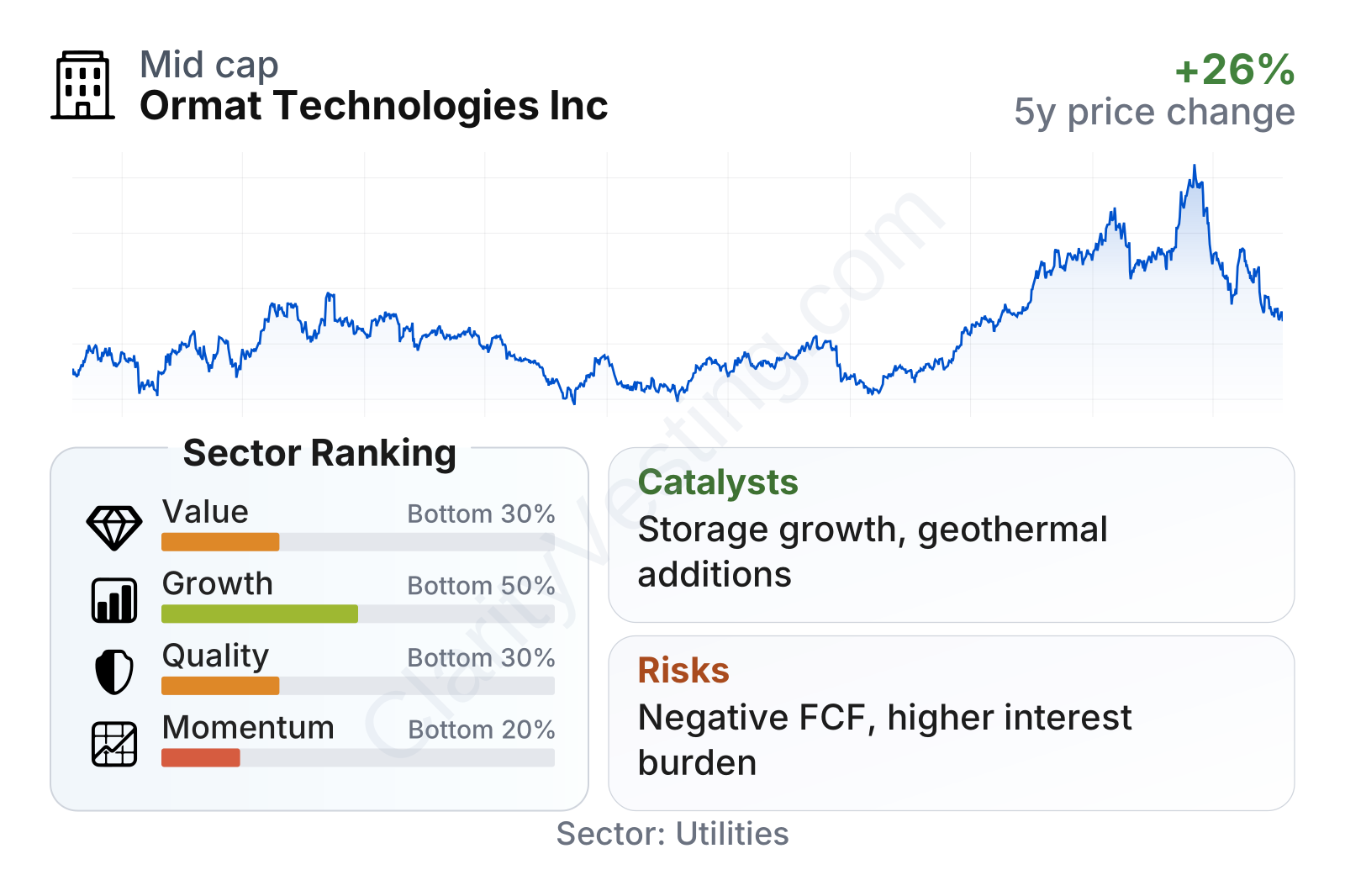
Ormat is a mid-sized renewable utility company with a market value in the mid-single-digit billions and a stock volatility that has been slightly below the broader market. The table points to a mixed profile. Growth has been respectable, with revenue trends better than much of the utility universe, but value, quality, and momentum currently rank in the lower part of the sector. In plain language, the company is growing faster than many traditional utilities, yet the stock trades at richer valuation multiples while current returns on capital and cash generation look weaker than sector norms.
The share price has been volatile over the past few years but the broader direction has been upward, especially through 2025 and into early 2026. More recently, the stock has cooled from its highs, which fits with the weaker short-term momentum shown in the latest metrics.
Growth
Ormat operates in a part of the energy market that has attractive long-term demand drivers. Electricity systems need more clean, reliable, around-the-clock power, and geothermal is one of the few renewable sources that can provide baseload generation rather than depending on sunlight or wind conditions. At the same time, battery storage is becoming increasingly valuable as grids add more variable renewable capacity. That gives Ormat exposure to two important themes at once: firm renewable power and grid flexibility.
The company’s strategy is coherent. It continues to expand its owned generation fleet, optimize existing geothermal resources, pursue new development opportunities, and grow storage assets in regions where power markets reward capacity and balancing services. This combination gives it more than one path to expansion. Unlike companies that depend on a single technology or one-off equipment sales, Ormat has a recurring infrastructure base plus development upside.
Revenue per share has shown a steady upward trend over the past five years, which is an encouraging sign because it suggests business expansion has outpaced dilution. The pace has not been explosive, but it has been consistent, and that fits the profile of a company building long-life energy assets rather than chasing short-duration demand spikes.
A meaningful catalyst is the broader policy and utility push toward cleaner and more resilient power systems in the United States. Geothermal can benefit from supportive regulation, tax incentives, and utility procurement trends that favor dependable carbon-light electricity. Energy storage can also benefit from capacity market needs, transmission bottlenecks, and the rising value of balancing services.
Recent company developments have also supported the growth case. Ormat has continued to announce progress on geothermal, solar, and storage capacity additions, and it has emphasized optimization projects that can lift output from existing sites without the same level of risk as a greenfield project. That is especially relevant for a long-duration asset owner because incremental improvements on existing plants can produce attractive returns if executed well.
The main limitation in the growth profile is cash conversion. Free cash flow has remained negative, which is not unusual for an infrastructure-heavy company in an expansion phase, but it does mean growth is being funded by a combination of debt, retained earnings, and access to capital markets rather than by internally generated excess cash alone. For long-term analysis, this makes project quality and financing discipline especially important.
Risks
This article is for informational purposes only and does not constitute financial advice. Some content is AI-generated. See Disclaimer


