Stock Analysis · Opko Health Inc (OPK)
Overview
OPKO Health is a diversified healthcare company operating across diagnostics, laboratory services, and biopharmaceuticals. In practical terms, it makes money from clinical testing through BioReference Health, from pharmaceutical and biologic products, and from royalty or collaboration-related income tied to intellectual property and partnered products. The company has historically tried to combine recurring service revenue from labs with higher-upside drug development and licensing opportunities.
Based on recent annual filings, revenue is mainly split between laboratory services and products or other healthcare-related activities, with the mix shifting over time as the lab business has contracted from its pandemic peak and the pharmaceutical side has become more important. Using the latest full-year picture as a guide, the main revenue sources are approximately the following:
- Laboratory services: about 45% to 55% — primarily clinical testing and diagnostic services, mainly through BioReference Health.
- Product revenue: about 30% to 40% — includes pharmaceutical products, diagnostic products, and other healthcare-related sales.
- Royalty, milestone, and other revenue: about 10% to 20% — includes income from partnered assets, licensing arrangements, and collaboration-related payments when recognized.
This mix matters because the company is no longer a straightforward laboratory operator. It is increasingly a hybrid business where execution in diagnostics, product commercialization, and licensing all influence results. Over the last several years, revenue has fallen sharply from unusually elevated levels reached during the COVID testing period, while operating costs have also been reduced. That has made the business leaner, but still uneven.
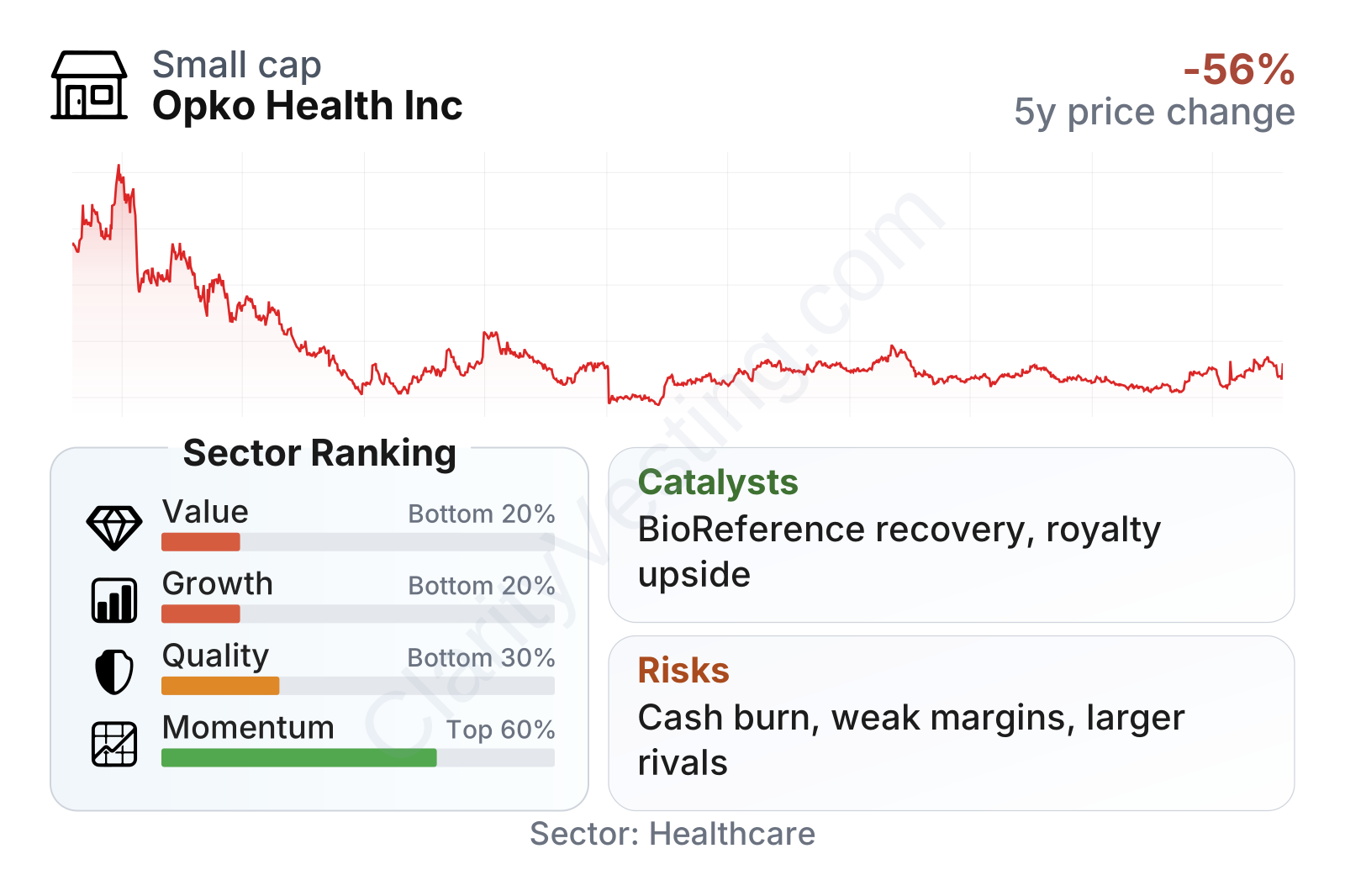
The long-term financial pattern shows a steep decline in revenue since 2021, driven largely by the normalization of COVID-related testing. Cost controls helped offset part of that pressure, and 2024 briefly returned to positive operating income, but profitability has remained inconsistent. That makes OPKO easier to understand as a turnaround and asset-monetization case than as a steady compounder.
Key Figures
| Metric | Value | Sector ⓘ |
|---|---|---|
| Date | Oct 17, 2026 | |
| Context | ||
| Sector | Healthcare | |
| Industry | Diagnostics & Research | |
| Market Cap ⓘ | $1.02B | |
| Beta ⓘ | 1.50 | |
Value (Cheapness) | ||
| P/E Ratio ⓘ | N/A | 24.79 |
| P/B Ratio ⓘ | 1.03 | 3.08 |
| FCF Yield ⓘ | -13.11% | 3.15% |
| Dividend Yield ⓘ | N/A | 1.94% |
| EBIT / EV ⓘ | -2.91% | 0.57% |
| PEG ⓘ | 93.65 | |
Growth (Business expansion) | ||
| Revenue Growth ⓘ | 4.30% | 7.45% |
| RPS Growth (5Y CAGR) ⓘ | -26.30% | 8.61% |
| EPS Growth (5Y CAGR) ⓘ | -36.54% | -17.81% |
| BVPS Growth (5Y CAGR) ⓘ | -10.24% | 3.72% |
| Margin Growth (5Y Trend) ⓘ | N/A | -0.62% |
| FCF Growth (5Y CAGR) ⓘ | N/A | 1.04% |
| DPS Growth (5Y CAGR) ⓘ | N/A | 6.77% |
Quality (Business durability) | ||
| ROIC (Latest) ⓘ | -2.82% | 3.24% |
| ROA (Latest) ⓘ | -3.81% | 3.01% |
| ROIC (5Y Median) ⓘ | -6.07% | 4.60% |
| ROA (5Y Median) ⓘ | -9.04% | 1.89% |
| Net Debt / EBIT (Latest) ⓘ | N/A | 1.34 |
| Net Debt / EBIT (5Y Median) ⓘ | N/A | 1.84 |
| Net Debt / EBITDA (Latest) ⓘ | 1.83 | 1.00 |
| Net Debt / Assets ⓘ | 5.00% | 5.45% |
| EBITDA / Interest ⓘ | 1.11 | 9.64 |
| Operating Margin (Latest) ⓘ | -6.77% | 9.27% |
| Operating Margin (5Y Median) ⓘ | -19.78% | 7.38% |
| Debt to Equity (Latest) ⓘ | 33.13% | 28.58% |
| Profit Margin (Latest) ⓘ | -12.40% | 3.59% |
| Free Cash Flow (Latest) ⓘ | -$134.02M | |
Momentum (Price trend) | ||
| 3Y Return ⓘ | +21.97% | +42.80% |
| 12M Return (excl. last month) ⓘ | +13.77% | +18.50% |
| 6M Return ⓘ | +36.44% | +7.57% |
| Price vs. 200-Day MA ⓘ | +21.33% | +5.12% |
OPKO is a small-cap healthcare company with above-average share-price volatility, as reflected by a beta around 1.5. The overall factor profile is weak in value, growth, and quality relative to much of the healthcare sector, while recent momentum has improved. In plain language, the market has recently become somewhat more constructive on the stock price, but the underlying business still shows below-median profitability, weaker long-term growth, and negative free cash flow. The low price-to-book ratio suggests the market is assigning limited value to future earnings power rather than rewarding current operations.
Growth
OPKO operates in areas that can offer attractive long-term demand: diagnostics, specialty testing, and biopharmaceutical development. These are generally supported by aging populations, more personalized medicine, and the need for recurring medical monitoring. So the sector backdrop is not the main issue. The more important question is whether OPKO can turn that backdrop into durable growth after the post-pandemic revenue reset.
The revenue trend has been difficult for several years, with repeated year-over-year declines following the collapse of COVID-related testing volumes. More recently, the business has shown signs of stabilization, including a return to modest positive year-over-year growth in the latest period. That is encouraging, but it follows a long stretch of contraction, so one positive quarter by itself does not yet establish a sustained growth pattern.
OPKO’s strategy still has logic. The company has continued to invest in research and development while reshaping its operating base, and it retains optionality through its pipeline and partnered assets. A meaningful catalyst remains the pharmaceutical and royalty side of the business, where even a small number of successful products, label expansions, or milestone events can have an outsized impact relative to the company’s current size. That is especially relevant because OPKO’s market value is modest compared with the revenue and asset base it has built over time.
Cash generation remains the clearest operational challenge. Free cash flow has stayed negative, which means the company has not yet converted its restructuring efforts into self-funding growth. For a long-term case to strengthen materially, OPKO likely needs a combination of steadier lab performance, improved product mix, and less cash burn from development and corporate overhead.
Recent company updates have continued to emphasize asset development, partner-supported programs, and efforts to streamline operations. Those can create significant opportunity if execution improves, particularly because healthcare licensing economics can change quickly when milestones or royalty streams accelerate. Still, the current growth profile is better described as early stabilization with upside catalysts rather than broad-based expansion already in place.
Risks
This article is for informational purposes only and does not constitute financial advice. Some content is AI-generated. See Disclaimer


