Stock Analysis · Opendoor Technologies Inc (OPEN)
Overview
Opendoor Technologies is a digital real estate company focused on buying and selling homes directly. Its best-known service is “iBuying”: a homeowner can request an offer online, and if Opendoor purchases the property, it then resells the home. The aim is to make a traditionally slow and uncertain process more convenient, using software, pricing models, and centralized operations.
The business is still heavily tied to the U.S. housing cycle. When transaction volumes are strong and home prices are stable, the model can scale quickly. When mortgage rates rise or home prices become harder to predict, activity can slow sharply because Opendoor carries housing inventory and must resell homes at acceptable margins.
Based on recent company reporting, revenue is overwhelmingly concentrated in home sales, with smaller contributions from services attached to those transactions.
- Home sales: approximately 95% to 98% of revenue. This is the resale value of homes Opendoor acquires from sellers and later sells to buyers.
- Other revenue, including marketplace and service-related fees: approximately 2% to 5% of revenue. This can include seller service charges and newer marketplace-related offerings that connect consumers with third-party buyers or service providers.
That concentration matters: even though Opendoor presents itself as a technology-enabled platform, its income statement still behaves largely like a home trading business rather than a software company. Revenue can look large because each house sale is booked at the full transaction value, but profitability depends on thin spreads, operating efficiency, and careful risk control.
Over the last several years, the company has cut operating costs materially, but revenue has also fallen well below the peak reached during the housing boom. Gross profit has narrowed and losses remain significant, showing that Opendoor has become leaner without yet proving that the model can consistently earn attractive returns across a difficult cycle.
The long-term pattern is clear: sales surged in the exceptional 2021-2022 housing period, then contracted sharply as the market normalized and financing conditions tightened. Operating expenses have been reduced, but not enough to offset weaker volume and thinner economics on home resales.
Key Figures
| Metric | Value | Sector ⓘ |
|---|---|---|
| Date | Oct 17, 2026 | |
| Context | ||
| Sector | Real Estate | |
| Industry | Real Estate Services | |
| Market Cap ⓘ | $1.93B | |
| Beta ⓘ | 3.75 | |
Value (Cheapness) | ||
| P/E Ratio ⓘ | N/A | 17.38 |
| P/B Ratio ⓘ | 2.45 | 0.85 |
| FCF Yield ⓘ | -24.53% | 7.38% |
| Dividend Yield ⓘ | N/A | 4.85% |
| EBIT / EV ⓘ | -39.37% | 3.78% |
| PEG ⓘ | N/A | |
Growth (Business expansion) | ||
| Revenue Growth ⓘ | -43.70% | 5.30% |
| RPS Growth (5Y CAGR) ⓘ | -19.44% | 6.02% |
| EPS Growth (5Y CAGR) ⓘ | -40.04% | -11.37% |
| BVPS Growth (5Y CAGR) ⓘ | -23.33% | 0.45% |
| Margin Growth (5Y Trend) ⓘ | N/A | -0.22% |
| FCF Growth (5Y CAGR) ⓘ | N/A | 5.40% |
| DPS Growth (5Y CAGR) ⓘ | N/A | 5.02% |
Quality (Business durability) | ||
| ROIC (Latest) ⓘ | -43.62% | 5.69% |
| ROE (Latest) ⓘ | -176.35% | 7.56% |
| ROA (Latest) ⓘ | -53.74% | 2.85% |
| ROIC (5Y Median) ⓘ | -7.72% | 4.22% |
| ROE (5Y Median) ⓘ | -46.67% | 6.03% |
| ROA (5Y Median) ⓘ | -11.71% | 2.44% |
| Net Debt / EBIT (Latest) ⓘ | N/A | 7.59 |
| Net Debt / EBIT (5Y Median) ⓘ | N/A | 8.40 |
| Net Debt / EBITDA (Latest) ⓘ | N/A | 5.27 |
| Net Debt / Assets ⓘ | -23.71% | 37.76% |
| EBITDA / Interest ⓘ | N/A | 4.10 |
| Operating Margin (Latest) ⓘ | -43.24% | 35.29% |
| Operating Margin (5Y Median) ⓘ | -6.21% | 37.31% |
| Debt to Equity (Latest) ⓘ | 21.23% | 88.87% |
| Profit Margin (Latest) ⓘ | -46.74% | 19.61% |
| Free Cash Flow (Latest) ⓘ | -$474.00M | |
Momentum (Price trend) | ||
| 3Y Return ⓘ | -4.53% | +30.75% |
| 12M Return (excl. last month) ⓘ | -72.09% | +4.36% |
| 6M Return ⓘ | -51.87% | -2.52% |
| Price vs. 200-Day MA ⓘ | -47.93% | -2.34% |
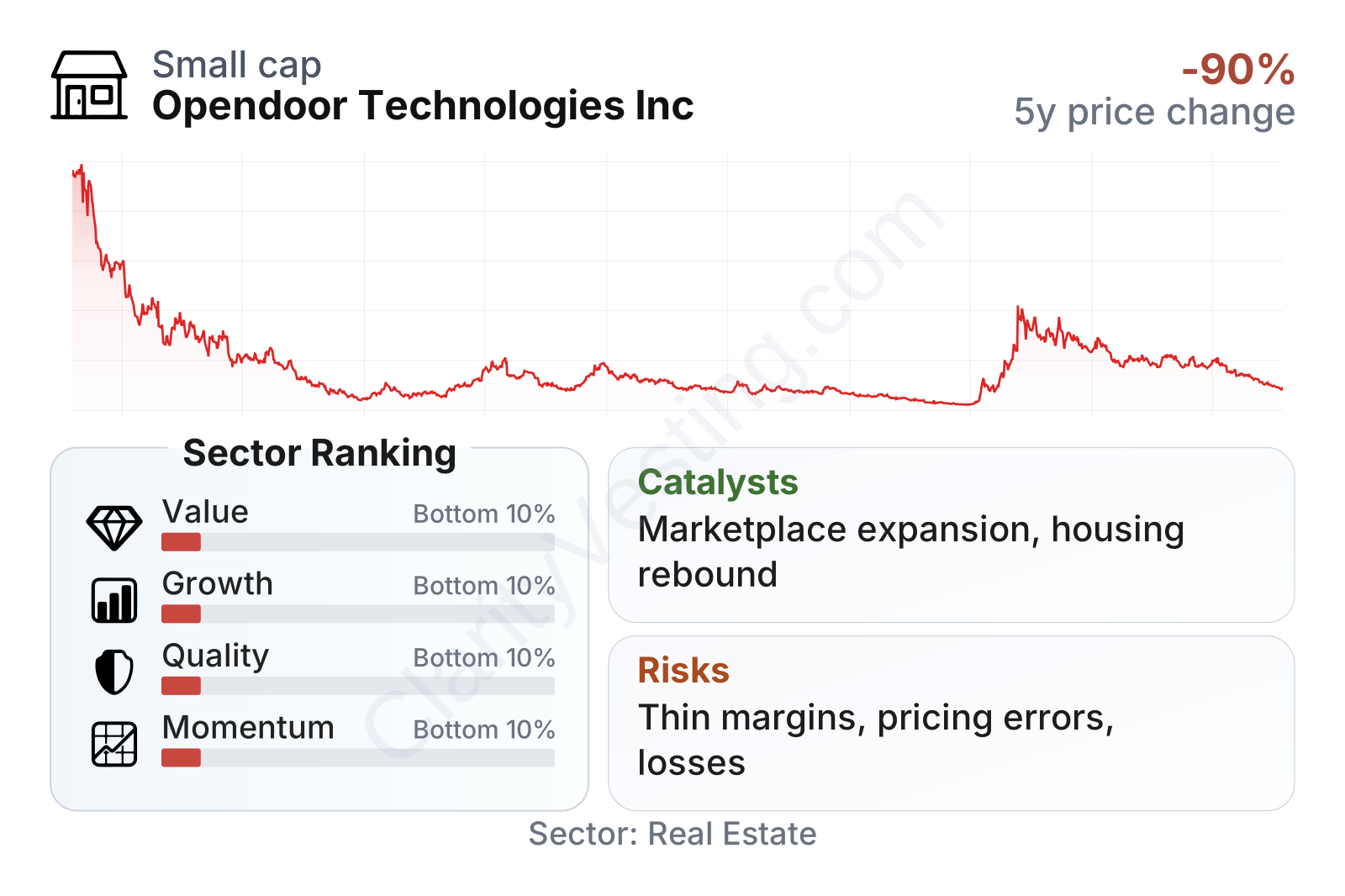
Opendoor remains a mid-sized public company by market value, but its market behavior is far more volatile than the broader real estate sector, with a beta well above 3. The stock price history reflects that instability: a steep collapse after 2021, a brief rebound, then renewed swings. Across value, growth, quality, and momentum, the company ranks near the bottom of its sector. The key takeaway is that the market is not rewarding current fundamentals; it is mainly assigning value to the possibility of a future turnaround rather than present operating strength.
Growth
Opendoor operates in a very large market. Residential real estate transactions in the United States represent a massive pool of potential activity, and the part of the process that the company targets is still fragmented and often frustrating for consumers. That creates room for digital products that make selling simpler, faster, and more certain. In that sense, the broader sector opportunity is real even if the housing market itself is cyclical.
The company’s strategy has gradually shifted from relying only on capital-intensive home purchases to building a broader platform around sellers. Management has emphasized lower-risk offerings, including marketplace tools that can match sellers with institutional or third-party buyers. Strategically, that makes sense: it could allow Opendoor to keep customer relationships and fee opportunities while using less balance-sheet capacity than traditional iBuying.
A major catalyst would be any sustained improvement in U.S. housing turnover. Existing-home activity has been constrained by elevated mortgage rates and affordability pressure. If rates ease or homeowners become more willing to move, transaction volumes could recover, giving Opendoor more opportunities to generate service fees and improve inventory utilization. Another useful tailwind would be better forecasting accuracy in local housing markets, because the model depends on buying homes at prices that still leave room for resale margins after repairs, carrying costs, and fees.
The longer-term revenue trend per share remains weak, which shows how far the company is from its earlier expansion phase. Even so, the strategic direction is more disciplined than before: the company is prioritizing tighter acquisition standards, lower fixed costs, and products that may earn revenue without requiring every transaction to sit on Opendoor’s balance sheet. If that transition works, future growth could become less dependent on aggressive home inventory accumulation.
Recent company communications have also highlighted efforts to expand product breadth and improve conversion across the seller journey. That matters because Opendoor does not need to win every customer through direct home purchases alone; it can potentially monetize convenience, liquidity options, and transaction support in several ways. The opportunity is therefore not only about more homes bought and sold, but about becoming a higher-utility consumer platform in residential transactions.
Risks
This article is for informational purposes only and does not constitute financial advice. Some content is AI-generated. See Disclaimer


