Stock Analysis · BeiGene Ltd (ONC)
Overview
BeiGene Ltd is a global oncology company focused on cancer medicines. It develops, manufactures, and sells therapies for blood cancers and solid tumors, while also advancing a broad pipeline of drug candidates. The business has evolved from a research-heavy biotech company into a commercial-stage cancer drug maker with growing international reach, especially in hematology and targeted oncology.
Its revenue mix is increasingly driven by internally developed medicines rather than collaboration payments. Based on the latest annual results and company disclosures, the main revenue sources are approximately:
- BRUKINSA product sales: about 75% to 80% of total revenue. BRUKINSA is BeiGene’s BTK inhibitor used in several blood cancer indications and has become the company’s core commercial product.
- Other product sales: about 10% to 15%. This includes sales from other marketed products, such as TEVIMBRA and selected in-licensed or partnered commercial products in certain markets.
- Collaboration, licensing, and services revenue: about 10% to 15%. This can include upfront or milestone-related income, co-development arrangements, and supply or research-related revenue.
What stands out is how much the business now depends on one major growth engine. That concentration raises risk, but it also makes the business easier to understand: BeiGene’s progress is largely tied to BRUKINSA’s global adoption and the company’s ability to turn its broader pipeline into the next wave of products.
The long-term operating trend has also improved materially. Over the last several years, revenue expanded from a little over $1 billion to more than $5 billion, while losses narrowed and the company moved into annual profitability in 2025. That shift suggests the commercial platform is becoming more self-sustaining rather than relying mainly on external funding.
The income flow over time shows a clear transition: revenue and gross profit have scaled quickly, research and selling expenses are still very large, but they are no longer overwhelming the business in the way they did a few years ago. The key change is that commercialization has started to absorb the fixed cost base more effectively.
Key Figures
| Metric | Value | Sector ⓘ |
|---|---|---|
| Date | Oct 10, 2026 | |
| Context | ||
| Sector | Healthcare | |
| Industry | Biotechnology | |
| Market Cap ⓘ | $41.41B | |
| Beta ⓘ | 0.61 | |
Value (Cheapness) | ||
| P/E Ratio ⓘ | 65.12 | 24.79 |
| P/B Ratio ⓘ | 7.84 | 2.97 |
| FCF Yield ⓘ | 3.00% | 3.11% |
| Dividend Yield ⓘ | N/A | 2.04% |
| EBIT / EV ⓘ | 2.62% | 0.57% |
| PEG ⓘ | 0.77 | |
Growth (Business expansion) | ||
| Revenue Growth ⓘ | 29.60% | 7.35% |
| RPS Growth (5Y CAGR) ⓘ | 38.83% | 8.61% |
| EPS Growth (5Y CAGR) ⓘ | N/A | -18.43% |
| BVPS Growth (5Y CAGR) ⓘ | -12.67% | 3.94% |
| Margin Growth (5Y Trend) ⓘ | N/A | -0.61% |
| FCF Growth (5Y CAGR) ⓘ | N/A | 0.88% |
| DPS Growth (5Y CAGR) ⓘ | N/A | 6.74% |
Quality (Business durability) | ||
| ROIC (Latest) ⓘ | 13.18% | 3.34% |
| ROA (Latest) ⓘ | 7.80% | 2.95% |
| ROIC (5Y Median) ⓘ | N/A | 4.60% |
| ROA (5Y Median) ⓘ | -14.47% | 1.89% |
| Net Debt / EBIT (Latest) ⓘ | -3.94 | 1.36 |
| Net Debt / EBIT (5Y Median) ⓘ | N/A | 1.86 |
| Net Debt / EBITDA (Latest) ⓘ | -3.41 | 1.02 |
| Net Debt / Assets ⓘ | -43.10% | 5.85% |
| EBITDA / Interest ⓘ | N/A | 9.60 |
| Operating Margin (Latest) ⓘ | 16.39% | 9.19% |
| Operating Margin (5Y Median) ⓘ | -33.59% | 7.53% |
| Debt to Equity (Latest) ⓘ | 22.10% | 29.44% |
| Profit Margin (Latest) ⓘ | 10.70% | 3.52% |
| Free Cash Flow (Latest) ⓘ | $1.24B | |
Momentum (Price trend) | ||
| 3Y Return ⓘ | +102.63% | +34.80% |
| 12M Return (excl. last month) ⓘ | +1.45% | +19.33% |
| 6M Return ⓘ | +12.15% | +7.18% |
| Price vs. 200-Day MA ⓘ | +9.03% | +3.20% |
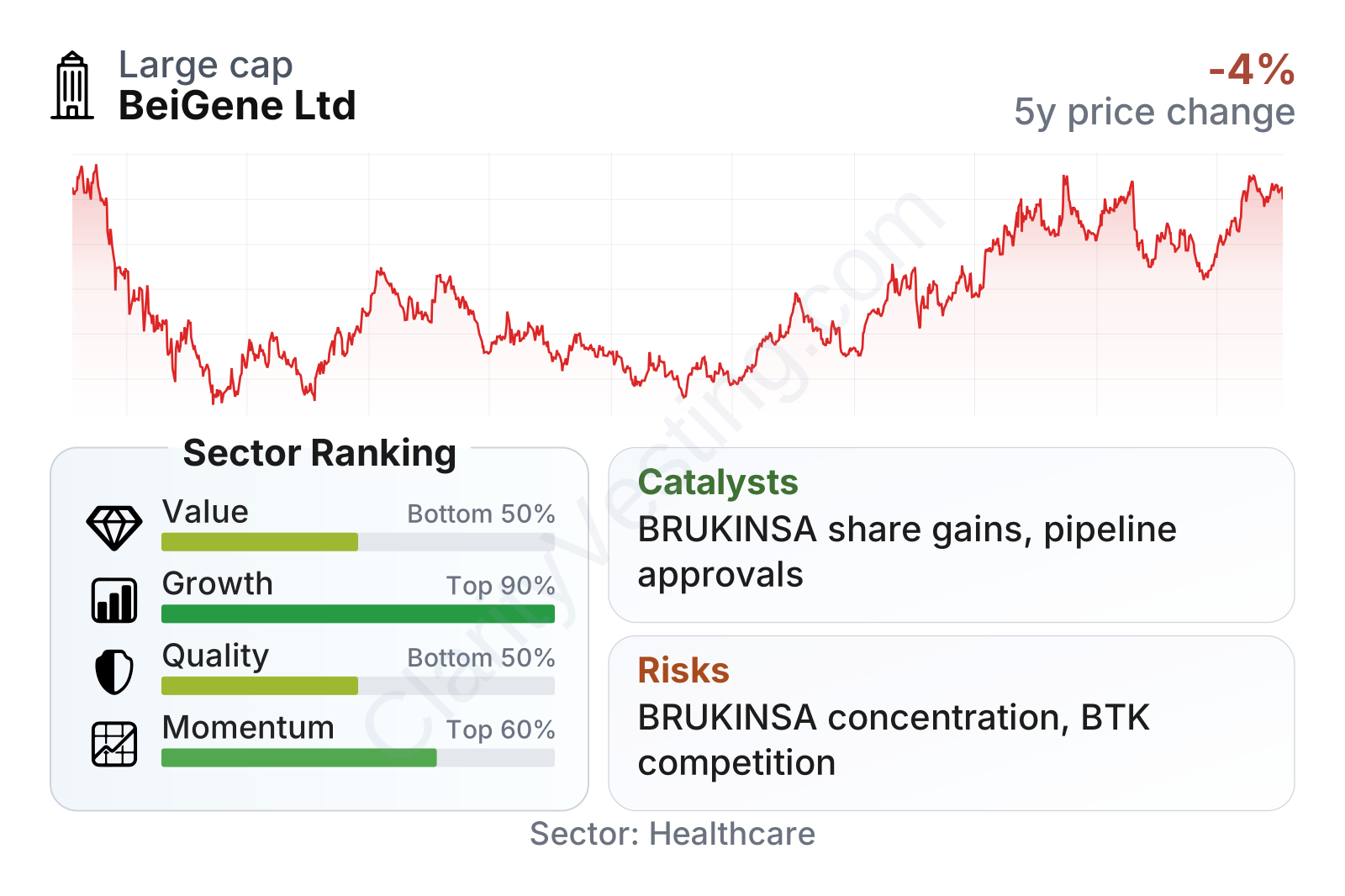
BeiGene now sits in an unusual position for a biotech company: growth ranks near the top of its sector, momentum is also strong, and balance-sheet leverage remains manageable. Quality is more mixed because the business spent years in heavy investment mode, which still affects multi-year profitability measures. On valuation metrics, the stock trades above many sector medians, but that premium is tied to the company’s recent shift into profitability and its unusually strong revenue trajectory.
The stock price history shows meaningful volatility, which is common in biotechnology, but the broader three-year picture is still favorable relative to much of the healthcare universe. The company’s size is now substantial for a biotech name, reflecting that it is no longer being valued only as a pipeline developer but increasingly as a scaled commercial oncology business.
Growth
BeiGene operates in one of the more attractive areas of healthcare: cancer treatment. Oncology remains a large and expanding market because cancer incidence rises with aging populations, treatment duration has increased, and innovation continues to create new targeted therapies and combination approaches. This is a sector where successful drugs can keep growing for years if they continue to add indications and expand geographically.
BeiGene’s strategy makes sense for long-term expansion because it combines three elements that rarely appear together in one biotech company: a fast-growing flagship product, a global commercial footprint, and an active late-stage pipeline. BRUKINSA is central here. It competes in the BTK inhibitor class, where market share gains matter a great deal, and management has consistently emphasized execution in the United States, Europe, and other major markets. The company is also building manufacturing and development capabilities that support a larger independent platform rather than a single-product model.
Revenue growth has remained very strong even as the base has become much larger. Growth has cooled from earlier surge levels, which is normal, but it is still running far above the sector median. That matters because rapid expansion at scale is much harder to achieve than rapid growth from a very small starting point.
Another important change is cash generation. Free cash flow has moved from deeply negative territory to clearly positive over the trailing twelve months. For a company that spent years funding aggressive research and global commercial buildout, this is a major milestone. It suggests growth is no longer coming at the same cash burn cost as before.
Potential catalysts are not limited to one product. BeiGene continues to pursue additional regulatory approvals, new indications for existing medicines, and pipeline readouts across oncology. Recent company updates have also highlighted further expansion of BRUKINSA in chronic lymphocytic leukemia and other hematologic cancers, continued uptake of TEVIMBRA, and broader development work in solid tumors and immunology-related areas. The most significant opportunity remains straightforward: if BRUKINSA continues taking share globally while new assets mature, the company could broaden from a one-engine growth profile into a multi-product oncology platform.
Risks
This article is for informational purposes only and does not constitute financial advice. Some content is AI-generated. See Disclaimer