Stock Analysis · Omai Gold Mines Corp (OMGGF)
Overview
Omai Gold Mines Corp is a Canadian gold exploration and development company focused on Guyana. Its main asset is the Omai gold project, located on the site of a past-producing mine that was once one of South America’s larger gold operations. The company is not yet a producing miner, which means it is still spending money to define the size and quality of the deposit, study how a future mine could work, and move the project through technical and permitting milestones.
Because Omai Gold Mines is still in the exploration and development stage, it currently has no meaningful operating revenue from gold sales. Its financial profile is therefore different from a producing mining company: cash mainly comes from raising capital rather than from selling metal.
The business is best understood through its asset base rather than current sales. The company’s economic exposure is concentrated in one core project.
- Omai gold project in Guyana: approximately 100% of the company’s business focus. This includes exploration drilling, mineral resource expansion, technical studies, and longer-term mine development planning.
- Operating revenue: 0% in recent annual results, as the company is not yet in commercial production.
- Financing activity: while not revenue, new equity financing has been the practical source of funding for exploration, studies, and corporate costs.
This makes Omai Gold Mines a project-driven company: its long-term value depends primarily on whether it can keep increasing confidence in the deposit, show attractive future mine economics, and eventually secure the capital and permits needed to build a mine.
The cost structure reflects that stage. There is essentially no revenue, while operating expenses have risen as drilling, studies, and corporate activity expanded. Losses have widened over time, which is common for a developer, but it also means the investment case depends heavily on future execution rather than current business income.
Key Figures
| Metric | Value | Sector ⓘ |
|---|---|---|
| Date | Oct 17, 2026 | |
| Context | ||
| Sector | Basic Materials | |
| Industry | Gold | |
| Market Cap ⓘ | $1.03B | |
| Beta ⓘ | 2.88 | |
Value (Cheapness) | ||
| P/E Ratio ⓘ | N/A | 16.90 |
| P/B Ratio ⓘ | 28.56 | 1.65 |
| FCF Yield ⓘ | -1.25% | 5.76% |
| Dividend Yield ⓘ | N/A | 2.13% |
| EBIT / EV ⓘ | -1.70% | 6.30% |
| PEG ⓘ | N/A | |
Growth (Business expansion) | ||
| Revenue Growth ⓘ | N/A | 11.10% |
| RPS Growth (5Y CAGR) ⓘ | N/A | 4.49% |
| EPS Growth (5Y CAGR) ⓘ | N/A | -13.47% |
| BVPS Growth (5Y CAGR) ⓘ | 32.56% | 5.51% |
| Margin Growth (5Y Trend) ⓘ | N/A | -1.54% |
| FCF Growth (5Y CAGR) ⓘ | N/A | 0.37% |
| DPS Growth (5Y CAGR) ⓘ | N/A | 6.08% |
Quality (Business durability) | ||
| ROIC (Latest) ⓘ | -49.02% | 9.26% |
| ROA (Latest) ⓘ | -69.20% | 4.91% |
| ROIC (5Y Median) ⓘ | -76.89% | 7.70% |
| ROA (5Y Median) ⓘ | -88.27% | 3.86% |
| Net Debt / EBIT (Latest) ⓘ | N/A | 1.40 |
| Net Debt / EBIT (5Y Median) ⓘ | N/A | 1.70 |
| Net Debt / EBITDA (Latest) ⓘ | N/A | 0.95 |
| Net Debt / Assets ⓘ | N/A | 13.69% |
| EBITDA / Interest ⓘ | N/A | 12.34 |
| Operating Margin (Latest) ⓘ | N/A | 13.20% |
| Operating Margin (5Y Median) ⓘ | N/A | 11.80% |
| Debt to Equity (Latest) ⓘ | N/A | 40.56% |
| Profit Margin (Latest) ⓘ | N/A | 6.43% |
| Free Cash Flow (Latest) ⓘ | -$12.94M | |
Momentum (Price trend) | ||
| 3Y Return ⓘ | +4953.38% | +68.89% |
| 12M Return (excl. last month) ⓘ | +161.77% | +30.21% |
| 6M Return ⓘ | -15.88% | -4.16% |
| Price vs. 200-Day MA ⓘ | -12.65% | -1.27% |
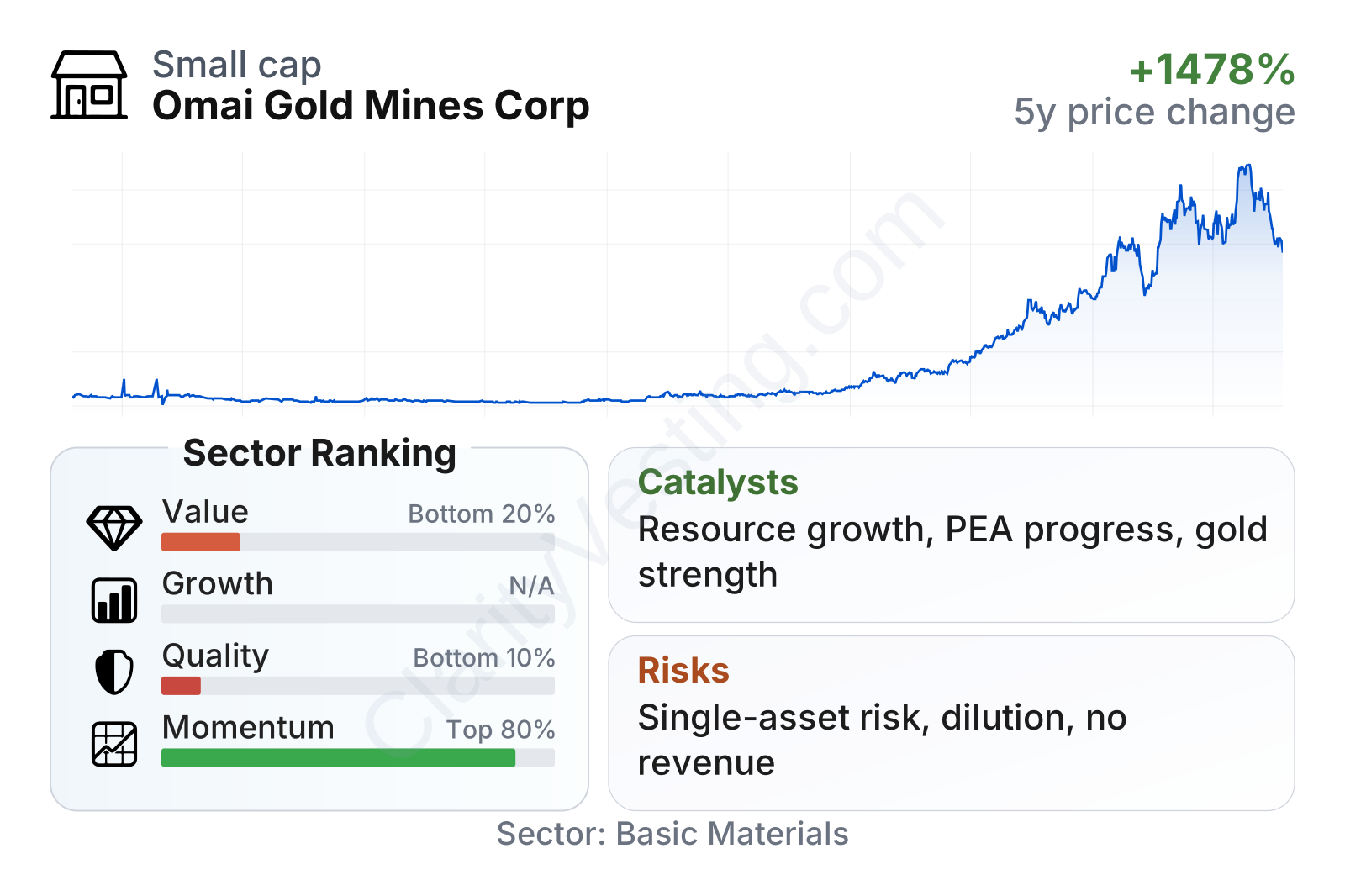
The market is valuing Omai Gold Mines as a sizable junior gold developer rather than a current producer. On traditional valuation measures, it screens as expensive versus the broader gold sector, largely because there are no earnings, no free cash flow, and no operating margin to anchor the share price. Profitability and return metrics sit near the bottom of the sector, which is typical for a company still advancing a mine project but still important to recognize.
At the same time, share performance has been exceptionally strong over the last one-, three-, and six-month comparison periods, placing momentum near the top of the sector. That strength suggests the market has been pricing in improving project expectations and a more favorable gold backdrop. The key point for long-term analysis is that the stock’s rise has come well ahead of production, so sentiment and milestone delivery matter a great deal.
The historical price move also shows how sharply market perception has changed. After trading at only a few cents in 2023, the stock re-rated dramatically through 2025 and 2026. That can be a sign of growing confidence in the project, but it also means expectations are much higher than they were before.
Growth
Omai Gold Mines operates in a part of the mining industry that can attract strong interest during periods of elevated gold prices and geopolitical uncertainty. Gold itself remains a globally recognized store of value, and higher gold prices can improve the economics of deposits that were previously less attractive. For a development-stage company, that backdrop matters because it can raise the estimated value of ounces still in the ground.
The company’s strategy is coherent for a junior miner. It is focused on one known mining district with historical production, existing site familiarity, and room to expand resources. In practical terms, that means management is not trying to build several unrelated projects at once; instead, it is concentrating capital and technical work on one flagship asset. That usually makes it easier for the market to track progress through drill results, updated resource estimates, engineering studies, and permitting steps.
One of the clearest catalysts is the transition from exploration success to formal development milestones. If drilling continues to improve confidence in the resource, and if technical studies show a mine could be built at an attractive cost, the project can move from being valued mainly on potential to being valued on a more detailed development plan. For companies like Omai Gold Mines, those milestones often matter more than near-term accounting results.
Cash generation remains negative and has become more negative as activity increased. That is not surprising for a company funding drilling and studies before production begins. What matters more is whether that spending is translating into project derisking: bigger or better-defined resources, stronger engineering work, and a clearer path to construction.
A notable positive for the broader setup is location. Guyana has attracted increasing attention from natural resource companies over the past several years, and Omai is one of the better-known historical gold sites in the country. The combination of a past-producing asset, ongoing technical advancement, and a strong gold market creates a credible growth framework. The strongest near- to medium-term opportunities likely come from resource expansion, updated economic studies, and any progress that moves the project closer to a construction decision.
Risks
This article is for informational purposes only and does not constitute financial advice. Some content is AI-generated. See Disclaimer


