Stock Analysis · OneMain Holdings Inc (OMF)
Overview
OneMain Holdings Inc is a consumer finance company focused on lending to people who are often underserved by traditional banks. Its main business is providing personal loans, especially to non-prime customers, meaning borrowers with lower credit scores or more limited access to mainstream credit. The company distributes these loans through a large branch network across the United States, direct mail, digital channels, and dealer relationships.
OneMain’s business model is fairly straightforward: it borrows money in capital markets and then lends it to consumers at higher rates, while trying to manage credit losses, funding costs, and operating expenses. The company also earns fee income tied to insurance products and other loan-related add-ons that can accompany its lending products.
Based on recent company filings, revenue is primarily generated from finance charges and interest on consumer loans, with a smaller contribution from insurance and other fee-based products. The mix can vary somewhat by quarter, but the broad structure is:
- Consumer loan interest and finance charges: approximately 80% to 90% of revenue. This is the core business and reflects payments made by borrowers on personal loans and credit products.
- Insurance and related commissions: approximately 10% to 15% of revenue. This generally includes credit insurance, non-credit insurance products, and commissions connected to optional products offered with loans.
- Other revenue: a small residual share. This can include servicing-related items and miscellaneous fees.
Over the last several years, total revenue has generally moved upward, rising from just under $5.0 billion in 2021 to above $6.2 billion in 2025. However, that top-line growth did not flow evenly to profit, because funding costs, credit expenses, and operating expenses also increased. That dynamic is central to understanding the company: OneMain can expand loan balances and revenue, but long-term value depends on how well it prices risk and controls losses through the credit cycle.
The revenue base has expanded over time, but earnings were squeezed as interest expense and credit-related costs consumed a larger share of the business. The rebound in 2025 suggests the model can recover when credit trends and pricing become more favorable, but profitability remains more cyclical than the revenue line alone might suggest.
Key Figures
| Metric | Value | Sector ⓘ |
|---|---|---|
| Date | Oct 17, 2026 | |
| Context | ||
| Sector | Financial Services | |
| Industry | Credit Services | |
| Market Cap ⓘ | $6.29B | |
| Beta ⓘ | 1.21 | |
Value (Cheapness) | ||
| P/E Ratio ⓘ | 8.45 | 12.26 |
| P/B Ratio ⓘ | 1.91 | 1.23 |
| FCF Yield ⓘ | 51.42% | 10.40% |
| Dividend Yield ⓘ | 7.47% | 3.02% |
| EBIT / EV ⓘ | 5.80% | 8.14% |
| PEG ⓘ | 0.75 | |
Growth (Business expansion) | ||
| Revenue Growth ⓘ | -2.70% | 9.35% |
| RPS Growth (5Y CAGR) ⓘ | 8.77% | 12.19% |
| EPS Growth (5Y CAGR) ⓘ | -19.32% | -9.53% |
| BVPS Growth (5Y CAGR) ⓘ | -3.24% | 4.99% |
| Margin Growth (5Y Trend) ⓘ | -18.97% | -3.86% |
| FCF Growth (5Y CAGR) ⓘ | 8.64% | 4.81% |
| DPS Growth (5Y CAGR) ⓘ | -18.70% | 8.79% |
Quality (Business durability) | ||
| ROIC (Latest) ⓘ | 4.93% | 9.49% |
| ROE (Latest) ⓘ | 23.10% | 13.90% |
| ROA (Latest) ⓘ | 2.87% | 1.55% |
| ROIC (5Y Median) ⓘ | 3.09% | 7.86% |
| ROE (5Y Median) ⓘ | 23.76% | 12.17% |
| ROA (5Y Median) ⓘ | 2.94% | 1.30% |
| Net Debt / EBIT (Latest) ⓘ | 13.44 | 0.96 |
| Net Debt / EBIT (5Y Median) ⓘ | 21.76 | 0.73 |
| Net Debt / EBITDA (Latest) ⓘ | 11.40 | 0.92 |
| Operating Margin (Latest) ⓘ | 25.74% | 22.30% |
| Operating Margin (5Y Median) ⓘ | 16.04% | 24.63% |
| Debt to Equity (Latest) ⓘ | 673.04% | 58.56% |
| Profit Margin (Latest) ⓘ | 25.86% | 26.57% |
| Free Cash Flow (Latest) ⓘ | $3.23B | |
Momentum (Price trend) | ||
| 3Y Return ⓘ | +83.39% | +88.33% |
| 12M Return (excl. last month) ⓘ | +7.56% | +19.38% |
| 6M Return ⓘ | +0.22% | +4.75% |
| Price vs. 200-Day MA ⓘ | -3.20% | +3.50% |
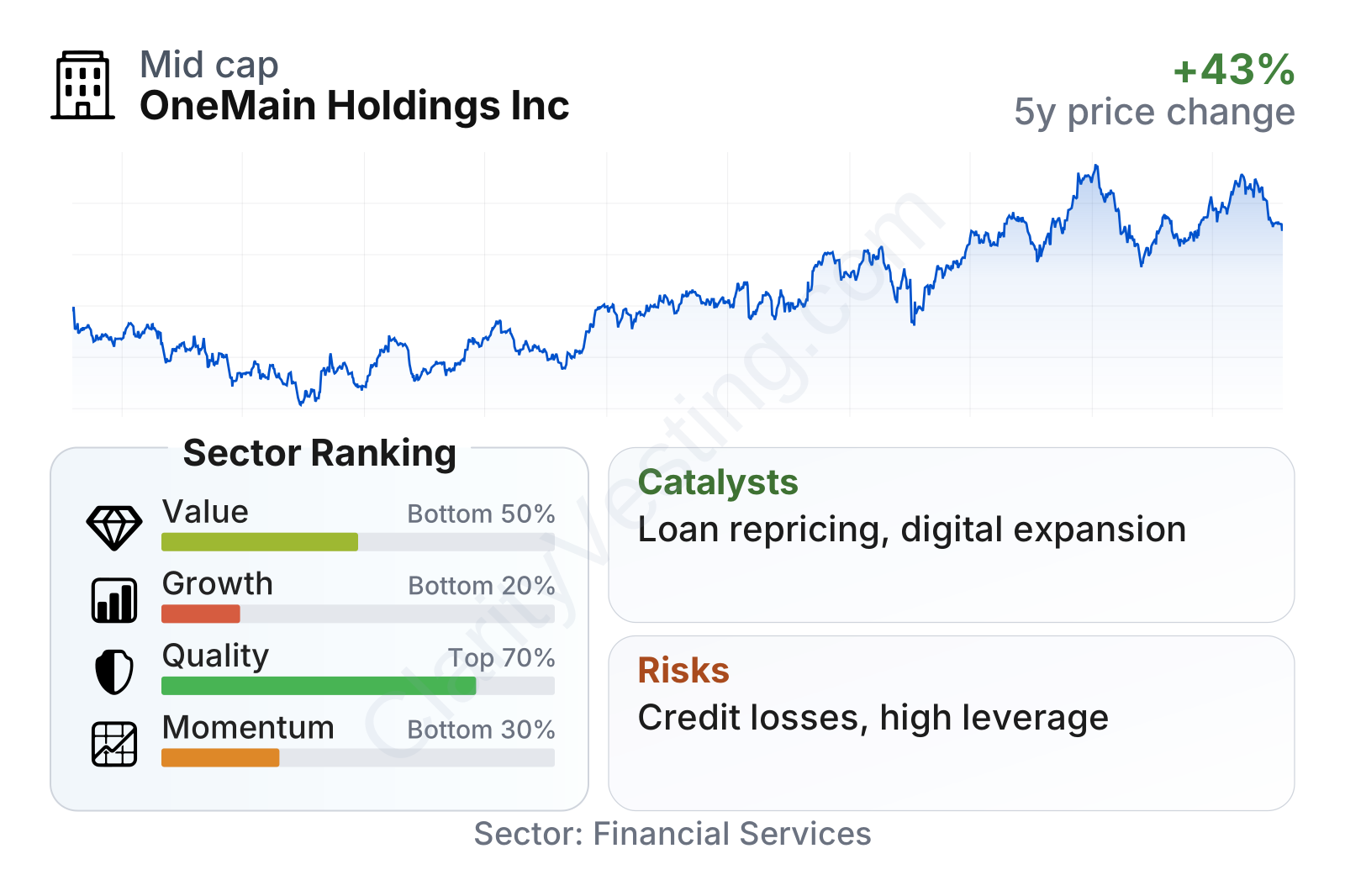
OneMain is a mid-sized financial company with a market value in the single-digit billions and a stock that has been more volatile than the broader market, as reflected by a beta above 1. Its valuation looks mixed: the earnings multiple is below the sector median, while the price-to-book ratio is above the sector median. That usually signals a market that is willing to pay a premium to book value for profitability, but not assigning a high multiple to earnings because of credit-cycle risk and leverage.
The profitability profile is stronger than many peers in key areas. Return on equity is around 23% and return on assets is close to 3%, both ahead of sector medians. The dividend yield is also notably high relative to the sector. On the other hand, growth metrics are weak, with recent revenue contracting year over year and five-year earnings and book value trends trailing the broader financial services group. Momentum is also softer than the sector, suggesting the market remains cautious despite the recovery in profits.
Growth
OneMain operates in a durable part of consumer finance rather than a high-growth corner of the market. Demand for personal loans tends to persist because many households need access to credit for debt consolidation, emergency spending, auto repairs, medical bills, or other everyday needs. That gives the company a large addressable market. The more important question is not whether demand exists, but whether OneMain can grow while keeping losses and funding costs under control.
The company’s strategy for growth is sensible within that context. It combines a nationwide branch footprint with digital origination, allowing it to reach customers who still value in-person service while also improving online convenience. OneMain has also been building adjacent products, including credit cards and point-of-sale financing, which can deepen customer relationships and broaden the revenue base beyond standard installment loans.
Earnings per share show why the stock is often judged through a cyclical lens. Profits fell sharply from the unusually strong 2021 level, bottomed through 2024, and then improved in 2025. That pattern suggests the company is not on a smooth compounding path, but it also shows that earnings can recover when pricing, underwriting, and credit performance align more favorably.
Book value per share has been less consistent than long-term investors often prefer. After a drop from 2021, it gradually recovered, but the multi-year trend remains modest. For a lender, this matters because book value helps show how much capital is being built over time after dividends, share repurchases, and credit costs.
A meaningful catalyst is the company’s ability to reprice new loans at higher yields while keeping origination volumes healthy. If credit quality stabilizes and borrowing costs stop rising, that can improve margins more quickly than headline revenue growth alone would suggest. Another potential growth support is the continued shift toward digital underwriting and cross-selling of multiple products to existing customers, which may improve efficiency and customer retention.
Recent company updates have also pointed to ongoing portfolio management efforts, including tighter underwriting in weaker segments and continued focus on capital returns. That does not create rapid expansion by itself, but it can improve the quality of future growth if the company balances volume with credit discipline.
Risks
This article is for informational purposes only and does not constitute financial advice. Some content is AI-generated. See Disclaimer


