Stock Analysis · Omeros Corporation (OMER)
Overview
Omeros Corporation is a biotechnology company focused on developing and commercializing medicines for serious diseases, with a particular emphasis on immunology, inflammation, and disorders involving the complement system, a part of the immune response. The company previously marketed the drug OMIDRIA for use during cataract surgery, but its business profile changed materially after the sale of that product and related assets. Today, Omeros is much more centered on its drug pipeline and on the potential value of its lead development programs than on a broad, diversified commercial base.
At this stage, the company’s revenue mix is unusually concentrated and can be difficult to interpret in a traditional way because recurring product sales have largely fallen away. Based on recent filings, the main sources of reported revenue appear to be:
- Licensing and contract-related revenue: this appears to represent the large majority of current reported revenue when recognized, and can include collaboration, milestone, or other agreement-based payments.
- Residual or limited product-related revenue: this is now a small portion of the business compared with the period when OMIDRIA was still contributing meaningfully.
- Other revenue: a minor category that may include service or miscellaneous items, depending on the reporting period.
The most important point for long-term analysis is that Omeros is no longer a standard commercial drug company with stable product sales. It is closer to a clinical-stage biotech with a publicly listed equity, meaningful intellectual property, and a valuation that depends heavily on whether its late-stage and regulatory programs convert into future approvals and commercialization.
The business flow over recent years shows a company that has kept research spending high while sharply reducing some operating costs in 2025. That cost reset helped narrow losses, but it does not change the bigger picture: the company still needs new products or milestone-driven revenue to build a durable operating model.
Key Figures
| Metric | Value | Sector ⓘ |
|---|---|---|
| Date | Oct 17, 2026 | |
| Context | ||
| Sector | Healthcare | |
| Industry | Biotechnology | |
| Market Cap ⓘ | $1.33B | |
| Beta ⓘ | 2.57 | |
Value (Cheapness) | ||
| P/E Ratio ⓘ | 15.11 | 24.79 |
| P/B Ratio ⓘ | N/A | 3.08 |
| FCF Yield ⓘ | -5.15% | 3.15% |
| Dividend Yield ⓘ | N/A | 1.94% |
| EBIT / EV ⓘ | 8.63% | 0.57% |
| PEG ⓘ | 0.81 | |
Growth (Business expansion) | ||
| Revenue Growth ⓘ | 14.90% | 7.45% |
| RPS Growth (5Y CAGR) ⓘ | N/A | 8.61% |
| EPS Growth (5Y CAGR) ⓘ | N/A | -17.81% |
| BVPS Growth (5Y CAGR) ⓘ | N/A | 3.72% |
| Margin Growth (5Y Trend) ⓘ | N/A | -0.62% |
| FCF Growth (5Y CAGR) ⓘ | N/A | 1.04% |
| DPS Growth (5Y CAGR) ⓘ | N/A | 6.77% |
Quality (Business durability) | ||
| ROIC (Latest) ⓘ | 255.08% | 3.24% |
| ROA (Latest) ⓘ | 52.83% | 3.01% |
| ROIC (5Y Median) ⓘ | -38.15% | 4.60% |
| ROA (5Y Median) ⓘ | -24.31% | 1.89% |
| Net Debt / EBIT (Latest) ⓘ | 0.62 | 1.34 |
| Net Debt / EBIT (5Y Median) ⓘ | N/A | 1.84 |
| Net Debt / EBITDA (Latest) ⓘ | 0.61 | 1.00 |
| Net Debt / Assets ⓘ | 28.51% | 5.45% |
| EBITDA / Interest ⓘ | 3.74 | 9.64 |
| Operating Margin (Latest) ⓘ | 343.84% | 9.27% |
| Operating Margin (5Y Median) ⓘ | N/A | 7.38% |
| Debt to Equity (Latest) ⓘ | -163.14% | 28.58% |
| Profit Margin (Latest) ⓘ | 324.88% | 3.59% |
| Free Cash Flow (Latest) ⓘ | -$68.73M | |
Momentum (Price trend) | ||
| 3Y Return ⓘ | +1120.13% | +42.80% |
| 12M Return (excl. last month) ⓘ | +319.80% | +18.50% |
| 6M Return ⓘ | +53.39% | +7.57% |
| Price vs. 200-Day MA ⓘ | +40.88% | +5.12% |
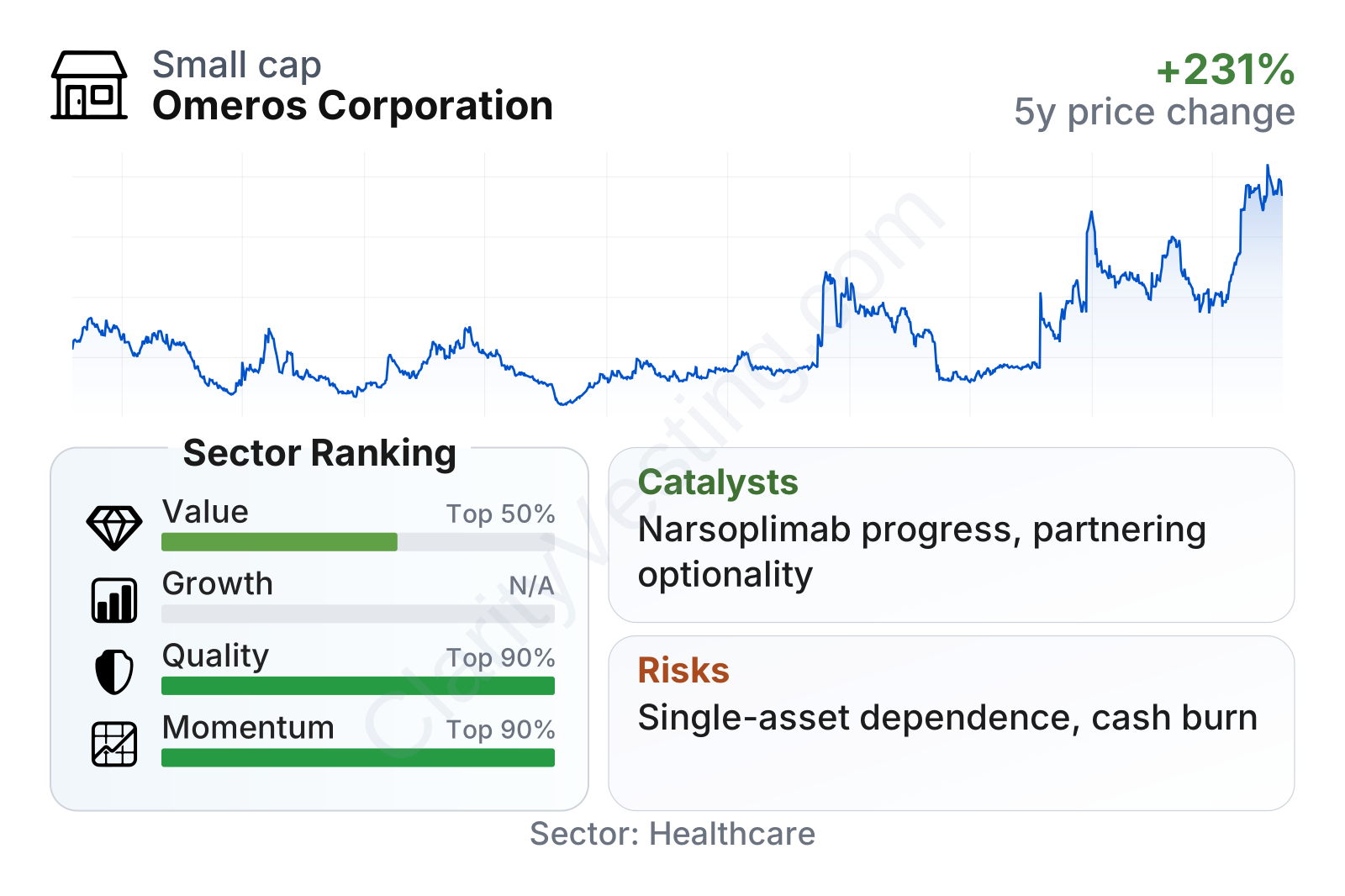
Omeros currently sits in an unusual position for a biotech of its size. On one hand, valuation multiples look lower than the sector median and recent revenue growth appears stronger than many peers. On the other hand, free cash flow remains negative and the stock carries very high volatility, reflected in a beta well above 2. The quality and momentum readings are strong relative to the sector, but those rankings are influenced by recent profitability improvements and the market’s sharp repricing of the shares, which can change quickly in biotech.
The share-price history also highlights how event-driven this company is. The stock moved from low single digits to above $10 more than once in the last two years, showing that sentiment can shift rapidly when investors reassess the odds of regulatory, legal, or clinical progress.
Growth
Omeros operates in a sector with long-term structural growth. Biotechnology remains supported by rising demand for treatments in rare diseases, immune disorders, and targeted therapies. In Omeros’ case, the most important growth logic is not broad industry expansion by itself, but whether the company can translate its scientific platform into approved products or meaningful partnerships.
The central growth asset is narsoplimab, a monoclonal antibody targeting MASP-2 in the lectin pathway of complement activation. This pathway is an area of active interest across biotech because complement-mediated diseases can be severe, difficult to treat, and suitable for premium pricing if a therapy shows clear clinical value. Omeros has also continued advancing other complement-related and immunology programs, but narsoplimab remains the main near-to-medium-term value driver.
Recent company updates have kept attention on regulatory and development progress around narsoplimab, including work tied to hematopoietic stem cell transplant-associated thrombotic microangiopathy and other indications. For a company of this size, any favorable regulatory re-engagement, label expansion path, or partnering transaction around a late-stage asset could materially change the revenue outlook.
Reported year-over-year revenue growth has recently rebounded sharply, but the base effect matters here. For Omeros, swings in recognized revenue can be large because they may reflect milestone timing or accounting effects rather than a steadily expanding product franchise. That means growth should be viewed as potentially lumpy rather than smooth.
Cash generation remains a key part of the growth debate. Free cash flow is still negative, although the recent trend looks less severe than the deeper cash outflows seen earlier. That suggests expense control is helping, but long-term self-funded growth would still require either a larger revenue stream, external capital, or business-development payments.
A recent strategic opportunity came from the company’s legal and contractual developments tied to OMIDRIA-related economics and broader capital flexibility. These events have helped reshape market expectations because they affect how much time Omeros may have to fund pipeline progress without immediate commercial success.
Risks
This article is for informational purposes only and does not constitute financial advice. Some content is AI-generated. See Disclaimer


