Stock Analysis · Omnicell Inc (OMCL)
Overview
Omnicell is a healthcare technology company focused on helping hospitals, health systems, and pharmacies manage medications more safely and efficiently. Its products combine hardware, software, analytics, and recurring services. In practice, the company is best known for automated medication dispensing systems used inside hospitals, pharmacy workflow tools, and technology that supports inventory control, medication adherence, and specialty pharmacy operations.
Its business is tied to a clear operational problem in healthcare: hospitals and pharmacies need to reduce medication errors, lower labor pressure, improve compliance, and operate with tighter budgets. Omnicell’s offering is designed to fit directly into those needs, which is why the company sits at the intersection of healthcare infrastructure and software-enabled automation.
Based on recent company filings, revenue is primarily generated from a mix of products and recurring service-related streams. The broad mix can be understood as follows:
- Products – about 56% to 60%: automated dispensing cabinets, central pharmacy automation, IV compounding and packaging-related systems, and other medication management equipment and software sold with these platforms.
- Services and subscriptions – about 40% to 44%: maintenance, support, cloud and software subscriptions, professional services, and other recurring customer contracts tied to installed systems.
At a business-line level, the company is still centered on medication management for healthcare providers, while newer software and service models aim to increase the recurring portion of sales over time. That matters for long-term analysis because recurring revenue is usually more stable than one-time equipment sales.
The financial flow over recent years shows a business that went through a difficult profitability reset after stronger 2021-2022 revenue levels. Revenue pulled back in 2023 and 2024, but operating costs were reduced meaningfully, especially selling and administrative expenses. That helped Omnicell return to positive operating income and net profit, although margins remain modest.
Key Figures
| Metric | Value | Sector ⓘ |
|---|---|---|
| Date | Oct 17, 2026 | |
| Context | ||
| Sector | Healthcare | |
| Industry | Health Information Services | |
| Market Cap ⓘ | $1.62B | |
| Beta ⓘ | 0.99 | |
Value (Cheapness) | ||
| P/E Ratio ⓘ | 43.24 | 24.79 |
| P/B Ratio ⓘ | 1.28 | 3.08 |
| FCF Yield ⓘ | 8.74% | 3.15% |
| Dividend Yield ⓘ | N/A | 1.94% |
| EBIT / EV ⓘ | 4.47% | 0.57% |
| PEG ⓘ | 15.40 | |
Growth (Business expansion) | ||
| Revenue Growth ⓘ | 7.50% | 7.45% |
| RPS Growth (5Y CAGR) ⓘ | 2.00% | 8.61% |
| EPS Growth (5Y CAGR) ⓘ | -20.83% | -17.81% |
| BVPS Growth (5Y CAGR) ⓘ | 2.66% | 3.72% |
| Margin Growth (5Y Trend) ⓘ | -6.52% | -0.62% |
| FCF Growth (5Y CAGR) ⓘ | -19.10% | 1.04% |
| DPS Growth (5Y CAGR) ⓘ | N/A | 6.77% |
Quality (Business durability) | ||
| ROIC (Latest) ⓘ | 2.10% | 3.24% |
| ROA (Latest) ⓘ | 1.98% | 3.01% |
| ROIC (5Y Median) ⓘ | 0.19% | 4.60% |
| ROA (5Y Median) ⓘ | 0.26% | 1.89% |
| Net Debt / EBIT (Latest) ⓘ | -1.46 | 1.34 |
| Net Debt / EBIT (5Y Median) ⓘ | 0.51 | 1.84 |
| Net Debt / EBITDA (Latest) ⓘ | -0.63 | 1.00 |
| Net Debt / Assets ⓘ | -4.61% | 5.45% |
| EBITDA / Interest ⓘ | N/A | 9.64 |
| Operating Margin (Latest) ⓘ | 5.05% | 9.27% |
| Operating Margin (5Y Median) ⓘ | 1.29% | 7.38% |
| Debt to Equity (Latest) ⓘ | 15.48% | 28.58% |
| Profit Margin (Latest) ⓘ | 3.14% | 3.59% |
| Free Cash Flow (Latest) ⓘ | $141.40M | |
Momentum (Price trend) | ||
| 3Y Return ⓘ | -14.91% | +42.80% |
| 12M Return (excl. last month) ⓘ | +1.15% | +18.50% |
| 6M Return ⓘ | -4.21% | +7.57% |
| Price vs. 200-Day MA ⓘ | -9.41% | +5.12% |
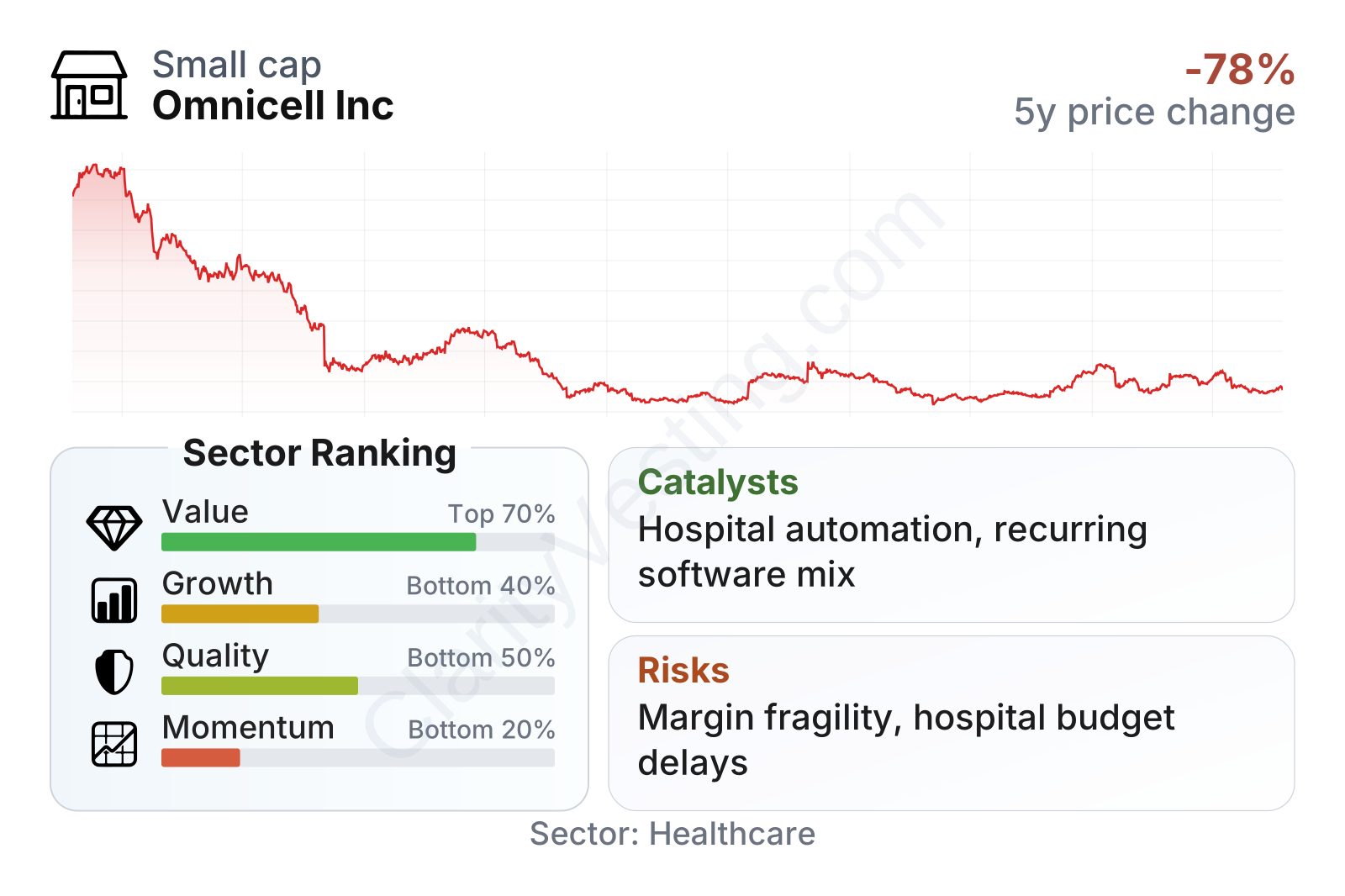
Omnicell is a mid-sized healthcare technology company with a stock that has been very volatile over the last several years. The share price remains far below its 2021 peak despite a partial recovery, which reflects both the earlier earnings deterioration and the market’s caution about the pace of the turnaround. The latest metric profile is mixed: valuation signals are relatively strong on cash generation and asset-based measures, but growth, quality, and price momentum rank weaker versus much of the healthcare sector. Balance-sheet leverage, however, looks notably improved.
Growth
Omnicell operates in a part of healthcare that still has long-term structural support. Hospitals continue to push for automation because pharmacy labor is expensive, medication safety remains a priority, and providers are under pressure to do more with fewer resources. These are not short-lived themes. They support demand for dispensing automation, pharmacy workflow tools, and software that can improve inventory visibility and reduce waste.
The company’s strategy also makes sense on paper for future expansion. Omnicell has been shifting from a more equipment-heavy model toward a broader platform that includes software, connected services, and subscription-like revenue. That transition is important because it can make revenue steadier, deepen customer relationships, and potentially lift margins over time if execution improves.
Recent revenue trends show a business emerging from a weak period rather than one already in a strong expansion phase. After a prolonged stretch of declining year-over-year revenue through 2023 and much of 2024, growth turned positive again and has remained positive into 2026, with the latest pace around the mid-single digits to mid-teens depending on the quarter. That points to stabilization and recovery, but not yet to sustained high growth.
Cash generation has held up better than earnings across this recovery. Trailing free cash flow remains solid at a little above $100 million, even though it is below the stronger level reached during the rebound in 2024. For a company of Omnicell’s size, that is an important support point: it suggests the business is not relying on aggressive borrowing to fund operations while it works through margin rebuilding.
Recent company updates have also pointed to continuing interest in its autonomous pharmacy vision, cloud-enabled offerings, and customer upgrades across health systems. Those are relevant catalysts because Omnicell already has an installed base inside hospitals. When a company with existing customer relationships adds more software and services, growth can come from both new clients and deeper spending from current ones.
Risks
This article is for informational purposes only and does not constitute financial advice. Some content is AI-generated. See Disclaimer


