Stock Analysis · Olam Group Limited (OLGPF)
Overview
Olam Group Limited is a global food and agribusiness company headquartered in Singapore. It operates across the agricultural supply chain: sourcing crops and raw materials from producing regions, processing them, transporting them, and supplying food, feed, and industrial customers around the world. Its activities span products such as edible nuts, cocoa, coffee, dairy, grains, animal feed ingredients, rice, cotton, and packaged foods in selected markets.
The group has been reshaping itself in recent years around clearer business lines. Public company materials describe three main pillars: OFI for higher-value food ingredients, Olam Agri for large-scale agricultural trading and processing, and the Remaining Olam Group businesses, which include assets that are being managed for value, developed, or monetized over time. That structure matters because the earnings profile of ingredients and branded food-related activities is different from the more cyclical and balance-sheet-intensive commodity trading operations.
Based on the company’s recent reporting structure, revenue is mainly generated from the following sources:
- Olam Agri: approximately 75% to 85% of group revenue in recent years. This segment includes grains and oilseeds, rice, edible oils, animal feed and protein, cotton, and other large-volume agricultural products. It is the biggest contributor by sales because these are high-turnover trading and processing businesses.
- OFI (Olam Food Ingredients): approximately 15% to 25% of group revenue. This business focuses on cocoa, coffee, dairy, nuts, and spices, supplying food manufacturers and brands with ingredients and solutions.
- Remaining Olam Group: generally a small share of revenue. This includes selected packaged foods, infrastructure-related assets, and other holdings that are less central to the group’s long-term simplified structure.
In practical terms, Olam is not a single-product company. It is a diversified agricultural platform with global sourcing, logistics, processing, and customer relationships. That diversification can reduce dependence on one commodity, but it also makes the business more complex to analyze than a typical branded consumer staples company.
The financial flow over recent years shows a business with very large revenue, thin operating margins, and meaningful financing costs. That is common in commodity-linked distribution and processing, where scale matters but profitability per dollar of sales is usually modest.
The broad trend suggests that Olam’s sales base is large and resilient, but interest expense has absorbed a significant share of operating profit. That helps explain why strong revenue and operating income do not always translate into equally strong bottom-line results.
Key Figures
| Metric | Value | Sector ⓘ |
|---|---|---|
| Date | Oct 03, 2026 | |
| Context | ||
| Sector | Consumer Defensive | |
| Industry | Food Distribution | |
| Market Cap ⓘ | $3.14B | |
| Beta ⓘ | 0.52 | |
Value (Cheapness) | ||
| P/E Ratio ⓘ | 81.58 | 18.16 |
| P/B Ratio ⓘ | 0.26 | 1.27 |
| FCF Yield ⓘ | 33.31% | 12.39% |
| Dividend Yield ⓘ | 1.23% | 2.83% |
| EBIT / EV ⓘ | N/A | 6.45% |
| PEG ⓘ | N/A | |
Growth (Business expansion) | ||
| Revenue Growth ⓘ | -18.30% | 3.80% |
| RPS Growth (5Y CAGR) ⓘ | -12.90% | 6.20% |
| EPS Growth (5Y CAGR) ⓘ | 26.68% | -14.64% |
| BVPS Growth (5Y CAGR) ⓘ | -4.23% | 3.26% |
| Margin Growth (5Y Trend) ⓘ | 11.66% | -0.25% |
| FCF Growth (5Y CAGR) ⓘ | N/A | 4.65% |
| DPS Growth (5Y CAGR) ⓘ | -10.95% | 6.86% |
Quality (Business durability) | ||
| ROIC (Latest) ⓘ | N/A | 12.58% |
| ROA (Latest) ⓘ | 8.29% | 6.35% |
| ROIC (5Y Median) ⓘ | 7.54% | 10.36% |
| ROA (5Y Median) ⓘ | 1.05% | 5.44% |
| Net Debt / EBIT (Latest) ⓘ | 8.05 | 1.91 |
| Net Debt / EBIT (5Y Median) ⓘ | 7.28 | 2.32 |
| Net Debt / EBITDA (Latest) ⓘ | 4.49 | 1.36 |
| Net Debt / Assets ⓘ | 35.30% | 21.25% |
| EBITDA / Interest ⓘ | 1.37 | 9.61 |
| Operating Margin (Latest) ⓘ | 2.86% | 8.96% |
| Operating Margin (5Y Median) ⓘ | 3.68% | 9.53% |
| Debt to Equity (Latest) ⓘ | 132.05% | 71.66% |
| Profit Margin (Latest) ⓘ | 7.54% | 5.40% |
| Free Cash Flow (Latest) ⓘ | $1.04B | |
Momentum (Price trend) | ||
| 3Y Return ⓘ | +17.99% | +15.25% |
| 12M Return (excl. last month) ⓘ | +39.69% | +2.63% |
| 6M Return ⓘ | +30.30% | +2.43% |
| Price vs. 200-Day MA ⓘ | +5.03% | +0.43% |
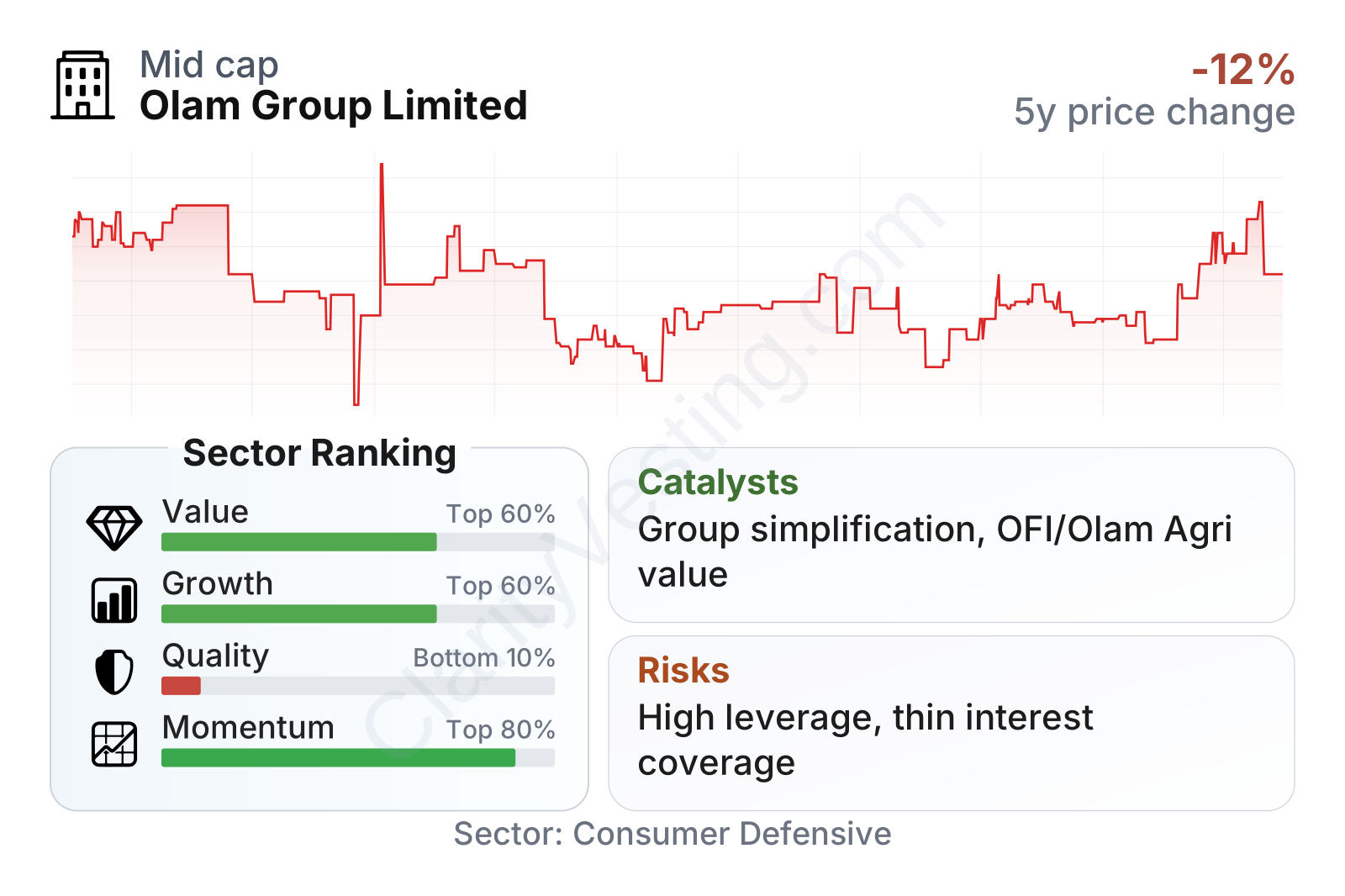
Olam is a mid-sized listed agribusiness by market value, and its share price has been relatively less volatile than the broader market, as reflected by a beta well below 1. Recent price momentum has been noticeably stronger than the sector median, even though the longer-term chart still shows a stock that has moved through sharp swings rather than a smooth compounding path.
The metric mix is unusual. On one side, free cash flow yield and price-to-book look optically attractive relative to the sector. On the other, the quality profile is weak versus peers because leverage is high, interest coverage is thin, and operating margins are below sector norms. Growth indicators are mixed as well: earnings per share and margin trends have improved over a multiyear period, but revenue growth has recently been negative and revenue per share over five years has declined.
Growth
Olam operates in sectors with durable long-term demand drivers. Global consumption of food, feed, edible oils, coffee, cocoa, and ingredients tends to rise over time with population growth, urbanization, and higher protein and packaged food consumption in emerging markets. That does not mean smooth annual expansion, because agricultural markets are cyclical, but it does mean the underlying end markets are structurally relevant.
The company’s strategy also has a clear industrial logic. Higher-value ingredient activities such as cocoa, coffee, nuts, and dairy solutions can command better margins and stronger customer stickiness than pure commodity trading. At the same time, the agricultural trading and processing platform gives Olam scale, origination reach, and access to supply chains that are hard to replicate quickly. In principle, combining global sourcing with more value-added processing can support better earnings quality over time.
A major catalyst has been the group’s portfolio restructuring. Olam has spent several years separating businesses, bringing in strategic investors, and pursuing pathways to unlock value from OFI and Olam Agri. This matters because conglomerate structures often trade at a discount when the market struggles to value very different businesses inside one listed entity. Further asset monetization, strategic transactions, or simplification steps could change how the company is assessed.
Another important tailwind is the continuing need for traceable and more sustainable agricultural supply chains. Large food manufacturers increasingly want reliable suppliers that can source globally, manage quality, and comply with environmental and social requirements. Olam’s scale, processing footprint, and established customer relationships make it relevant in that transition, especially in ingredients and regulated supply chains.
Recent company communications have continued to emphasize simplification, disciplined capital allocation, and extracting value from strategic holdings. If that process continues successfully, the market may focus more on the underlying franchises and less on the complexity of the group structure.
Risks
This article is for informational purposes only and does not constitute financial advice. Some content is AI-generated. See Disclaimer