Stock Analysis · Oklo Inc (OKLO)
Overview
Oklo Inc is an early-stage advanced nuclear company focused on building small power plants, selling clean electricity, and developing fuel recycling capabilities. Its flagship concept is a compact fast reactor called Aurora. Rather than mainly acting as a traditional equipment vendor, Oklo aims to operate plants and sell power directly to customers under long-term agreements. The target market includes data centers, industrial users, defense-related demand, and other customers that need reliable electricity around the clock.
The business is still in the development phase. That means the company has attracted strong market attention, but it has not yet built a commercial reactor in operation and has not yet established recurring operating revenue at scale. Recent filings show that reported revenue remains negligible, while spending has risen sharply as Oklo expands engineering, licensing, business development, and corporate infrastructure.
Based on current public filings, Oklo’s revenue mix is not yet meaningful as a mature breakdown because commercial operations have not started. At this stage, the economic model is expected to come from the following areas once projects move into operation:
- Power sales: expected to be the core future revenue stream, potentially representing the large majority of revenue once plants are operating. This would include long-term electricity supply contracts.
- Capacity and energy-related services: possible supplemental revenue from availability, grid support, or structured power arrangements depending on customer contracts and market design.
- Fuel recycling and fuel-related activities: a longer-dated opportunity tied to Oklo’s plans around used nuclear fuel and fuel supply economics.
Today, however, the practical revenue picture is simple: commercial revenue is close to 0%, while nearly all current financial activity reflects operating expenses, research and development, and corporate build-out rather than a functioning sales base.
The financial flow highlights a company that is still pre-revenue. Operating expenses have increased rapidly over the last several years, with research and development and administrative spending both climbing as Oklo prepares for licensing and future deployment. Losses have widened accordingly, which is typical for a company trying to create a new nuclear platform but also underscores how much execution remains ahead.
Key Figures
| Metric | Value | Sector ⓘ |
|---|---|---|
| Date | Oct 17, 2026 | |
| Context | ||
| Sector | Utilities | |
| Industry | Utilities - Independent Power Producers | |
| Market Cap ⓘ | $5.91B | |
| Beta ⓘ | 1.22 | |
Value (Cheapness) | ||
| P/E Ratio ⓘ | N/A | 17.28 |
| P/B Ratio ⓘ | 1.56 | 1.51 |
| FCF Yield ⓘ | -4.67% | 0.65% |
| Dividend Yield ⓘ | N/A | 3.77% |
| EBIT / EV ⓘ | -3.22% | 5.01% |
| PEG ⓘ | N/A | |
Growth (Business expansion) | ||
| Revenue Growth ⓘ | N/A | 6.10% |
| RPS Growth (5Y CAGR) ⓘ | N/A | 3.87% |
| EPS Growth (5Y CAGR) ⓘ | N/A | -11.30% |
| BVPS Growth (5Y CAGR) ⓘ | 218.10% | 4.23% |
| Margin Growth (5Y Trend) ⓘ | N/A | 3.57% |
| FCF Growth (5Y CAGR) ⓘ | N/A | -8.84% |
| DPS Growth (5Y CAGR) ⓘ | N/A | 4.84% |
Quality (Business durability) | ||
| ROIC (Latest) ⓘ | -5.57% | 6.53% |
| ROA (Latest) ⓘ | -6.64% | 3.20% |
| ROIC (5Y Median) ⓘ | -6.39% | 5.95% |
| ROA (5Y Median) ⓘ | -70.32% | 2.75% |
| Net Debt / EBIT (Latest) ⓘ | N/A | 7.13 |
| Net Debt / EBIT (5Y Median) ⓘ | N/A | 7.23 |
| Net Debt / EBITDA (Latest) ⓘ | N/A | 4.31 |
| Net Debt / Assets ⓘ | -48.86% | 38.42% |
| EBITDA / Interest ⓘ | N/A | 4.58 |
| Operating Margin (Latest) ⓘ | -12670.74% | 20.83% |
| Operating Margin (5Y Median) ⓘ | N/A | 20.08% |
| Debt to Equity (Latest) ⓘ | 0.13% | 137.69% |
| Profit Margin (Latest) ⓘ | N/A | 11.37% |
| Free Cash Flow (Latest) ⓘ | -$275.82M | |
Momentum (Price trend) | ||
| 3Y Return ⓘ | +181.94% | +52.37% |
| 12M Return (excl. last month) ⓘ | -56.22% | +8.84% |
| 6M Return ⓘ | -50.43% | -3.95% |
| Price vs. 200-Day MA ⓘ | -49.59% | -0.79% |
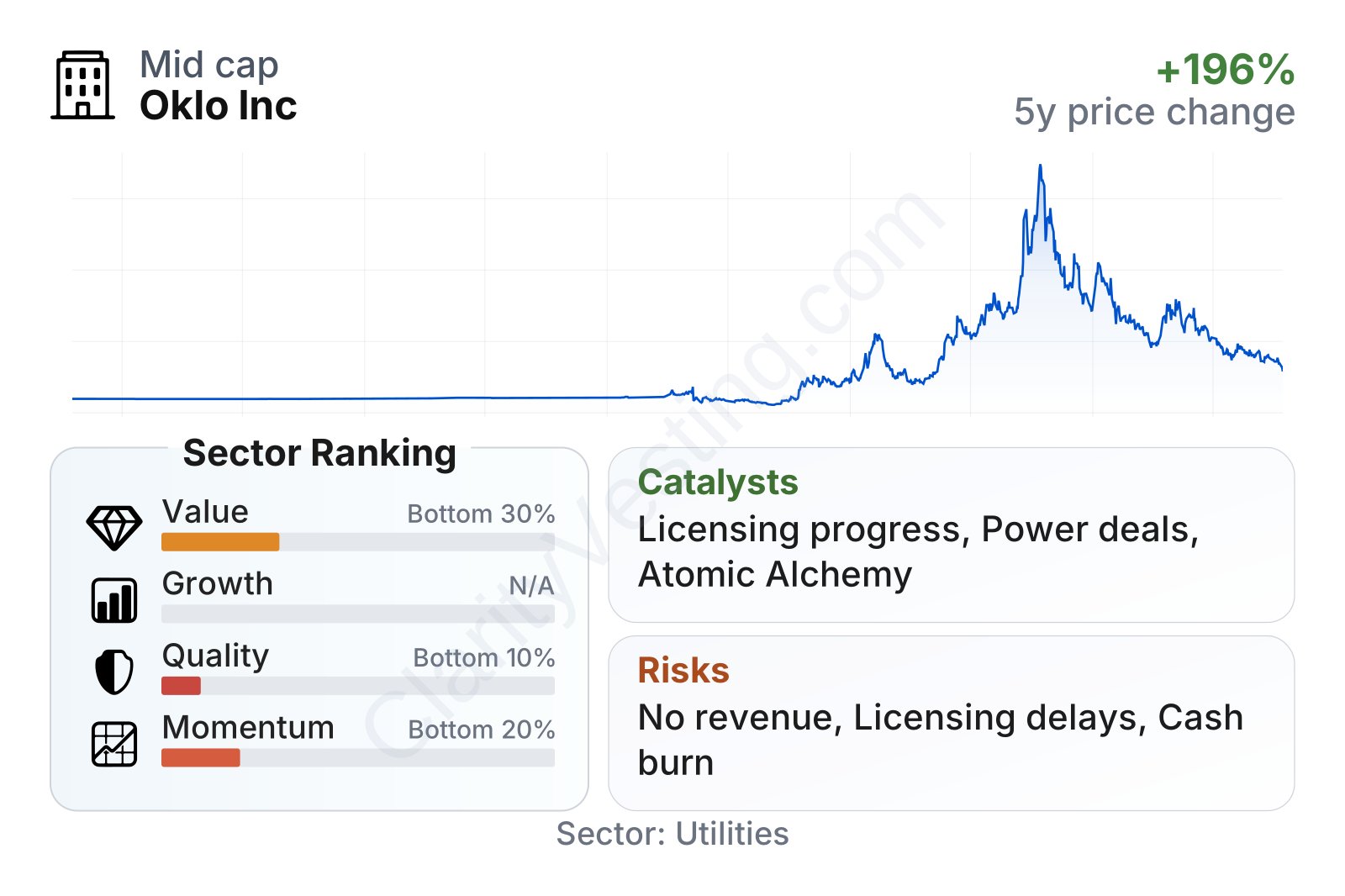
Oklo is currently a mid-sized public company by market value, but its fundamentals still look like those of a pre-commercial developer rather than an established utility. The overall profile is unusual for the utilities sector: value metrics rank in the lower end of the group, quality metrics are very weak because profitability is deeply negative, and momentum has cooled sharply after a dramatic earlier stock run. Balance-sheet leverage is extremely low, which is a clear distinction versus many traditional power companies, but that strength reflects limited debt rather than a mature cash-generating business.
The contrast is important. In a standard utility, investors often look for steady earnings, dividends, and predictable cash flow. Oklo currently offers almost none of that. What the market is valuing instead is the possibility that its reactor model, customer pipeline, and regulatory progress eventually translate into a commercially valuable power platform.
Growth
Oklo operates in a part of the energy market that has gained real momentum. Interest in firm clean power has increased as electricity demand rises from data centers, artificial intelligence infrastructure, electrification, and grid reliability needs. Wind and solar continue to grow, but many large customers also want power sources that can run continuously without depending on weather conditions. That creates a potentially favorable backdrop for advanced nuclear developers if they can actually deliver projects on time and under regulatory rules.
Oklo’s strategy is conceptually coherent for that environment. The company is not only promoting a reactor design; it is also trying to secure future demand through power agreements and customer relationships before plants are operating. That approach could matter because long-term offtake is often one of the biggest hurdles for new power infrastructure. In addition, the company’s focus on smaller reactors aims to address one of the biggest weaknesses of traditional nuclear projects: very large upfront cost and long construction timelines.
Recent company developments have reinforced the opportunity set. Oklo has highlighted progress around site and customer development, including agreements tied to future power demand, and it has also expanded its position through the proposed acquisition of Atomic Alchemy, which would add radioisotope production capabilities and broaden the commercial platform beyond electricity alone. That does not remove execution risk, but it does show an effort to build multiple routes to future revenue around nuclear infrastructure.
The problem is timing. Revenue per share has remained at 0 over the last several years, which confirms that the commercial phase has not started yet. So the growth case is not visible in reported sales; it is visible in contracts, licensing milestones, strategic partnerships, and the possibility of future project deployment.
Cash use has been moving sharply in the wrong direction as the company scales up. Trailing free cash flow is deeply negative and has deteriorated substantially over time, showing that growth currently requires increasing capital consumption rather than internally funded expansion. For a company at this stage, that is not surprising, but it means the pace of future progress will depend heavily on access to capital, disciplined project selection, and credible regulatory advancement.
Risks
This article is for informational purposes only and does not constitute financial advice. Some content is AI-generated. See Disclaimer


