Stock Analysis · ONEOK Inc (OKE)
Overview
ONEOK Inc. is a large U.S. midstream energy company. In simple terms, it does not mainly drill for oil and gas itself. Instead, it helps move, process, fractionate, store, and transport energy products. Its network includes natural gas gathering systems, natural gas liquids pipelines, fractionators, storage assets, and refined products and crude-related transportation infrastructure. That makes ONEOK an important link between production areas, processing hubs, and end markets.
The company’s business became broader after its combination with Magellan Midstream, which added major refined products and crude oil transportation assets. As a result, ONEOK now has a more diversified mix of cash flows than it had a few years ago, with exposure to natural gas, natural gas liquids, and liquids transportation.
Based on recent company reporting, revenue is primarily generated from fee-based services and commodity-related sales tied to several operating segments. Approximate revenue mix can shift meaningfully with commodity prices and product marketing activity, but the business is generally organized around these main sources:
- Natural Gas Liquids segment: the largest contributor, likely around 35% to 45% of total revenue in recent periods. This includes NGL gathering, processing, fractionation, transportation, storage, and marketing.
- Natural Gas Gathering and Processing segment: likely around 20% to 30%. This includes collecting raw natural gas from wells, processing it, and preparing it for downstream markets.
- Refined Products and Crude segment: likely around 20% to 30%. This business became much more important after the Magellan transaction and includes transportation, storage, and terminal services for gasoline, diesel, jet fuel, and crude oil.
- Natural Gas Pipelines segment: likely around 10% to 15%. This includes interstate and intrastate transportation as well as storage services.
For long-term readers, the key point is that ONEOK is not a pure commodity producer. A meaningful part of its economics comes from infrastructure that earns fees for handling volumes. That tends to make results more stable than those of exploration and production companies, although not completely insulated from energy cycles.
The long-term trend in the business flow is favorable: revenue, operating income, and net income have all expanded materially since 2021, even though interest expense has also risen sharply after the company’s expansion and acquisitions. That combination points to a larger and more profitable platform, but one that now carries a heavier financing burden.
Key Figures
| Metric | Value | Sector ⓘ |
|---|---|---|
| Date | Oct 24, 2026 | |
| Context | ||
| Sector | Energy | |
| Industry | Oil & Gas Midstream | |
| Market Cap ⓘ | $58.53B | |
| Beta ⓘ | 0.80 | |
Value (Cheapness) | ||
| P/E Ratio ⓘ | 15.95 | 15.40 |
| P/B Ratio ⓘ | 2.58 | 1.71 |
| FCF Yield ⓘ | 4.96% | 8.24% |
| Dividend Yield ⓘ | 4.59% | 3.52% |
| EBIT / EV ⓘ | 7.09% | 7.45% |
| PEG ⓘ | 1.71 | |
Growth (Business expansion) | ||
| Revenue Growth ⓘ | 52.80% | 26.85% |
| RPS Growth (5Y CAGR) ⓘ | 8.39% | 6.78% |
| EPS Growth (5Y CAGR) ⓘ | -7.76% | -14.41% |
| BVPS Growth (5Y CAGR) ⓘ | 27.46% | 6.08% |
| Margin Growth (5Y Trend) ⓘ | 3.15% | 0.55% |
| FCF Growth (5Y CAGR) ⓘ | 7.25% | 2.75% |
| DPS Growth (5Y CAGR) ⓘ | 2.37% | 16.79% |
Quality (Business durability) | ||
| ROIC (Latest) ⓘ | 8.77% | 11.30% |
| ROA (Latest) ⓘ | 5.41% | 6.00% |
| ROIC (5Y Median) ⓘ | 10.13% | 10.35% |
| ROA (5Y Median) ⓘ | 6.42% | 5.46% |
| Net Debt / EBIT (Latest) ⓘ | 5.15 | 1.64 |
| Net Debt / EBIT (5Y Median) ⓘ | 5.07 | 1.82 |
| Net Debt / EBITDA (Latest) ⓘ | 4.15 | 1.08 |
| Net Debt / Assets ⓘ | 47.94% | 17.29% |
| EBITDA / Interest ⓘ | 4.45 | 9.53 |
| Operating Margin (Latest) ⓘ | 16.21% | 16.21% |
| Operating Margin (5Y Median) ⓘ | 18.65% | 20.55% |
| Debt to Equity (Latest) ⓘ | 143.97% | 52.27% |
| Profit Margin (Latest) ⓘ | 9.29% | 8.79% |
| Free Cash Flow (Latest) ⓘ | $2.91B | |
Momentum (Price trend) | ||
| 3Y Return ⓘ | +60.40% | +68.93% |
| 12M Return (excl. last month) ⓘ | +35.27% | +42.90% |
| 6M Return ⓘ | +12.60% | +9.18% |
| Price vs. 200-Day MA ⓘ | +7.39% | +9.87% |
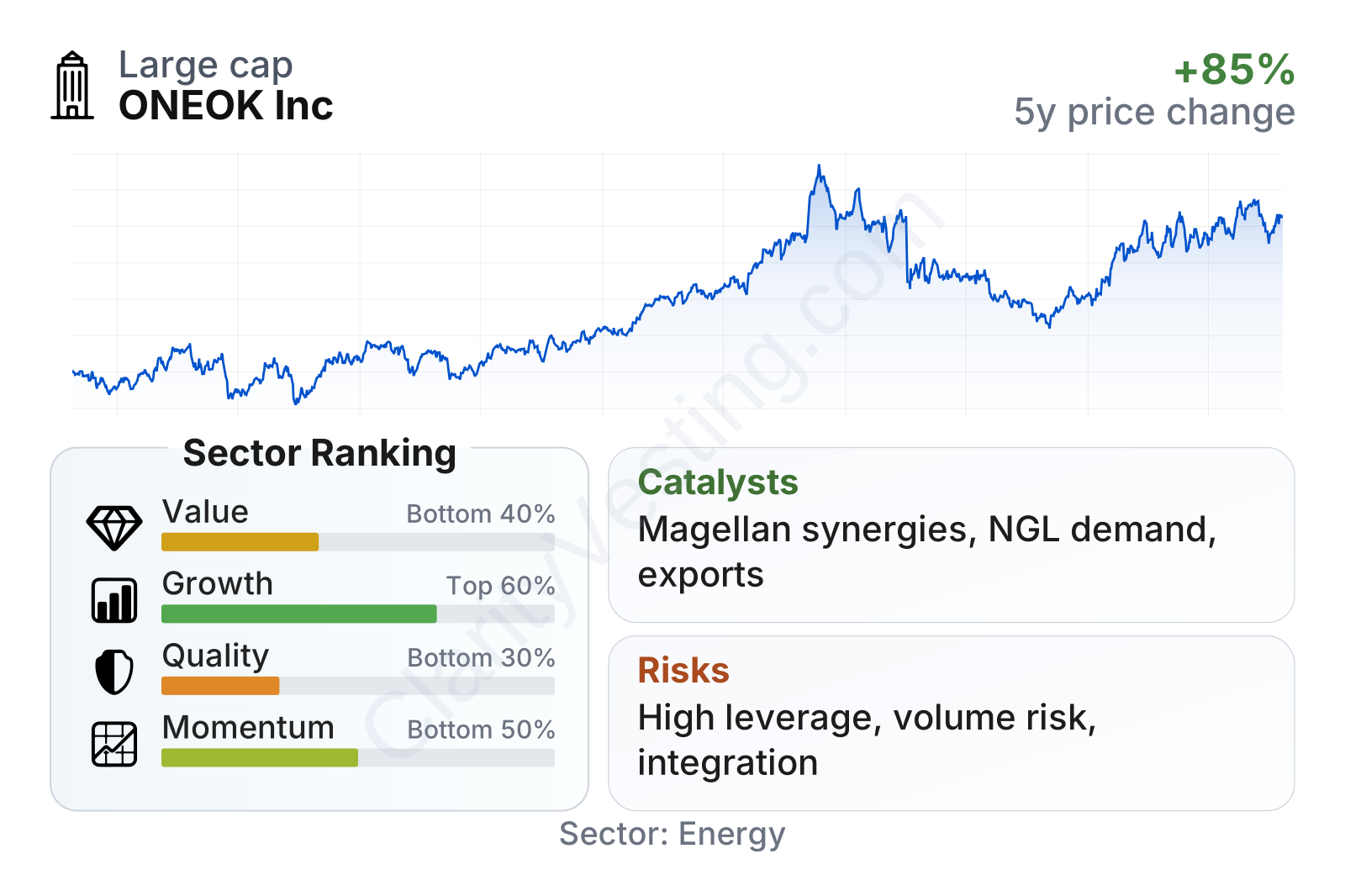
ONEOK is a very large midstream operator with a market value above $50 billion, and its share-price volatility has been lower than the broader market, as suggested by a beta below 1. In the factor breakdown, growth looks better than valuation and balance-sheet quality. Revenue growth, free cash flow growth, and book value growth have generally outpaced sector medians, but leverage remains clearly above typical energy peers. Profitability is still solid, though recent returns on capital sit below many companies in the sector. The dividend yield is above the sector median, while valuation appears close to average on earnings but less attractive on free cash flow and asset-based measures.
Growth
ONEOK operates in a part of the energy market that still has long-term relevance. Natural gas and natural gas liquids remain important to U.S. power generation, heating, exports, petrochemicals, and industrial demand. Even in a world focused on decarbonization, gas infrastructure is often viewed as more durable than many other hydrocarbon assets because it supports electricity reliability and feedstock demand. On top of that, U.S. production growth in regions such as the Permian, Bakken, Mid-Continent, and Rocky Mountain areas creates ongoing demand for gathering, processing, and transport infrastructure.
The company’s strategy also has a clear industrial logic. By combining gathering systems, processing plants, pipelines, fractionators, and storage assets, ONEOK can handle multiple steps of the value chain. That can improve asset utilization, create cross-selling opportunities, and reduce dependence on any single basin or product. The Magellan combination strengthened this model further by adding refined products and crude pipelines with established routes and tariff-based cash flows.
Revenue growth has been strong recently, including a sharp rebound in the latest periods. Some of that reflects acquisitions and portfolio expansion rather than purely organic volume growth, so it should not automatically be treated as a new normal. Still, it shows that the company is now operating on a much larger commercial base than before.
Free cash flow has remained positive over time, which matters for a capital-intensive business. The pattern is not perfectly smooth, but it suggests the company can still generate substantial cash after capital spending. That supports debt service, dividends, and integration spending, while giving management room to pursue selective projects.
Recent company updates have emphasized integration progress, synergy capture, and expansion opportunities across its enlarged system. For the next few years, the clearest catalysts are continued U.S. NGL demand, pipeline and fractionation optimization, export-related infrastructure demand, and the full financial contribution from acquired assets. If management delivers on integration targets while keeping volumes high, the growth profile could remain supported even without unusually strong commodity prices.
Risks
This article is for informational purposes only and does not constitute financial advice. Some content is AI-generated. See Disclaimer


