Stock Analysis · Oil Refineries Ltd (OILRF)
Overview
Oil Refineries Ltd is one of Israel’s main downstream energy companies. It operates a large refining complex in Haifa and turns crude oil into transportation fuels, industrial fuels, and feedstocks used by other industries. In practical terms, the company buys crude oil and sells products such as gasoline, diesel, jet fuel, fuel oil, LPG, bitumen, and petrochemical materials. Its business sits in the refining and marketing part of the oil value chain, where profitability depends heavily on refining margins, input costs, utilization rates, and local and regional demand for fuels.
The company’s revenue is driven primarily by sales of refined petroleum products, with a smaller but still meaningful contribution from petrochemical-related activities. Based on the company’s business structure and public disclosures, the revenue mix can be understood approximately as follows:
- Refined fuels and distillates: about 75% to 85% — gasoline, diesel, jet fuel, marine and industrial fuels, LPG, and other products sold into domestic and export markets.
- Petrochemical and polymer chain products: about 15% to 25% — aromatics, olefins, feedstocks, and related materials used by chemical and manufacturing customers, including activity connected to its group companies.
- Other services and by-products: a low single-share contribution — utilities, storage, and miscellaneous industrial outputs when disclosed.
The business model is straightforward but cyclical: revenue can remain very large even when profits weaken, because crude oil and product values move with global energy prices. What matters most is not only sales volume, but the spread between crude input costs and the prices achieved on refined products. Over the last several years, revenue has moved sharply with the energy cycle, while profits have been much more volatile.
The long-term appeal of the company comes from its strategic infrastructure role in Israel’s fuel system and its integrated position between refining and petrochemical operations. That said, it remains a classic commodity-linked business rather than a stable, high-margin compounder.
The business has shown how sensitive refining economics can be. Revenue climbed strongly in 2022, then moderated in 2023 through 2025 as energy markets normalized. More importantly, a much larger share of sales has recently been absorbed by input costs, which helps explain why net income fell much faster than revenue during the downturn.
Key Figures
| Metric | Value | Sector ⓘ |
|---|---|---|
| Date | Oct 17, 2026 | |
| Context | ||
| Sector | Energy | |
| Industry | Oil & Gas Refining & Marketing | |
| Market Cap ⓘ | $2.05B | |
| Beta ⓘ | -0.06 | |
Value (Cheapness) | ||
| P/E Ratio ⓘ | 5.45 | 15.44 |
| P/B Ratio ⓘ | 1.02 | 1.73 |
| FCF Yield ⓘ | 8.56% | 8.20% |
| Dividend Yield ⓘ | 1.68% | 3.59% |
| EBIT / EV ⓘ | 14.89% | 7.46% |
| PEG ⓘ | N/A | |
Growth (Business expansion) | ||
| Revenue Growth ⓘ | 83.90% | 26.90% |
| RPS Growth (5Y CAGR) ⓘ | -0.24% | 6.90% |
| EPS Growth (5Y CAGR) ⓘ | -13.83% | -15.73% |
| BVPS Growth (5Y CAGR) ⓘ | 7.00% | 6.07% |
| Margin Growth (5Y Trend) ⓘ | -6.22% | 0.58% |
| FCF Growth (5Y CAGR) ⓘ | -12.82% | 1.86% |
| DPS Growth (5Y CAGR) ⓘ | -17.43% | 16.79% |
Quality (Business durability) | ||
| ROIC (Latest) ⓘ | 11.64% | 11.40% |
| ROA (Latest) ⓘ | 7.70% | 6.06% |
| ROIC (5Y Median) ⓘ | 11.97% | 10.30% |
| ROA (5Y Median) ⓘ | 6.09% | 5.42% |
| Net Debt / EBIT (Latest) ⓘ | 1.54 | 1.64 |
| Net Debt / EBIT (5Y Median) ⓘ | 1.55 | 1.83 |
| Net Debt / EBITDA (Latest) ⓘ | 1.05 | 1.08 |
| Net Debt / Assets ⓘ | 12.55% | 17.29% |
| EBITDA / Interest ⓘ | 4.69 | 9.64 |
| Operating Margin (Latest) ⓘ | 5.86% | 16.27% |
| Operating Margin (5Y Median) ⓘ | 5.77% | 20.39% |
| Debt to Equity (Latest) ⓘ | 74.67% | 54.76% |
| Profit Margin (Latest) ⓘ | 4.96% | 8.82% |
| Free Cash Flow (Latest) ⓘ | $175.09M | |
Momentum (Price trend) | ||
| 3Y Return ⓘ | +193.67% | +67.38% |
| 12M Return (excl. last month) ⓘ | +197.66% | +49.19% |
| 6M Return ⓘ | +66.12% | +7.07% |
| Price vs. 200-Day MA ⓘ | +53.14% | +9.56% |
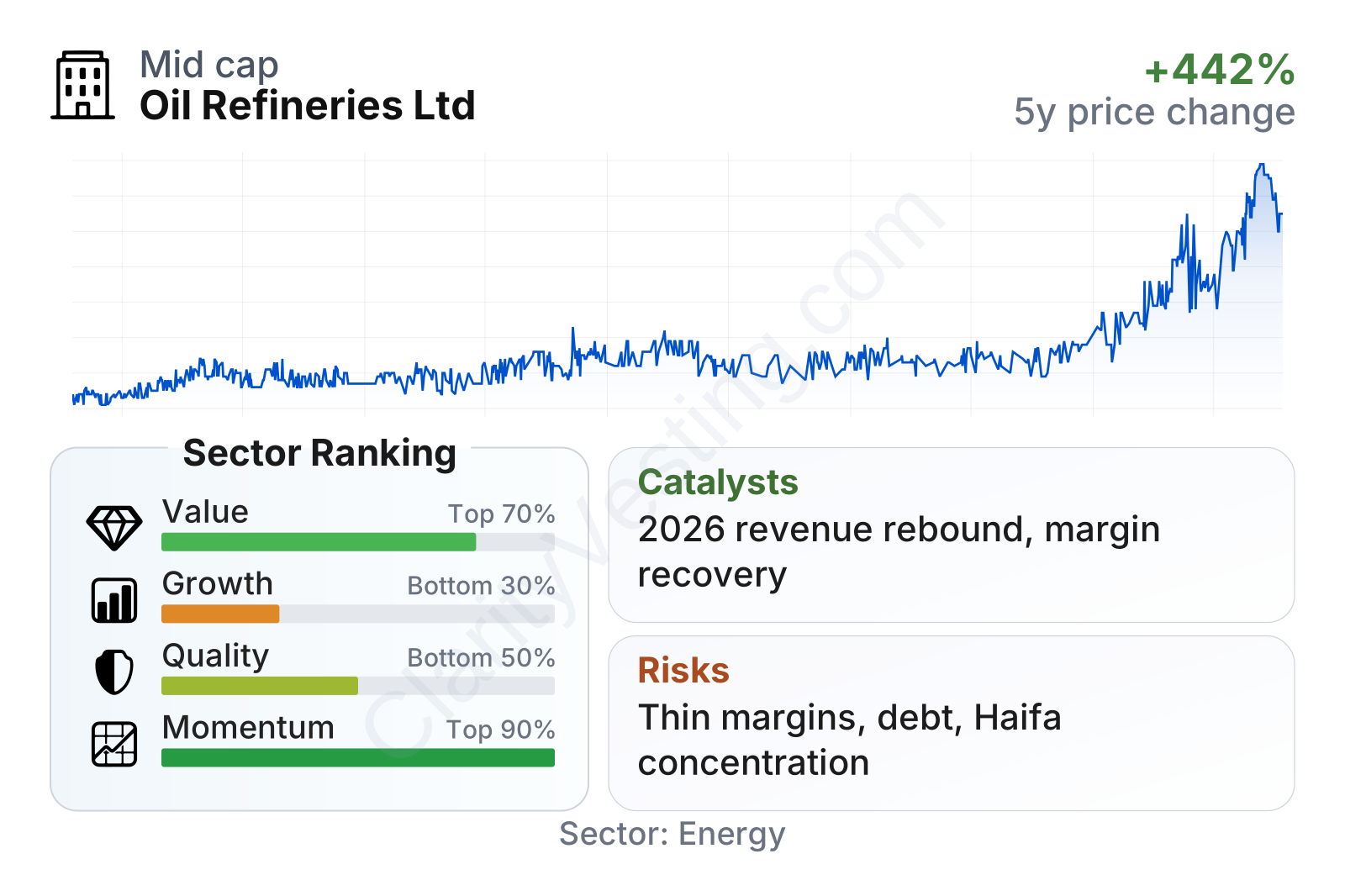
Oil Refineries is a mid-sized energy company with unusually strong recent share-price momentum, but the underlying fundamentals are more mixed. Valuation measures look inexpensive versus much of the sector, especially on earnings, book value, and operating value relative to enterprise value. At the same time, growth and quality indicators are less convincing: recent revenue rebounded sharply, yet the longer five-year picture for revenue per share, free cash flow, and dividends remains weak. Profitability and balance-sheet leverage are still acceptable for a refiner, but margins remain below sector norms.
The stock’s beta appears unusually low and even slightly negative in the latest reading, which is not a reliable sign of low business risk here. For a refiner, the real volatility tends to come from commodity spreads, regulation, and operational events rather than a smooth trading pattern alone.
Growth
Oil refining is not a classic high-growth sector, but it remains essential. Demand for liquid fuels is still supported by transportation, aviation, heavy industry, shipping, and national energy security needs. In many developed markets, environmental pressure has reduced investment in new refining capacity, which can support margins for existing assets when utilization is tight. That can create periods of strong earnings power for established operators even if long-term volume growth is modest.
For Oil Refineries, the growth case is less about opening a large new market and more about improving the value captured from existing assets. The company’s strategy makes the most sense when it focuses on operating efficiency, better product mix, reliability of the Haifa complex, and higher-value conversion into petrochemical chains. If management can improve throughput quality and reduce downtime, earnings can recover faster than revenue because refining businesses have high operating leverage.
Recent sales trends show just how cyclical the company is. After a long stretch of declining year-over-year revenue through 2023, 2024, and much of 2025, growth turned positive again in 2026, with a particularly sharp rebound by mid-year. That suggests market conditions improved materially, but it should not automatically be read as a durable structural trend. In refining, a strong rebound can come from better prices, stronger cracks, improved volumes, or easy comparisons after a weak period.
Cash generation also deserves attention. Free cash flow remains positive, which is important in a capital-intensive business, but it is well below the stronger levels seen earlier in the cycle. That means the company still has financial flexibility, though not the same cushion it had when industry conditions were more favorable. A sustained recovery in free cash flow would be one of the clearest signs that recent operational and market improvements are translating into stronger economics.
A practical catalyst is the company’s leverage to refining margins: even moderate improvement in industry conditions can have an outsized effect on profit because margins were compressed in the weaker period. Another positive factor is the company’s strategic domestic position in Israel, where local supply relevance can support utilization and commercial resilience. If the company also benefits from stronger petrochemical demand or better integration within the group structure, that can add to earnings recovery without requiring major top-line expansion.
Risks
This article is for informational purposes only and does not constitute financial advice. Some content is AI-generated. See Disclaimer


