Stock Analysis · Oicintra Inc (OICT)
Overview
Oicintra Inc. appears to be a very small operating business history wrapped inside a much larger public-market valuation. Based on its SEC filings and public company disclosures, it has been associated with mining and precious-metals-related activities, but recent reported operating results suggest that the company currently has little to no meaningful recurring commercial revenue. That makes it different from established mining companies that already produce metal at scale and generate sales from active mines.
For long-term readers, the main point is simple: this is not a mature cash-generating miner today. It looks more like a company whose value depends heavily on future development, corporate strategy, and market expectations rather than on a large, stable base of present-day business activity.
The latest available filings do not show a diversified revenue structure. Reported revenue has been minimal, and there is not enough evidence of a stable operating breakdown by product, geography, or business line. In practical terms, the revenue mix currently looks like this:
- Operating revenue: approximately 0% to a very low level of total economic value reflected by the market, with no clearly established recurring business segment in the latest public filings.
- Potential future value drivers: asset development, project execution, capital market access, and any transition toward commercial production or monetization of mining-related assets.
That profile matters because long-term outcomes will likely depend much more on whether the company can build or acquire productive assets than on optimizing an already functioning business model.
The longer financial pattern points to a company that has moved from large reported losses earlier in its public history to almost no reported operating activity more recently. That can sometimes indicate restructuring or a shell-like phase, but it also means current fundamentals offer limited evidence of a proven business engine.
Key Figures
| Metric | Value | Sector ⓘ |
|---|---|---|
| Date | Oct 17, 2026 | |
| Context | ||
| Sector | Basic Materials | |
| Industry | Other Precious Metals & Mining | |
| Market Cap ⓘ | $5.06B | |
| Beta ⓘ | -1.42 | |
Value (Cheapness) | ||
| P/E Ratio ⓘ | N/A | 16.90 |
| P/B Ratio ⓘ | N/A | 1.65 |
| FCF Yield ⓘ | N/A | 5.76% |
| Dividend Yield ⓘ | N/A | 2.13% |
| EBIT / EV ⓘ | N/A | 6.30% |
| PEG ⓘ | N/A | |
Growth (Business expansion) | ||
| Revenue Growth ⓘ | N/A | 11.10% |
| RPS Growth (5Y CAGR) ⓘ | N/A | 4.49% |
| EPS Growth (5Y CAGR) ⓘ | N/A | -13.47% |
| BVPS Growth (5Y CAGR) ⓘ | -87.49% | 5.51% |
| Margin Growth (5Y Trend) ⓘ | N/A | -1.54% |
| FCF Growth (5Y CAGR) ⓘ | N/A | 0.37% |
| DPS Growth (5Y CAGR) ⓘ | N/A | 6.08% |
Quality (Business durability) | ||
| ROIC (Latest) ⓘ | N/A | 9.26% |
| ROA (Latest) ⓘ | N/A | 4.91% |
| ROIC (5Y Median) ⓘ | N/A | 7.70% |
| ROA (5Y Median) ⓘ | -8.73% | 3.86% |
| Net Debt / EBIT (Latest) ⓘ | N/A | 1.40 |
| Net Debt / EBIT (5Y Median) ⓘ | N/A | 1.70 |
| Net Debt / EBITDA (Latest) ⓘ | N/A | 0.95 |
| Net Debt / Assets ⓘ | N/A | 13.69% |
| EBITDA / Interest ⓘ | N/A | 12.34 |
| Operating Margin (Latest) ⓘ | N/A | 13.20% |
| Operating Margin (5Y Median) ⓘ | N/A | 11.80% |
| Debt to Equity (Latest) ⓘ | N/A | 40.56% |
| Profit Margin (Latest) ⓘ | N/A | 6.43% |
| Free Cash Flow (Latest) ⓘ | N/A | |
Momentum (Price trend) | ||
| 3Y Return ⓘ | +125.20% | +68.89% |
| 12M Return (excl. last month) ⓘ | +11.94% | +30.21% |
| 6M Return ⓘ | +0.09% | -4.16% |
| Price vs. 200-Day MA ⓘ | -0.34% | -1.27% |
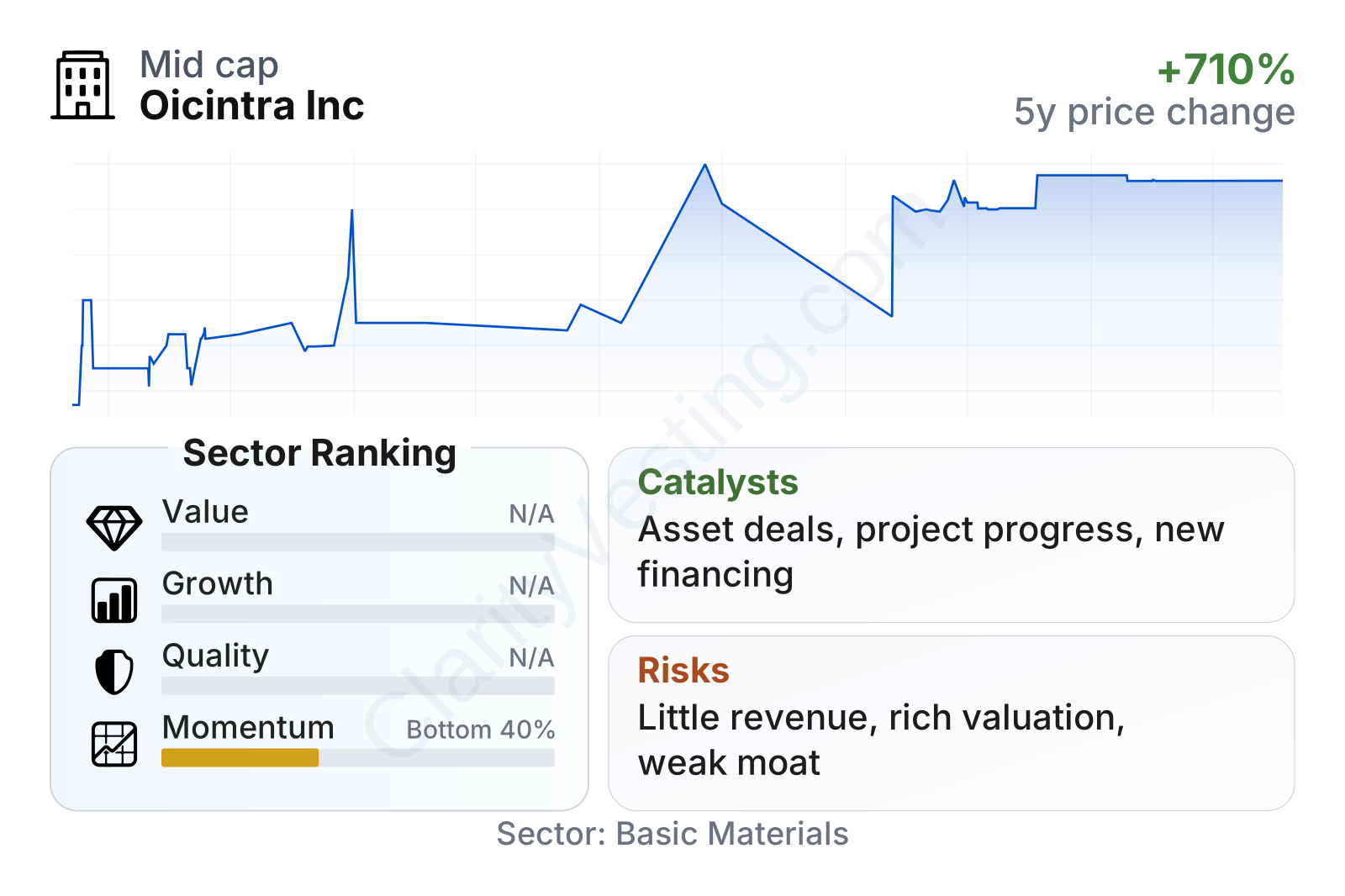
The stock has delivered a strong multiyear price gain from its 2021 level, but recent momentum has been weaker than the sector, and the share price has been roughly flat in the latest periods. In other words, the market has already assigned a much larger valuation than in prior years, yet recent trading no longer shows the same upward force.
The company’s size is now in the mid-cap range by market value, which stands out sharply against its limited reported operations. Several standard valuation measures are not very useful here because earnings appear negligible or absent, which is why ratios such as P/E and PEG do not provide a solid anchor. On quality and growth, the available metrics point to a weak operating base: profit margin is effectively 0%, revenue growth is not currently visible, and book value per share has contracted heavily over five years. Compared with the broader basic materials universe, this looks less like a functioning producer and more like a company valued on expectations.
Growth
The broader precious metals and mining sector can offer long-term support when gold and other metals remain strategically important. Demand drivers can include central bank buying, inflation hedging, geopolitical uncertainty, and the need for raw materials across industry. That said, being in a potentially attractive sector is not enough by itself. The key question is whether Oicintra can convert sector tailwinds into a real operating business.
At this stage, the company’s strategic logic would need to come from project development, acquisitions, joint ventures, or a restart of meaningful business activity. For a mining-related company without substantial current revenue, future growth typically depends on proving asset quality, securing permits, raising capital on acceptable terms, and eventually moving into production or monetization. If any of those steps are achieved, the upside in business scale can be dramatic because the starting revenue base is so low. The reverse is also true: delays or weak execution can leave the company with little fundamental progress.
A potentially important catalyst would be any verified update showing tangible operational progress: acquisition of credible mineral assets, reserve or resource advancement, financing tied to project development, or evidence of commercial production plans. Without that kind of milestone, growth remains more theoretical than demonstrated.
Recent market behavior suggests the company has already attracted attention, as shown by the strong share appreciation over several years. But the flattening in more recent periods implies the market may now be waiting for concrete proof rather than rewarding possibility alone.
Risks
This article is for informational purposes only and does not constitute financial advice. Some content is AI-generated. See Disclaimer


