Stock Analysis · Omega Healthcare Investors Inc (OHI)
Overview
Omega Healthcare Investors is a healthcare real estate investment trust, or REIT. In simple terms, it owns healthcare properties and earns rent from operators that run the facilities. The company is focused mainly on skilled nursing facilities and, to a smaller extent, senior housing properties. Its business model is based on collecting contractual rental income, interest income from real estate loans and financing arrangements, and occasional gains tied to property sales, restructurings, or operator transitions.
Omega’s portfolio is concentrated in long-term care real estate, a niche of healthcare property that depends heavily on aging demographics and government-supported reimbursement systems. Based on the company’s recent filings, revenue is primarily generated from the following sources:
- Rental income from skilled nursing facilities: the clear majority of revenue, supported by long-term leases with operators that manage nursing homes and post-acute care facilities.
- Rental income from senior housing and other healthcare properties: a smaller but still relevant share, including assisted living and related assets.
- Interest and other investment income: income from mortgage loans, direct financing leases, and similar arrangements with operators.
- Other property-related income: transition fees, lease restructurings, and asset sale activity when applicable.
The company does not disclose a simple consumer-style product mix, because its revenue comes from a property portfolio rather than product sales. What matters most is that the portfolio is heavily weighted toward skilled nursing, making Omega more specialized than many broader healthcare REITs.
Over the last few years, revenue has recovered after a weaker period in 2022 and has moved back above the $1 billion annual level. Operating income and net income also improved materially in the latest full-year view, suggesting that tenant conditions and rent collections have become more stable than they were during the industry stress that followed the pandemic.
The income flow highlights a business with very low direct property-level cost of revenue and strong underlying margins, which is typical for a landlord model. It also shows a meaningful interest burden, so financing discipline remains an important part of the investment case.
Key Figures
| Metric | Value | Sector ⓘ |
|---|---|---|
| Date | Oct 17, 2026 | |
| Context | ||
| Sector | Real Estate | |
| Industry | REIT - Healthcare Facilities | |
| Market Cap ⓘ | $14.40B | |
| Beta ⓘ | 0.53 | |
Value (Cheapness) | ||
| P/E Ratio ⓘ | 16.16 | 17.38 |
| P/B Ratio ⓘ | 2.80 | 0.85 |
| FCF Yield ⓘ | 6.27% | 7.38% |
| Dividend Yield ⓘ | 5.95% | 4.85% |
| EBIT / EV ⓘ | 6.22% | 3.78% |
| PEG ⓘ | 11.99 | |
Growth (Business expansion) | ||
| Revenue Growth ⓘ | 11.20% | 5.30% |
| RPS Growth (5Y CAGR) ⓘ | -2.97% | 6.02% |
| EPS Growth (5Y CAGR) ⓘ | -11.60% | -11.37% |
| BVPS Growth (5Y CAGR) ⓘ | -0.23% | 0.45% |
| Margin Growth (5Y Trend) ⓘ | 9.28% | -0.22% |
| FCF Growth (5Y CAGR) ⓘ | 8.80% | 5.40% |
| DPS Growth (5Y CAGR) ⓘ | -0.95% | 5.02% |
Quality (Business durability) | ||
| ROIC (Latest) ⓘ | 11.39% | 5.69% |
| ROE (Latest) ⓘ | 17.19% | 7.56% |
| ROA (Latest) ⓘ | 8.32% | 2.85% |
| ROIC (5Y Median) ⓘ | 7.10% | 4.22% |
| ROE (5Y Median) ⓘ | 11.03% | 6.03% |
| ROA (5Y Median) ⓘ | 4.36% | 2.44% |
| Net Debt / EBIT (Latest) ⓘ | 3.56 | 7.59 |
| Net Debt / EBIT (5Y Median) ⓘ | 7.45 | 8.40 |
| Net Debt / EBITDA (Latest) ⓘ | 2.75 | 5.27 |
| Net Debt / Assets ⓘ | 39.64% | 37.76% |
| EBITDA / Interest ⓘ | 6.97 | 4.10 |
| Operating Margin (Latest) ⓘ | 86.49% | 35.29% |
| Operating Margin (5Y Median) ⓘ | 61.22% | 37.31% |
| Debt to Equity (Latest) ⓘ | 74.55% | 88.87% |
| Profit Margin (Latest) ⓘ | 68.06% | 19.61% |
| Free Cash Flow (Latest) ⓘ | $903.33M | |
Momentum (Price trend) | ||
| 3Y Return ⓘ | +63.43% | +30.75% |
| 12M Return (excl. last month) ⓘ | +17.09% | +4.36% |
| 6M Return ⓘ | +0.40% | -2.52% |
| Price vs. 200-Day MA ⓘ | -0.40% | -2.34% |
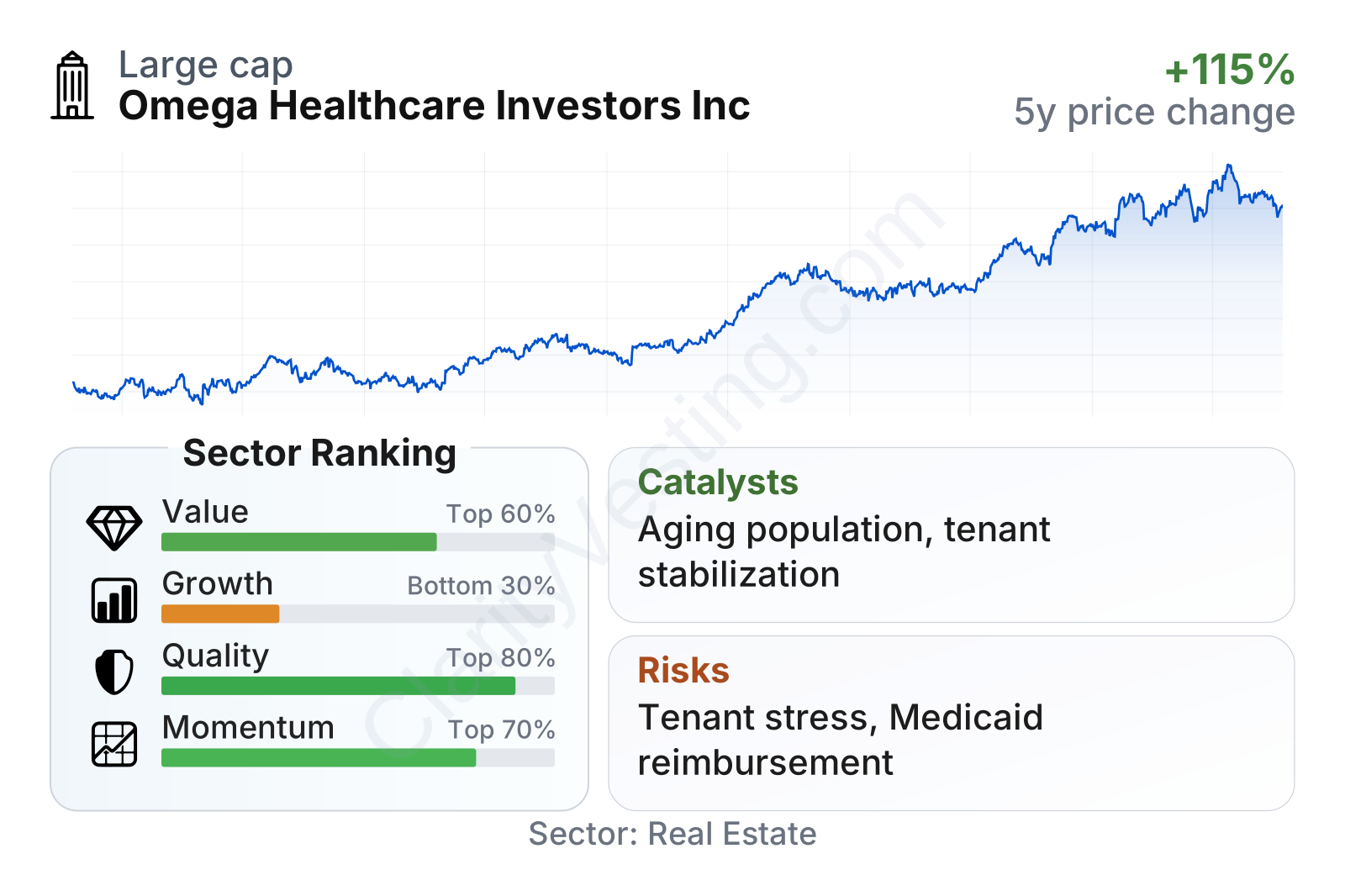
Omega is a large healthcare REIT with a market value in the mid-teens of billions of dollars and a relatively low beta, meaning its share price has historically been less volatile than the broader stock market. On valuation, earnings-based measures look close to the sector midpoint, but the stock trades at a much higher price-to-book multiple than the sector median. Quality is a stronger area: returns on capital, equity, and assets are well above typical sector levels, while leverage and interest coverage look better than many peers. Growth is the weaker category, not because recent revenue has been poor, but because the longer five-year record still reflects the difficult operating environment of earlier years. Price performance has been favorable versus much of the sector over one, three, and six years.
Growth
Omega operates in a part of healthcare tied to one of the clearest long-term demand trends in the economy: an aging population. Skilled nursing facilities and senior care properties should see structural demand support as the number of older adults rises over time. That does not guarantee smooth growth, but it does create a favorable backdrop for well-positioned owners of long-term care real estate.
The company’s strategy is fairly straightforward and logical for this industry. It aims to expand through selective acquisitions, operator financing, redevelopment, and portfolio transitions while keeping a specialized focus on skilled nursing. That specialization can be valuable because this segment has operational complexity, regulatory friction, and reimbursement exposure that discourage some less focused real estate owners. A specialized landlord with scale, operator relationships, and underwriting experience can have an advantage when assets need recapitalization or when weaker operators need to be replaced.
Revenue per share has been relatively stable in recent years after a noticeable drop from the 2021 level. That pattern suggests the business has been in a recovery and normalization phase rather than in a rapid expansion phase. Recent year-over-year growth looks healthy, but the longer trend still shows that Omega is rebuilding from a period of tenant stress rather than compounding at a high rate.
Dividend per share has edged down over the five-year period, which reflects the more cautious capital allocation needed after earlier pressure on tenant coverage and rent collections. Even so, the current dividend yield remains above the sector median, and the recent improvement in profitability and leverage gives the payout a firmer operating backdrop than it had during the tougher years.
One of the more important catalysts is operator stabilization. When tenant health improves, Omega can collect deferred obligations, re-lease troubled properties, and recycle capital into stronger relationships. Another useful catalyst is the financing environment: lower borrowing costs or improved credit access can support acquisition activity and make the REIT structure more attractive. In addition, the skilled nursing sector has been benefiting from improving occupancy and reimbursement support in recent years, which can strengthen tenants’ ability to pay rent.
Recent company updates have also pointed to continued investment activity and portfolio repositioning. For Omega, that matters because growth is often less about opening brand-new facilities and more about buying assets at attractive yields, funding operators, and improving the productivity of an existing portfolio through transitions.
Risks
This article is for informational purposes only and does not constitute financial advice. Some content is AI-generated. See Disclaimer


