Stock Analysis · One Gas Inc (OGS)
Overview
ONE Gas is a regulated natural gas utility. It distributes natural gas to residential, commercial, and industrial customers through local pipeline networks in Oklahoma, Kansas, and Texas. Unlike gas producers or exporters, the company does not depend on drilling results or commodity trading for its core business. Its role is closer to essential infrastructure: delivering gas safely, maintaining pipes, connecting new customers, and recovering approved costs through state-regulated rates.
The business is organized mainly by geography, and revenue is driven by customer bills in each service territory. Based on the company’s reporting structure and customer mix, the largest revenue sources are:
- Oklahoma natural gas distribution: approximately 35% to 40% of total revenue. This includes service to homes, businesses, and industrial users, plus transportation and fixed monthly charges.
- Kansas natural gas distribution: approximately 30% to 35% of total revenue. This is a large, mature service area with a broad residential base and rate-regulated returns.
- Texas natural gas distribution: approximately 25% to 30% of total revenue. This includes gas delivery operations in attractive Texas markets that can benefit from population growth.
- Other utility-related revenue: generally a low-single-digit share of total revenue. This can include service fees, reconnection charges, and similar non-core items.
For a regulated gas utility, reported revenue can move up and down with weather, customer usage, and the cost of purchased gas passed through to customers. That means revenue does not always reflect the real economic strength of the business. A more useful pattern here is that operating income and net income have held up better than total revenue over time, helped by rate relief and cost recovery mechanisms. Interest expense has also risen in recent years, which matters because utilities are capital-intensive and regularly use debt to fund infrastructure.
Key Figures
| Metric | Value | Sector ⓘ |
|---|---|---|
| Date | Oct 17, 2026 | |
| Context | ||
| Sector | Utilities | |
| Industry | Utilities - Regulated Gas | |
| Market Cap ⓘ | $4.69B | |
| Beta ⓘ | 0.63 | |
Value (Cheapness) | ||
| P/E Ratio ⓘ | 15.83 | 17.28 |
| P/B Ratio ⓘ | 1.32 | 1.51 |
| FCF Yield ⓘ | -3.69% | 0.65% |
| Dividend Yield ⓘ | 3.67% | 3.77% |
| EBIT / EV ⓘ | 5.98% | 5.01% |
| PEG ⓘ | 4.19 | |
Growth (Business expansion) | ||
| Revenue Growth ⓘ | -2.90% | 6.10% |
| RPS Growth (5Y CAGR) ⓘ | 4.46% | 3.87% |
| EPS Growth (5Y CAGR) ⓘ | -8.51% | -11.30% |
| BVPS Growth (5Y CAGR) ⓘ | 6.75% | 4.23% |
| Margin Growth (5Y Trend) ⓘ | 2.15% | 3.57% |
| FCF Growth (5Y CAGR) ⓘ | -49.86% | -8.84% |
| DPS Growth (5Y CAGR) ⓘ | 3.56% | 4.84% |
Quality (Business durability) | ||
| ROIC (Latest) ⓘ | 5.74% | 6.53% |
| ROA (Latest) ⓘ | 3.33% | 3.20% |
| ROIC (5Y Median) ⓘ | 5.71% | 5.95% |
| ROA (5Y Median) ⓘ | 2.86% | 2.75% |
| Net Debt / EBIT (Latest) ⓘ | 7.15 | 7.13 |
| Net Debt / EBIT (5Y Median) ⓘ | 8.05 | 7.23 |
| Net Debt / EBITDA (Latest) ⓘ | 4.32 | 4.31 |
| Net Debt / Assets ⓘ | 38.42% | 38.42% |
| EBITDA / Interest ⓘ | 5.79 | 4.58 |
| Operating Margin (Latest) ⓘ | 20.49% | 20.83% |
| Operating Margin (5Y Median) ⓘ | 16.98% | 20.08% |
| Debt to Equity (Latest) ⓘ | 95.92% | 137.69% |
| Profit Margin (Latest) ⓘ | 12.47% | 11.37% |
| Free Cash Flow (Latest) ⓘ | -$172.84M | |
Momentum (Price trend) | ||
| 3Y Return ⓘ | +19.69% | +52.37% |
| 12M Return (excl. last month) ⓘ | +5.35% | +8.84% |
| 6M Return ⓘ | -15.33% | -3.95% |
| Price vs. 200-Day MA ⓘ | -7.37% | -0.79% |
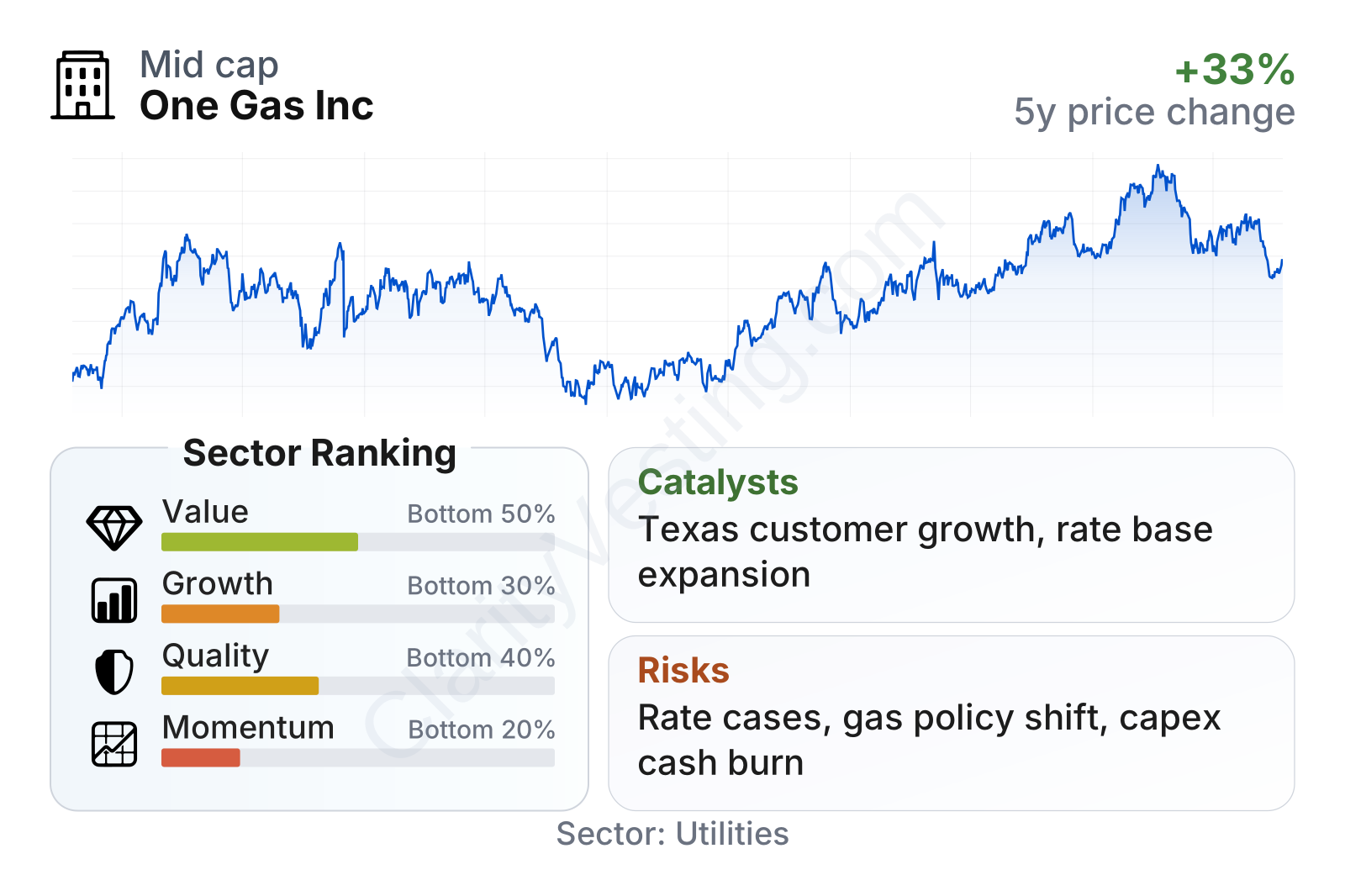
ONE Gas is a mid-sized utility with a relatively low stock volatility profile, as shown by its beta below 1. On valuation, the shares trade around the sector middle on earnings and book value, rather than at a clear premium. The weaker areas are growth and momentum: revenue has been soft recently, free cash flow is negative, and share-price performance has lagged much of the utility group over the last several measured periods. Quality is more mixed than weak, with profit margin roughly in line with the sector and interest coverage better than many peers, but returns on capital remain modest as expected for a regulated utility.
Growth
ONE Gas operates in a slow-growth sector, but not a stagnant one. Regulated gas utilities usually grow through a combination of customer additions, infrastructure replacement, safety upgrades, and rate base expansion. That tends to produce steadier growth than cyclical industries, though usually at a moderate pace. The long-term case depends less on rapid demand growth and more on whether the company can keep investing in its network and earn authorized returns on that investment.
A practical advantage for ONE Gas is its footprint. Oklahoma and Kansas are stable utility markets, while Texas offers exposure to stronger demographic trends. Population growth, housing development, and business activity can support new customer connections and system expansion. The company’s strategy also fits the industry: modernize pipes, improve reliability and safety, and seek regulatory approval to recover those investments over time.
Revenue per share has increased over a five-year view, even though the path has been uneven. That pattern is typical for a gas utility because weather and commodity pass-through can distort annual revenue. What matters more is whether the underlying customer base, rate base, and allowed returns continue moving upward. In that respect, the company’s multi-year revenue-per-share trend is better than the recent year-over-year slowdown suggests.
Free cash flow is the main growth tension. It has been negative lately, which is common when utilities are in a heavy investment cycle. That does not automatically signal weakness, because capital spending on pipes and system integrity is part of how regulated utilities grow earnings over time. Still, it means growth is currently being funded more by external capital and less by internally generated cash after investment.
Recent company updates in 2026 have continued to center on capital investment, rate activity, and operational execution rather than a transformative event. That is normal for this industry. The most meaningful catalyst is not a single headline but the steady conversion of infrastructure spending into future regulated earnings, especially if Texas customer growth remains favorable and rate cases continue to support recovery of invested capital.
Risks
This article is for informational purposes only and does not constitute financial advice. Some content is AI-generated. See Disclaimer


