Stock Analysis · Organon & Co (OGN)
Overview
Organon & Co is a global pharmaceutical company focused on women’s health, established brands, and biosimilars. It was created in 2021 as a spin-off from Merck & Co. The business model is relatively straightforward: it sells prescription medicines and related products through a portfolio that mixes mature cash-generating brands with areas where management is trying to build future growth, especially women’s health.
Its revenue base is diversified across three main segments. Based on recent company reporting, the revenue mix is approximately:
- Established Brands: about 75% — older prescription medicines across areas such as cardiovascular, respiratory, dermatology, and non-opioid pain management. These products are typically well known and broadly distributed, but many face pricing pressure and generic competition over time.
- Women’s Health: about 20% — contraception, fertility, and other women’s health treatments. This includes products such as Nexplanon as well as fertility offerings, making this the company’s most strategically important growth platform.
- Biosimilars: about 5% — lower-cost versions of biologic medicines marketed in partnership arrangements. This is still the smallest business line, but it gives Organon exposure to a category expected to expand as healthcare systems look for more affordable biologic treatments.
Geographically, Organon sells globally, with a meaningful share outside the United States. That international footprint helps reduce dependence on a single market, but it also adds currency and regional pricing exposure.
The earnings flow over the past few years shows a business that still produces substantial gross profit, but with pressure building lower down the income statement. Revenue has stayed near the same broad level since the spin-off, while interest expense has remained high and net income has become much thinner. That pattern matters because it means the company still has operating scale, but less room for error than it had earlier after becoming independent.
Key Figures
| Metric | Value | Sector ⓘ |
|---|---|---|
| Date | Oct 24, 2026 | |
| Context | ||
| Sector | Healthcare | |
| Industry | Drug Manufacturers - General | |
| Market Cap ⓘ | $3.61B | |
| Beta ⓘ | 1.54 | |
Value (Cheapness) | ||
| P/E Ratio ⓘ | 17.63 | 25.42 |
| P/B Ratio ⓘ | 3.70 | 3.08 |
| FCF Yield ⓘ | 13.79% | 3.12% |
| Dividend Yield ⓘ | 0.58% | 1.85% |
| EBIT / EV ⓘ | 8.70% | 0.56% |
| PEG ⓘ | N/A | |
Growth (Business expansion) | ||
| Revenue Growth ⓘ | -2.30% | 7.50% |
| RPS Growth (5Y CAGR) ⓘ | -1.05% | 8.60% |
| EPS Growth (5Y CAGR) ⓘ | -27.46% | -17.73% |
| BVPS Growth (5Y CAGR) ⓘ | N/A | 3.72% |
| Margin Growth (5Y Trend) ⓘ | -13.40% | -0.57% |
| FCF Growth (5Y CAGR) ⓘ | -27.71% | 0.96% |
| DPS Growth (5Y CAGR) ⓘ | -12.35% | 6.69% |
Quality (Business durability) | ||
| ROIC (Latest) ⓘ | 6.47% | 3.17% |
| ROA (Latest) ⓘ | 1.56% | 2.98% |
| ROIC (5Y Median) ⓘ | 16.13% | 4.56% |
| ROA (5Y Median) ⓘ | 8.48% | 1.87% |
| Net Debt / EBIT (Latest) ⓘ | 7.74 | 1.34 |
| Net Debt / EBIT (5Y Median) ⓘ | 6.30 | 1.86 |
| Net Debt / EBITDA (Latest) ⓘ | 5.65 | 1.00 |
| Net Debt / Assets ⓘ | 56.31% | 5.06% |
| EBITDA / Interest ⓘ | 2.81 | 9.55 |
| Operating Margin (Latest) ⓘ | 15.65% | 9.25% |
| Operating Margin (5Y Median) ⓘ | 20.72% | 7.33% |
| Debt to Equity (Latest) ⓘ | 850.20% | 26.68% |
| Profit Margin (Latest) ⓘ | 3.41% | 3.34% |
| Free Cash Flow (Latest) ⓘ | $498.00M | |
Momentum (Price trend) | ||
| 3Y Return ⓘ | -0.24% | +51.61% |
| 12M Return (excl. last month) ⓘ | +30.67% | +19.90% |
| 6M Return ⓘ | +50.88% | +10.10% |
| Price vs. 200-Day MA ⓘ | +21.34% | +6.44% |
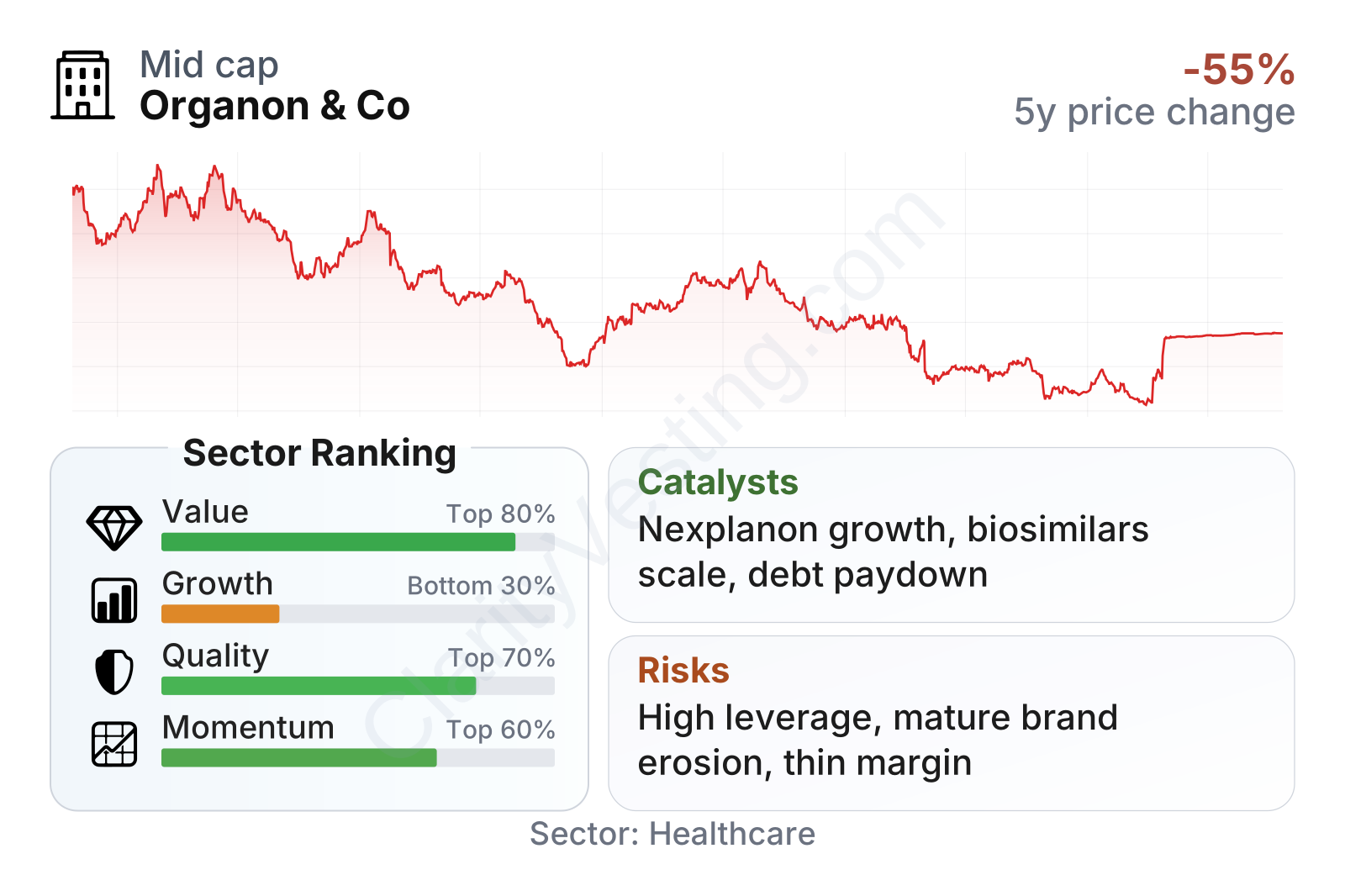
Organon is a mid-sized healthcare company with a stock that has been volatile, reflected in a beta above 1.5. The market-based factors are mixed: valuation measures look inexpensive versus much of the healthcare sector, and cash generation remains notable relative to its market value. At the same time, growth metrics rank weakly against peers, while quality is held back by leverage even though operating returns and margins are still better than many sector companies. Price momentum has improved recently, but that follows a long period of stock weakness rather than a long-established uptrend.
Growth
Organon operates in healthcare, which is structurally supported by aging populations, ongoing medicine demand, and continued pressure on health systems to balance innovation with affordability. Within that broad sector, its most attractive exposure is women’s health, where long-acting contraception, fertility treatment, and related care remain important medical categories with durable demand. Biosimilars also sit in a favorable long-term niche because payers and governments want lower-cost alternatives to expensive biologic drugs.
The challenge is that Organon’s current revenue base is still dominated by established brands, a category that tends to be stable rather than fast growing. That explains why the company’s recent growth record has been uneven. Quarterly year-over-year revenue changes have moved around low single-digit gains and declines, and the latest readings remain negative. This does not point to a business in broad expansion yet; it points to one trying to offset erosion in mature products with targeted growth platforms.
Management’s strategy makes industrial sense. Organon uses the cash flow from mature medicines to support debt reduction, business development, and investment in women’s health and biosimilars. In principle, that is a rational structure for a spin-off with a legacy portfolio: maximize the value of established brands while gradually shifting the mix toward categories with better long-term demand.
A key support for that strategy is cash generation. Free cash flow has fallen sharply from the very high levels seen soon after the spin-off, but it has recently stabilized in the several-hundred-million-dollar range on a trailing basis. That still provides meaningful financial flexibility compared with the company’s equity value, even if it is no longer a standout cash machine on the same scale as before.
The most important growth catalyst is execution in women’s health, especially around Nexplanon and the broader fertility portfolio, along with any portfolio expansion through licensing or acquisitions. Another potential catalyst is stronger commercialization of biosimilars, where even a small revenue base can produce noticeable percentage growth. In 2026, company communications and filings have continued to emphasize portfolio management, productivity, and capital allocation discipline rather than a single transformative product launch, so the opportunity appears more cumulative than sudden.
Risks
This article is for informational purposes only and does not constitute financial advice. Some content is AI-generated. See Disclaimer


