Stock Analysis · OFG Bancorp (OFG)
Overview
OFG Bancorp is a regional bank holding company based in Puerto Rico. Through Oriental Bank, it provides everyday banking services to consumers, businesses, and commercial clients. Its activities include taking deposits, making loans, processing payments, managing wealth, and offering insurance and treasury services. In simple terms, OFG makes money largely by gathering deposits at one cost and lending or investing those funds at a higher return, while also collecting fees from financial services.
The company’s revenue mix is still dominated by traditional banking income. Based on recent annual results, the main sources of revenue can be outlined approximately as follows:
- Net interest income: about 75% to 80% of total revenue. This is the spread between interest earned on loans and investment securities and interest paid on deposits and borrowings.
- Service charges and fees on deposit accounts: about 6% to 8%. This includes account-related charges and transaction fees.
- Mortgage banking and servicing activities: about 4% to 6%. This includes gains on mortgage production and servicing-related income.
- Wealth management, brokerage, and trust services: about 3% to 5%. These are recurring fees tied to client assets and advisory services.
- Insurance commissions and other financial service fees: about 2% to 4%. This comes from insurance products and related client services.
- Other income: about 5% to 8%. This can include treasury-related activity, card income, and various banking fees.
That structure matters because it shows OFG is primarily a spread-based bank rather than a fee-heavy financial platform. The upside is that strong lending and deposit discipline can produce solid profitability. The tradeoff is that earnings remain sensitive to interest rates, credit quality, and the economic health of Puerto Rico and nearby markets. Over the last several years, total revenue and net income have both moved higher, although funding costs have also risen as interest expense increased meaningfully.
The long-term pattern points to a bank that has expanded revenue steadily since 2021 and converted a good share of that growth into profit, even as deposit and funding costs became more expensive.
Key Figures
| Metric | Value | Sector ⓘ |
|---|---|---|
| Date | Oct 17, 2026 | |
| Context | ||
| Sector | Financial Services | |
| Industry | Banks - Regional | |
| Market Cap ⓘ | $2.15B | |
| Beta ⓘ | 0.74 | |
Value (Cheapness) | ||
| P/E Ratio ⓘ | 10.04 | 12.26 |
| P/B Ratio ⓘ | 1.57 | 1.23 |
| FCF Yield ⓘ | 9.42% | 10.40% |
| Dividend Yield ⓘ | 2.56% | 3.02% |
| EBIT / EV ⓘ | 14.31% | 8.14% |
| PEG ⓘ | 0.92 | |
Growth (Business expansion) | ||
| Revenue Growth ⓘ | 10.40% | 9.35% |
| RPS Growth (5Y CAGR) ⓘ | 14.78% | 12.19% |
| EPS Growth (5Y CAGR) ⓘ | -6.87% | -9.53% |
| BVPS Growth (5Y CAGR) ⓘ | 8.97% | 4.99% |
| Margin Growth (5Y Trend) ⓘ | -8.97% | -3.86% |
| FCF Growth (5Y CAGR) ⓘ | 26.85% | 4.81% |
| DPS Growth (5Y CAGR) ⓘ | 27.98% | 8.79% |
Quality (Business durability) | ||
| ROIC (Latest) ⓘ | 14.01% | 9.49% |
| ROE (Latest) ⓘ | 15.84% | 13.90% |
| ROA (Latest) ⓘ | 1.81% | 1.55% |
| ROIC (5Y Median) ⓘ | 13.60% | 7.86% |
| ROE (5Y Median) ⓘ | 15.75% | 12.17% |
| ROA (5Y Median) ⓘ | 1.71% | 1.30% |
| Net Debt / EBIT (Latest) ⓘ | -0.59 | 0.96 |
| Net Debt / EBIT (5Y Median) ⓘ | -1.98 | 0.73 |
| Net Debt / EBITDA (Latest) ⓘ | -0.54 | 0.92 |
| Operating Margin (Latest) ⓘ | 31.46% | 22.30% |
| Operating Margin (5Y Median) ⓘ | 36.33% | 24.63% |
| Debt to Equity (Latest) ⓘ | 41.07% | 58.56% |
| Profit Margin (Latest) ⓘ | 33.85% | 26.57% |
| Free Cash Flow (Latest) ⓘ | $202.66M | |
Momentum (Price trend) | ||
| 3Y Return ⓘ | +85.35% | +88.33% |
| 12M Return (excl. last month) ⓘ | +25.07% | +19.38% |
| 6M Return ⓘ | +24.58% | +4.75% |
| Price vs. 200-Day MA ⓘ | +14.27% | +3.50% |
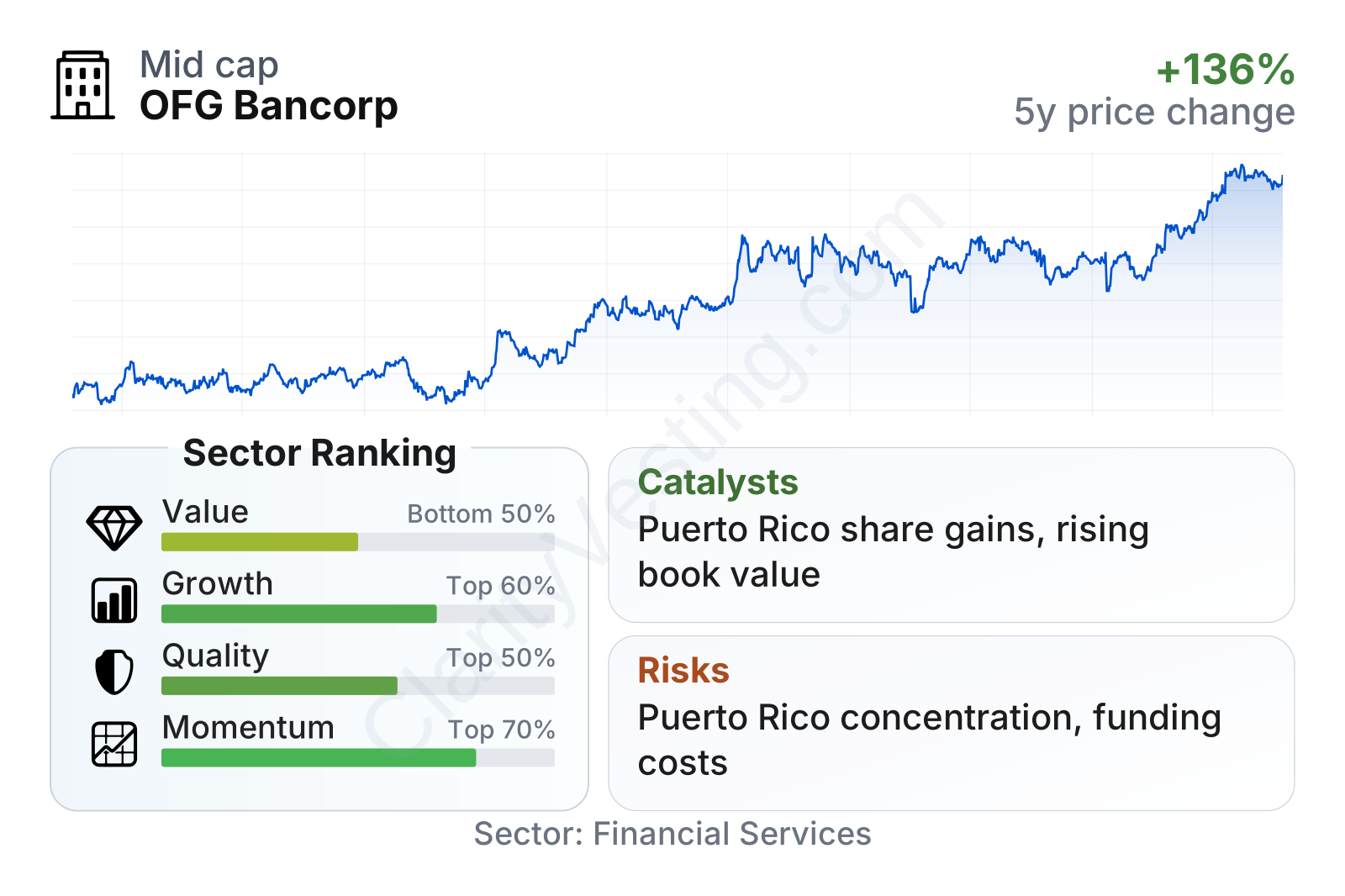
OFG sits in the regional banking space as a mid-sized institution with a relatively low beta, meaning its share price has historically moved less violently than many stocks. The broad picture from the current metrics is mixed but generally constructive: profitability and balance-sheet quality look better than many sector peers, growth ranks somewhat above average, and recent price momentum has been strong. On valuation, the picture is less one-sided. The earnings multiple is below the sector median, but the price-to-book ratio is above the sector median, suggesting the market is willing to pay a premium for the company’s profitability and operating consistency.
The stock’s longer-term price path also shows that the market has re-rated the bank upward since 2023. That usually happens when investors see improving earnings power, stronger returns on equity, and fewer concerns about balance-sheet weakness.
Growth
OFG operates in a mature sector, so its growth opportunity is not about disrupting banking from scratch. Instead, it comes from taking market share, expanding relationships with existing clients, and improving the profitability of each dollar of assets and deposits. In Puerto Rico, banking has become more concentrated over time, which can help disciplined operators strengthen their competitive position. That backdrop can support growth if OFG continues to execute well on loans, deposits, and cross-selling of services such as wealth management and insurance.
The recent operating record suggests the strategy has been working. Revenue has climbed at a solid pace over the last several years, and book value per share has also advanced steadily. That matters for a bank because book value is a simple way to track the growth of shareholder capital over time. The company has also increased dividends over the last five years at a pace well above the sector median, which usually signals confidence in earnings durability and capital strength.
Earnings per share have shown a clear upward trend from 2021 through 2025. Even without assuming rapid future expansion, that pattern suggests OFG has been able to convert balance-sheet growth and pricing discipline into rising profit per share.
Book value per share has also moved higher year after year, reinforcing the idea that growth has not come only from short-term rate benefits but also from retained earnings and capital accumulation.
A notable catalyst is the company’s ability to keep producing above-average returns while still growing. In banking, high returns with stable credit quality can become self-reinforcing: stronger profits support capital, capital supports lending capacity, and lending capacity supports future income. Another positive factor is that Puerto Rico’s economy has seen periods of investment tied to reconstruction, infrastructure funding, and business activity, which can support demand for loans, deposits, and treasury services. If management continues to deepen customer relationships rather than relying only on balance-sheet expansion, growth could remain more durable.
Risks
This article is for informational purposes only and does not constitute financial advice. Some content is AI-generated. See Disclaimer


