Stock Analysis · OC Oerlikon Corporation AG (OERLF)
Overview
OC Oerlikon Corporation AG is a Swiss industrial technology company focused on advanced materials, surface engineering, and manmade fiber equipment. In simple terms, it helps other manufacturers make parts last longer, perform better, or produce specialized materials more efficiently. Its products and services are used in industries such as automotive, aerospace, energy, tooling, textiles, and filtration.
After the separation of its former polymer processing activities, Oerlikon is more concentrated than it used to be. The company now centers on two main businesses: surface solutions and manmade fibers. Surface solutions includes coatings, materials, equipment, and services that improve wear resistance, heat resistance, and overall component performance. Manmade fibers provides machinery and systems used to produce synthetic fibers, which are widely used in apparel, carpets, industrial textiles, and technical applications.
Based on the latest annual reporting structure, revenue is mainly generated from the following sources:
- Surface Solutions: approximately 65% to 75% of revenue. This segment includes coating services, coating materials, equipment, and related aftermarket activities for industrial components and tools.
- Manmade Fibers: approximately 25% to 35% of revenue. This business supplies equipment and technologies for filament, staple fiber, and nonwoven production lines.
This mix matters for long-term analysis. Surface Solutions tends to be the steadier business because it benefits from recurring service demand and broad industrial exposure, while Manmade Fibers is usually more cyclical because customers place larger capital equipment orders that can move sharply with industry conditions.
The multi-year income flow shows a company that became smaller after portfolio changes, but also one whose profitability came under pressure. Revenue has fallen from the high-$2 billion range a few years ago to the mid-$1 billion range more recently, and operating profit narrowed much faster than sales. That suggests Oerlikon is still in the middle of a restructuring and repositioning phase rather than a stable earnings expansion period.
Key Figures
| Metric | Value | Sector ⓘ |
|---|---|---|
| Date | Oct 24, 2026 | |
| Context | ||
| Sector | Industrials | |
| Industry | Specialty Industrial Machinery | |
| Market Cap ⓘ | $2.32B | |
| Beta ⓘ | 0.99 | |
Value (Cheapness) | ||
| P/E Ratio ⓘ | 63.64 | 22.29 |
| P/B Ratio ⓘ | 1.93 | 1.98 |
| FCF Yield ⓘ | N/A | 6.26% |
| Dividend Yield ⓘ | 2.86% | 1.92% |
| EBIT / EV ⓘ | 4.08% | 4.83% |
| PEG ⓘ | 0.41 | |
Growth (Business expansion) | ||
| Revenue Growth ⓘ | 0.50% | 9.30% |
| RPS Growth (5Y CAGR) ⓘ | -12.27% | 7.76% |
| EPS Growth (5Y CAGR) ⓘ | -14.01% | -13.17% |
| BVPS Growth (5Y CAGR) ⓘ | -11.22% | 6.13% |
| Margin Growth (5Y Trend) ⓘ | -6.42% | 0.74% |
| FCF Growth (5Y CAGR) ⓘ | -14.32% | 10.79% |
| DPS Growth (5Y CAGR) ⓘ | -13.09% | 9.41% |
Quality (Business durability) | ||
| ROIC (Latest) ⓘ | N/A | 10.75% |
| ROA (Latest) ⓘ | N/A | 5.41% |
| ROIC (5Y Median) ⓘ | 3.64% | 9.37% |
| ROA (5Y Median) ⓘ | 1.63% | 4.95% |
| Net Debt / EBIT (Latest) ⓘ | N/A | 2.04 |
| Net Debt / EBIT (5Y Median) ⓘ | 8.04 | 2.27 |
| Net Debt / EBITDA (Latest) ⓘ | N/A | 1.39 |
| Net Debt / Assets ⓘ | 19.40% | 19.27% |
| EBITDA / Interest ⓘ | N/A | 9.58 |
| Operating Margin (Latest) ⓘ | N/A | 10.49% |
| Operating Margin (5Y Median) ⓘ | 4.92% | 10.30% |
| Debt to Equity (Latest) ⓘ | N/A | 64.82% |
| Profit Margin (Latest) ⓘ | 21.44% | 6.67% |
| Free Cash Flow (Latest) ⓘ | N/A | |
Momentum (Price trend) | ||
| 3Y Return ⓘ | +85.26% | +67.77% |
| 12M Return (excl. last month) ⓘ | +64.08% | +12.05% |
| 6M Return ⓘ | +35.40% | 0.00% |
| Price vs. 200-Day MA ⓘ | +34.25% | +0.67% |
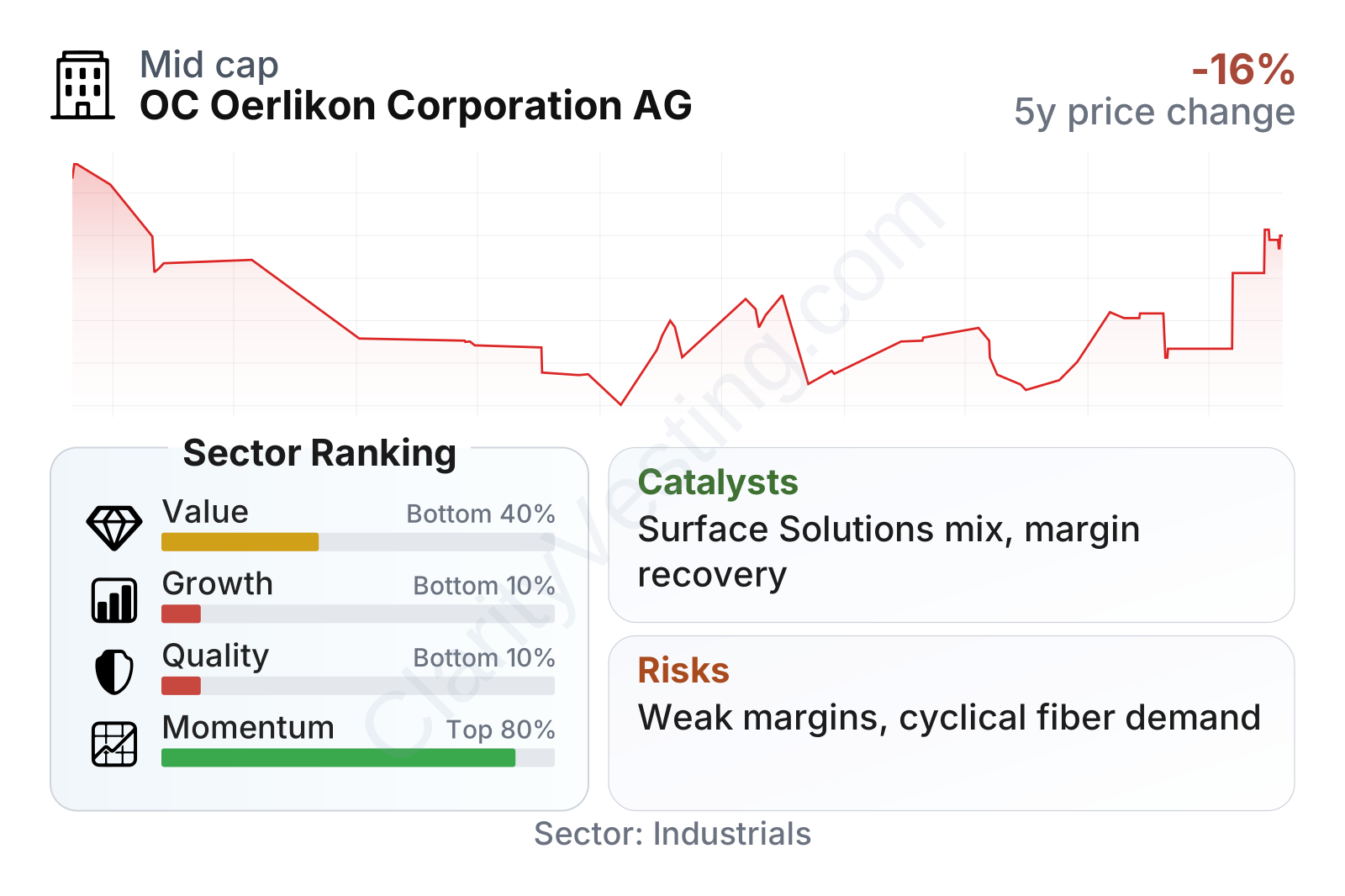
Oerlikon is a mid-sized industrial company with share-price volatility close to the broader market. The recent market trend has been strong, with the stock outperforming much of its industrial peer group over the last 6 to 12 months and trading well above its long-term average level. That price strength stands in contrast to weaker underlying business quality and growth rankings.
The valuation picture is mixed. The dividend yield is above the sector median, and the price-to-book ratio is around the sector norm, but the earnings multiple is much higher than the typical industrial peer. That usually means the market is looking past depressed current earnings and expecting a recovery. At the same time, growth and quality metrics are weak relative to the sector: long-term revenue, free cash flow, margins, and book value trends all rank near the bottom of the comparison group.
Profitability also needs careful interpretation. The headline profit margin appears unusually high for an industrial company, but that does not line up with the weak operating margin and elevated earnings multiple, which suggests non-operating items may be affecting net income. For long-term analysis, operating profit and cash generation give a clearer picture, and both have been under pressure.
Growth
Oerlikon operates in areas that have real long-term industrial relevance, even if near-term growth has been uneven. Surface engineering benefits from durable trends: manufacturers want longer-lasting components, greater energy efficiency, reduced material waste, and lower maintenance costs. Those needs are supported by stricter performance requirements in aerospace, automotive, tooling, and energy applications. In many cases, coatings are a small cost relative to the value they protect, which can make demand more resilient than for large capital equipment.
The Manmade Fibers business also has structural opportunities, although it is less predictable. Synthetic fibers remain essential in global textiles and technical materials, while nonwovens are used in hygiene, filtration, and medical applications. Demand here can rise with population growth, industrialization, and manufacturing upgrades, but order timing can be lumpy because customers often invest in large projects rather than steady replacement cycles.
Strategically, Oerlikon’s sharper focus after simplifying its portfolio makes industrial sense. A more concentrated company can direct capital, research spending, and management attention toward businesses where it has technical depth. The challenge is that focus alone does not create growth; it must translate into stronger margins, recurring service sales, and better returns on invested capital.
A meaningful catalyst is execution in Surface Solutions. If management can expand higher-value coatings, materials, and aftermarket services, that could improve earnings quality because these activities are typically less cyclical than new equipment orders. Another potential catalyst is recovery in industrial production, especially in end markets where component performance and maintenance cycles matter.
Recent company updates have also emphasized portfolio streamlining, operational discipline, and efforts to improve profitability after a difficult earnings period. For a business with weak recent operating income, even moderate margin recovery could have a noticeable effect on earnings because the current base is low.
Risks
This article is for informational purposes only and does not constitute financial advice. Some content is AI-generated. See Disclaimer


