Stock Analysis · Old Dominion Freight Line Inc (ODFL)
Overview
Old Dominion Freight Line is a U.S. transportation company focused on less-than-truckload shipping, usually called LTL. In simple terms, LTL combines freight from many customers into one network so trailers are not moving with just one shipper’s goods. This is useful for businesses that need to move palletized freight that is too large for parcel delivery but not enough to fill a full truck. Old Dominion runs this service through a large network of service centers, tractors, and trailers across the United States, while also offering related transportation and logistics services.
The business is much more specialized than a broad logistics company. Old Dominion’s model is built around premium service, on-time delivery, low cargo claims, and tight control of its own network. That matters in LTL because reliability often helps carriers keep better pricing and stronger customer loyalty than operators competing mostly on low rates.
Revenue is heavily concentrated in freight transportation, with only a small share coming from adjacent services. Based on company reporting, the mix is approximately:
- LTL services: about 98% to 99% of revenue. This includes domestic less-than-truckload shipments moved through Old Dominion’s owned network.
- Other services: about 1% to 2% of revenue. This mainly includes truckload brokerage and other value-added transportation offerings.
That concentration is important for long-term analysis: Old Dominion is not a diversified industrial group. It is essentially a focused bet on the quality and economics of the U.S. LTL freight market.
The company’s financial structure also shows a business that converts a large share of revenue into operating profit compared with most transportation peers, although revenue has moved down from the 2022 peak as the freight cycle softened. Even so, margins have remained unusually strong for the industry.
Over the past several years, revenue climbed sharply into the 2022 freight boom and then eased as demand normalized. What stands out more than the revenue pullback is that profitability stayed high, which suggests pricing discipline and efficient operations rather than a business that depends only on favorable market conditions.
Key Figures
| Metric | Value | Sector ⓘ |
|---|---|---|
| Date | Oct 24, 2026 | |
| Context | ||
| Sector | Industrials | |
| Industry | Trucking | |
| Market Cap ⓘ | $39.17B | |
| Beta ⓘ | 1.20 | |
Value (Cheapness) | ||
| P/E Ratio ⓘ | 36.22 | 22.29 |
| P/B Ratio ⓘ | 8.67 | 1.98 |
| FCF Yield ⓘ | 2.85% | 6.26% |
| Dividend Yield ⓘ | 0.61% | 1.92% |
| EBIT / EV ⓘ | 3.96% | 4.83% |
| PEG ⓘ | 2.16 | |
Growth (Business expansion) | ||
| Revenue Growth ⓘ | 10.40% | 9.30% |
| RPS Growth (5Y CAGR) ⓘ | 3.78% | 7.76% |
| EPS Growth (5Y CAGR) ⓘ | -18.57% | -13.17% |
| BVPS Growth (5Y CAGR) ⓘ | 6.97% | 6.13% |
| Margin Growth (5Y Trend) ⓘ | -1.70% | 0.74% |
| FCF Growth (5Y CAGR) ⓘ | 9.57% | 10.79% |
| DPS Growth (5Y CAGR) ⓘ | 18.07% | 9.41% |
Quality (Business durability) | ||
| ROIC (Latest) ⓘ | 24.55% | 10.75% |
| ROA (Latest) ⓘ | 19.36% | 5.41% |
| ROIC (5Y Median) ⓘ | 55.88% | 9.37% |
| ROA (5Y Median) ⓘ | 21.56% | 4.95% |
| Net Debt / EBIT (Latest) ⓘ | -0.18 | 2.04 |
| Net Debt / EBIT (5Y Median) ⓘ | -0.05 | 2.27 |
| Net Debt / EBITDA (Latest) ⓘ | -0.15 | 1.39 |
| Net Debt / Assets ⓘ | -4.60% | 19.27% |
| EBITDA / Interest ⓘ | 2,739.34 | 9.58 |
| Operating Margin (Latest) ⓘ | 25.83% | 10.49% |
| Operating Margin (5Y Median) ⓘ | 26.79% | 10.30% |
| Debt to Equity (Latest) ⓘ | 0.44% | 64.82% |
| Profit Margin (Latest) ⓘ | 19.44% | 6.67% |
| Free Cash Flow (Latest) ⓘ | $1.11B | |
Momentum (Price trend) | ||
| 3Y Return ⓘ | -2.17% | +67.77% |
| 12M Return (excl. last month) ⓘ | +25.28% | +12.05% |
| 6M Return ⓘ | -15.59% | 0.00% |
| Price vs. 200-Day MA ⓘ | -6.01% | +0.67% |
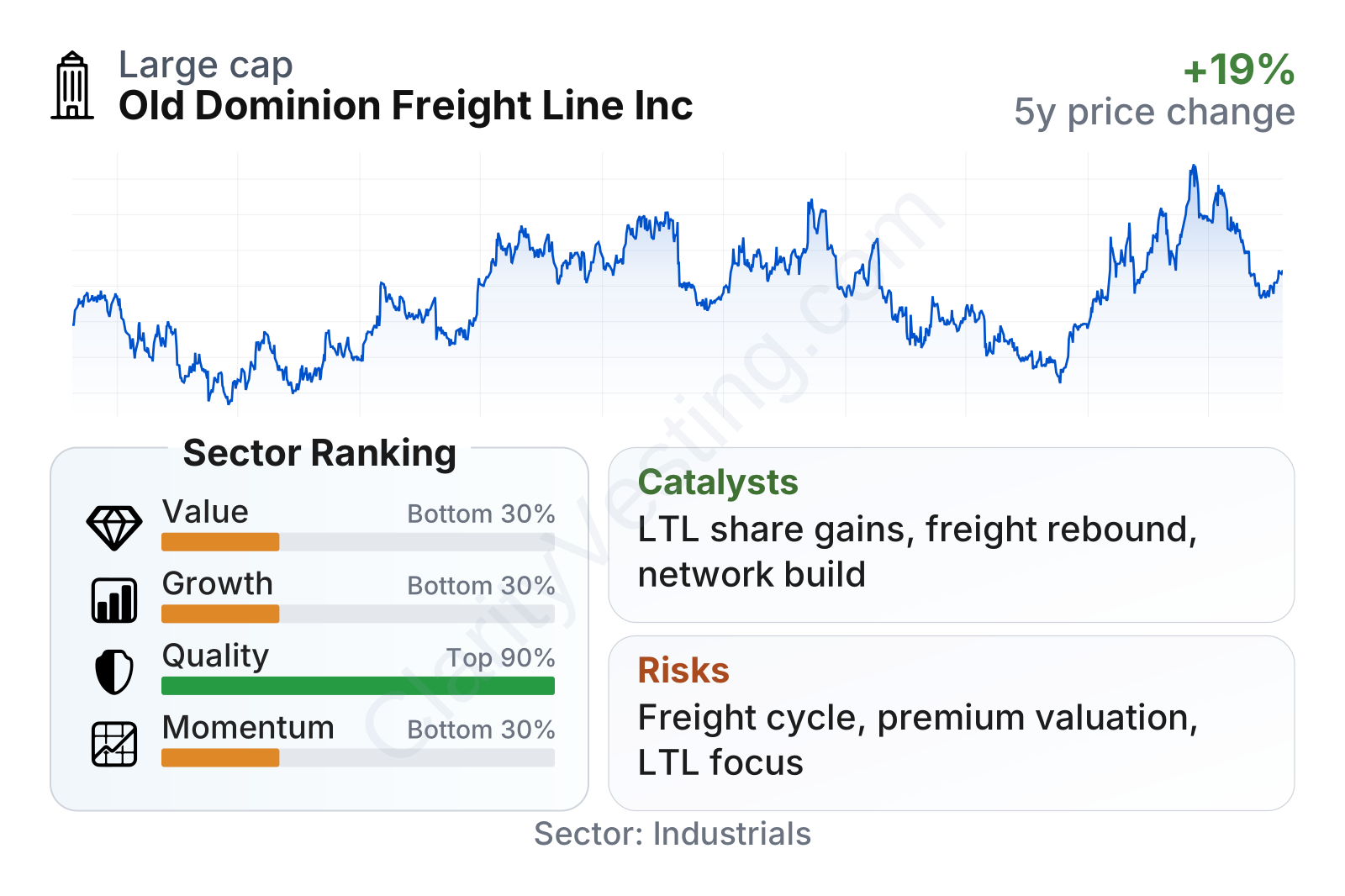
Old Dominion is a large transportation company with moderate share-price volatility for an industrial stock. The most striking feature in the metrics table is the contrast between excellent business quality and a demanding valuation. Returns on capital and assets are far above most sector peers, profit margins are unusually high for trucking, and leverage is close to zero. At the same time, the stock trades at clear premiums on earnings, book value, and free-cash-flow yield, while recent long-term growth measures are less impressive than that premium would normally imply.
Growth
The company operates in a sector that should remain structurally relevant for a very long time. Freight still has to move between factories, distributors, retailers, and job sites, and LTL is especially important for shipments that need speed and flexibility without paying for a full trailer. That gives Old Dominion exposure to broad U.S. industrial activity, manufacturing, retail replenishment, and e-commerce-related business supply chains.
That said, this is not a pure secular growth market in the way software or digital services can be. LTL is tied to the economic cycle. Shipment volumes can weaken when industrial production, housing activity, or business inventories slow. For Old Dominion, long-term growth depends less on the industry growing rapidly every year and more on taking share through better service, disciplined pricing, and network expansion.
The company’s strategy is coherent for that goal. Management has consistently invested in service centers, fleet, technology, and network density. In LTL, density matters because more freight moving through the same network can improve asset utilization and lower unit costs. That can support a virtuous cycle: better service attracts more freight, more freight improves network efficiency, and stronger efficiency helps protect margins.
Revenue growth has been uneven in recent years, reflecting the freight downturn after the unusually strong 2021-2022 period. More recently, the pattern suggests some reacceleration after a long stretch of declines. That does not by itself prove a full cycle recovery, but it does indicate that the worst part of the slowdown may be easing.
Cash generation has also remained solid. Free cash flow has stayed around the billion-dollar level even through a softer freight environment, which is notable for a carrier that continues to invest in its network. This supports future capacity additions without creating balance-sheet stress.
A meaningful catalyst for Old Dominion is any sustained recovery in U.S. industrial freight demand. Another is continued market-share gains as shippers favor dependable service over lower-cost alternatives. There is also an industry-structure angle: in LTL, not every carrier has the balance sheet, network quality, or operating consistency to keep investing through weaker periods. Old Dominion does, which can strengthen its relative position when freight volumes recover.
Recent company communications have also continued to emphasize capital spending on real estate and equipment to support future capacity. That may pressure near-term free cash flow at times, but strategically it aligns with a business trying to emerge from the downcycle with a larger and more efficient network.
Risks
This article is for informational purposes only and does not constitute financial advice. Some content is AI-generated. See Disclaimer