Stock Analysis · Odfjell Drilling Ltd (ODFJF)
Overview
Odfjell Drilling Ltd is an offshore drilling contractor focused on harsh-environment operations, especially in the North Sea and other demanding offshore regions. In simple terms, the company owns and operates large drilling rigs used by oil and gas producers to drill wells at sea. It also provides engineering, well services, and project support connected to offshore drilling operations.
The business is built around a relatively small number of high-specification assets rather than a broad consumer-facing operation. That makes revenue heavily influenced by rig utilization, contract dayrates, contract duration, and the level of offshore spending by major energy companies. The company is incorporated in Bermuda and is listed in Oslo, with a U.S. over-the-counter share listing under ODFJF.
Based on the company’s annual reporting structure, revenue is primarily generated from the following sources:
- Own fleet drilling operations: approximately 70% to 80% of revenue in recent years. This includes dayrate income from Odfjell Drilling’s operated semi-submersible rigs, mainly under long-term contracts in harsh environments.
- External fleet / management services: approximately 15% to 25%. This includes platform drilling, operations management, engineering support, and related services provided to rigs or installations not fully owned by the company.
- Well services and other activities: approximately 5% to 10%. This typically includes specialist offshore services tied to well intervention, project support, and technical assistance.
The revenue mix matters because the own-fleet segment generally carries the strongest earnings potential when rigs are contracted at attractive rates, while management and service activities can add stability and customer relationships without requiring the same level of capital investment.
Over the last several years, the company’s income profile has shown the impact of stronger offshore market conditions: revenue has moved higher overall, margins have improved materially versus earlier periods, and interest costs remain meaningful but more manageable than before. The business remains capital-intensive, but its earnings power rises sharply when premium rigs stay busy on firm contracts.
The profit path has been uneven, but the broader direction has improved since 2021. Revenue has grown, operating income has expanded significantly from earlier-cycle levels, and 2025 shows a much healthier earnings picture than 2024, helped by stronger contract economics and lower interest burden relative to operating profit.
Key Figures
| Metric | Value | Sector ⓘ |
|---|---|---|
| Date | Oct 17, 2026 | |
| Context | ||
| Sector | Energy | |
| Industry | Oil & Gas Drilling | |
| Market Cap ⓘ | $2.47B | |
| Beta ⓘ | 0.30 | |
Value (Cheapness) | ||
| P/E Ratio ⓘ | 10.73 | 15.44 |
| P/B Ratio ⓘ | 1.71 | 1.73 |
| FCF Yield ⓘ | -6.44% | 8.20% |
| Dividend Yield ⓘ | 9.03% | 3.59% |
| EBIT / EV ⓘ | 8.63% | 7.46% |
| PEG ⓘ | N/A | |
Growth (Business expansion) | ||
| Revenue Growth ⓘ | 51.10% | 26.90% |
| RPS Growth (5Y CAGR) ⓘ | 6.70% | 6.90% |
| EPS Growth (5Y CAGR) ⓘ | 43.09% | -15.73% |
| BVPS Growth (5Y CAGR) ⓘ | 2.69% | 6.07% |
| Margin Growth (5Y Trend) ⓘ | 13.33% | 0.58% |
| FCF Growth (5Y CAGR) ⓘ | N/A | 1.86% |
| DPS Growth (5Y CAGR) ⓘ | 146.01% | 16.79% |
Quality (Business durability) | ||
| ROIC (Latest) ⓘ | 10.32% | 11.40% |
| ROA (Latest) ⓘ | 9.01% | 6.06% |
| ROIC (5Y Median) ⓘ | N/A | 10.30% |
| ROA (5Y Median) ⓘ | 5.47% | 5.42% |
| Net Debt / EBIT (Latest) ⓘ | 2.84 | 1.64 |
| Net Debt / EBIT (5Y Median) ⓘ | 3.59 | 1.83 |
| Net Debt / EBITDA (Latest) ⓘ | 2.84 | 1.08 |
| Net Debt / Assets ⓘ | 33.03% | 17.29% |
| EBITDA / Interest ⓘ | 4.54 | 9.64 |
| Operating Margin (Latest) ⓘ | 58.18% | 16.27% |
| Operating Margin (5Y Median) ⓘ | 41.54% | 20.39% |
| Debt to Equity (Latest) ⓘ | N/A | 54.76% |
| Profit Margin (Latest) ⓘ | 20.50% | 8.82% |
| Free Cash Flow (Latest) ⓘ | -$159.10M | |
Momentum (Price trend) | ||
| 3Y Return ⓘ | N/A | +67.38% |
| 12M Return (excl. last month) ⓘ | +24.63% | +49.19% |
| 6M Return ⓘ | -2.01% | +7.07% |
| Price vs. 200-Day MA ⓘ | +9.16% | +9.56% |
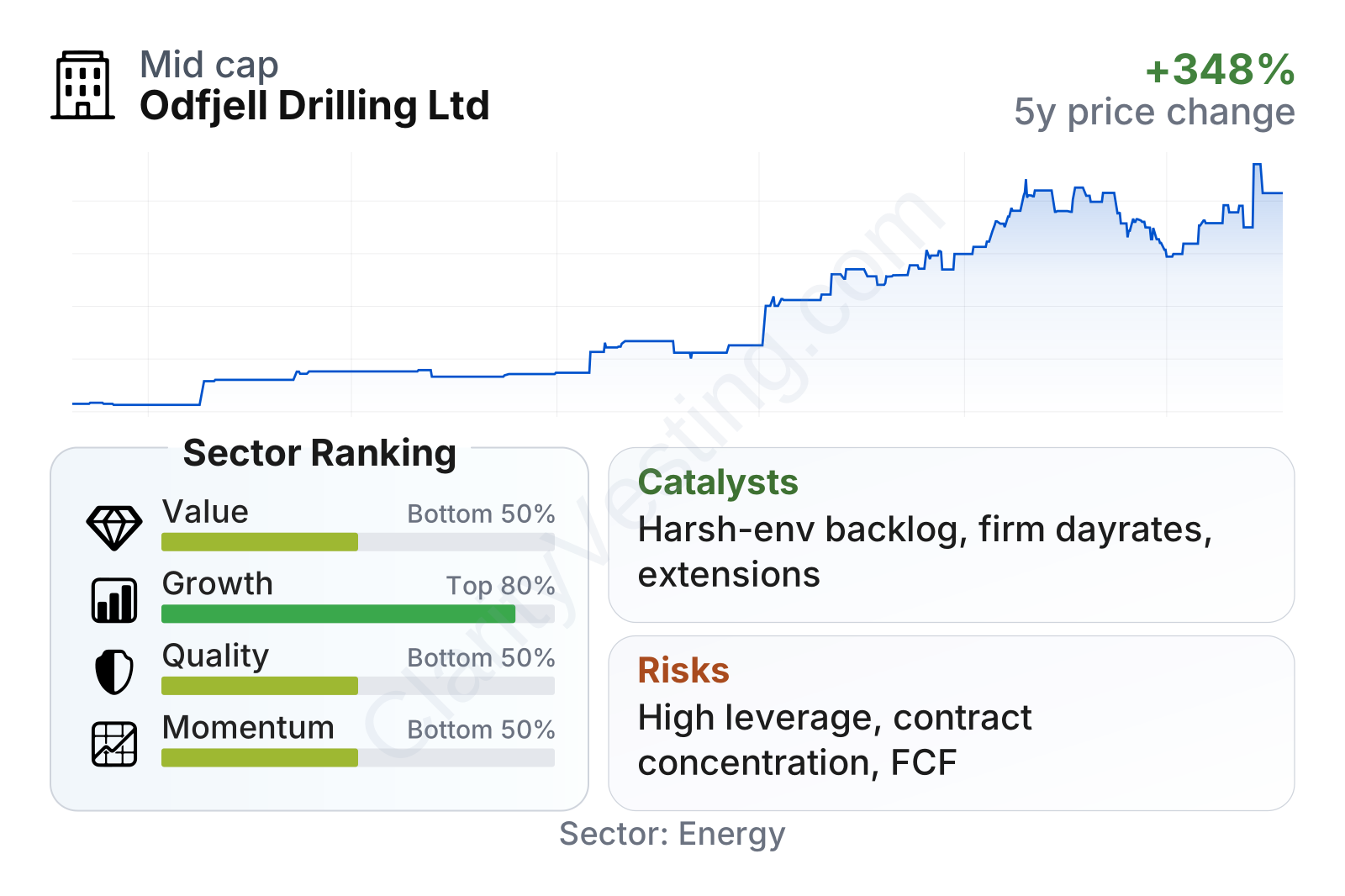
Odfjell Drilling sits in the mid-sized range within the energy sector and has shown relatively low share-price volatility, with a beta well below 1. Valuation metrics look mixed rather than outright cheap or expensive: the earnings multiple is below the sector median, but book value is slightly above the median and free cash flow is currently negative, which weakens the simple low-P/E argument.
The strongest part of the current profile is growth. Recent revenue growth has been far above the sector median, earnings per share have compounded strongly over five years, and operating margins are exceptionally high compared with most peers. Profitability is a standout feature: operating margin and net margin are both well above sector norms, suggesting the company’s contracted fleet is generating strong economics when fully utilized.
The weaker side is balance-sheet quality and cash conversion. Leverage remains elevated versus the sector, net debt ratios are clearly above median levels, and interest coverage is lower than many energy peers. The dividend yield is unusually high, but it sits alongside negative trailing free cash flow, which means payout sustainability depends more on future cash generation than on recent free cash flow alone.
Market performance has also been strong. The share price rose severalfold from late 2023 into early 2026 before pulling back from its highs, which suggests that a large part of the market has already recognized the improved offshore cycle and the company’s stronger earnings profile.
Growth
Odfjell Drilling operates in a part of the energy market that has become more attractive after years of underinvestment. Offshore drilling, especially in harsh environments, benefits when oil and gas producers prioritize fields with long reserve lives, reliable output, and established infrastructure. The North Sea and Norwegian Continental Shelf fit that description well. These are not fast-changing, speculative basins; they are mature regions where operators still need technically advanced rigs to maintain and develop production.
The company’s strategy is logically aligned with that market. Instead of competing across every type of offshore asset, it concentrates on harsh-environment rigs where technical barriers are high and the number of suitable competitors is smaller. That focus can support stronger pricing, longer contracts, and closer relationships with major customers such as Equinor and other large offshore operators.
A major growth support is contract backlog. For an offshore driller, backlog is important because it gives visibility into future revenue and reduces the risk of sudden idle periods. Odfjell Drilling has continued to announce contract awards, extensions, and options for its core fleet, reinforcing the idea that demand for premium harsh-environment capacity remains healthy. In this industry, even a few years of secured utilization can materially improve earnings visibility.
Another positive factor is industry supply. New offshore rigs are expensive and take time to build, while many older rigs are less competitive or unsuitable for harsh-environment work. That creates a tighter market for modern, capable assets. If offshore spending remains stable, a constrained supply backdrop can keep dayrates firm and support further cash generation.
Recent company updates have also pointed to ongoing commercial momentum around fleet utilization and contract coverage. The main opportunity is straightforward: if Odfjell Drilling keeps its premium rigs working under favorable terms, revenue and profit can remain elevated without requiring a dramatic expansion of the fleet. In a niche business like this, disciplined execution on a small number of high-value assets can matter more than aggressive expansion.
Risks
This article is for informational purposes only and does not constitute financial advice. Some content is AI-generated. See Disclaimer


