Stock Analysis · ODDITY Tech Ltd (ODD)
Overview
ODDITY Tech Ltd is a consumer beauty and wellness company that combines direct-to-consumer brand building with data, software, and artificial intelligence tools. The group is best known for IL MAKIAGE in beauty and SpoiledChild in wellness. Its model is different from many traditional cosmetics companies because it relies heavily on online sales, customer acquisition algorithms, personalization tools, and in-house technology to test products, match users, and improve repeat purchases.
Revenue comes primarily from selling beauty and wellness products through the company’s own digital channels. Based on the latest annual results and company disclosures, the business mix appears to be concentrated in a small number of brands.
- IL MAKIAGE: approximately 65% to 75% of revenue. This brand includes makeup, skin-related beauty products, and personalized online product matching.
- SpoiledChild: approximately 25% to 35% of revenue. This business focuses on wellness, hair, skin, and age-conscious products sold mainly online.
- Other and emerging initiatives: currently a very small share of revenue. This includes earlier-stage technology and brand incubation efforts.
The company’s economics have historically benefited from high gross margins, which is common in premium beauty sold directly online. At the same time, operating expenses can swing sharply because growth depends on marketing efficiency, product launches, and technology spending. Over the last several years, revenue expanded quickly and gross profit rose even faster in absolute dollars, but more recent trends show that cost discipline and cash conversion have become more important than pure top-line growth.
The long-term pattern shows a business that scaled from a few hundred million dollars in annual sales to more than $800 million, while gross profit remained strong. The main change to watch is that operating expenses rose much faster in the most recent period, which helps explain why profitability and cash generation have weakened after a very strong earlier phase.
Key Figures
| Metric | Value | Sector ⓘ |
|---|---|---|
| Date | Oct 21, 2026 | |
| Context | ||
| Sector | Consumer Defensive | |
| Industry | Household & Personal Products | |
| Market Cap ⓘ | $1.09B | |
| Beta ⓘ | 2.24 | |
Value (Cheapness) | ||
| P/E Ratio ⓘ | 106.95 | 18.68 |
| P/B Ratio ⓘ | 5.23 | 1.24 |
| FCF Yield ⓘ | -3.40% | 12.11% |
| Dividend Yield ⓘ | N/A | 2.67% |
| EBIT / EV ⓘ | 0.79% | 6.40% |
| PEG ⓘ | N/A | |
Growth (Business expansion) | ||
| Revenue Growth ⓘ | -25.10% | 4.10% |
| RPS Growth (5Y CAGR) ⓘ | 35.17% | 6.22% |
| EPS Growth (5Y CAGR) ⓘ | N/A | -13.59% |
| BVPS Growth (5Y CAGR) ⓘ | 51.71% | 3.27% |
| Margin Growth (5Y Trend) ⓘ | 7.99% | -0.13% |
| FCF Growth (5Y CAGR) ⓘ | 127.55% | 4.10% |
| DPS Growth (5Y CAGR) ⓘ | N/A | 6.83% |
Quality (Business durability) | ||
| ROIC (Latest) ⓘ | 0.76% | 12.34% |
| ROA (Latest) ⓘ | 1.48% | 6.30% |
| ROIC (5Y Median) ⓘ | 30.35% | 10.53% |
| ROA (5Y Median) ⓘ | 14.05% | 5.44% |
| Net Debt / EBIT (Latest) ⓘ | 41.87 | 1.98 |
| Net Debt / EBIT (5Y Median) ⓘ | -0.31 | 2.35 |
| Net Debt / EBITDA (Latest) ⓘ | 16.23 | 1.38 |
| Net Debt / Assets ⓘ | 41.92% | 21.70% |
| EBITDA / Interest ⓘ | N/A | 9.49 |
| Operating Margin (Latest) ⓘ | 1.38% | 8.88% |
| Operating Margin (5Y Median) ⓘ | 15.45% | 9.57% |
| Debt to Equity (Latest) ⓘ | 229.88% | 72.35% |
| Profit Margin (Latest) ⓘ | 2.23% | 5.40% |
| Free Cash Flow (Latest) ⓘ | -$36.88M | |
Momentum (Price trend) | ||
| 3Y Return ⓘ | -13.01% | +24.53% |
| 12M Return (excl. last month) ⓘ | -71.03% | +1.93% |
| 6M Return ⓘ | +59.63% | +1.61% |
| Price vs. 200-Day MA ⓘ | +30.01% | +2.99% |
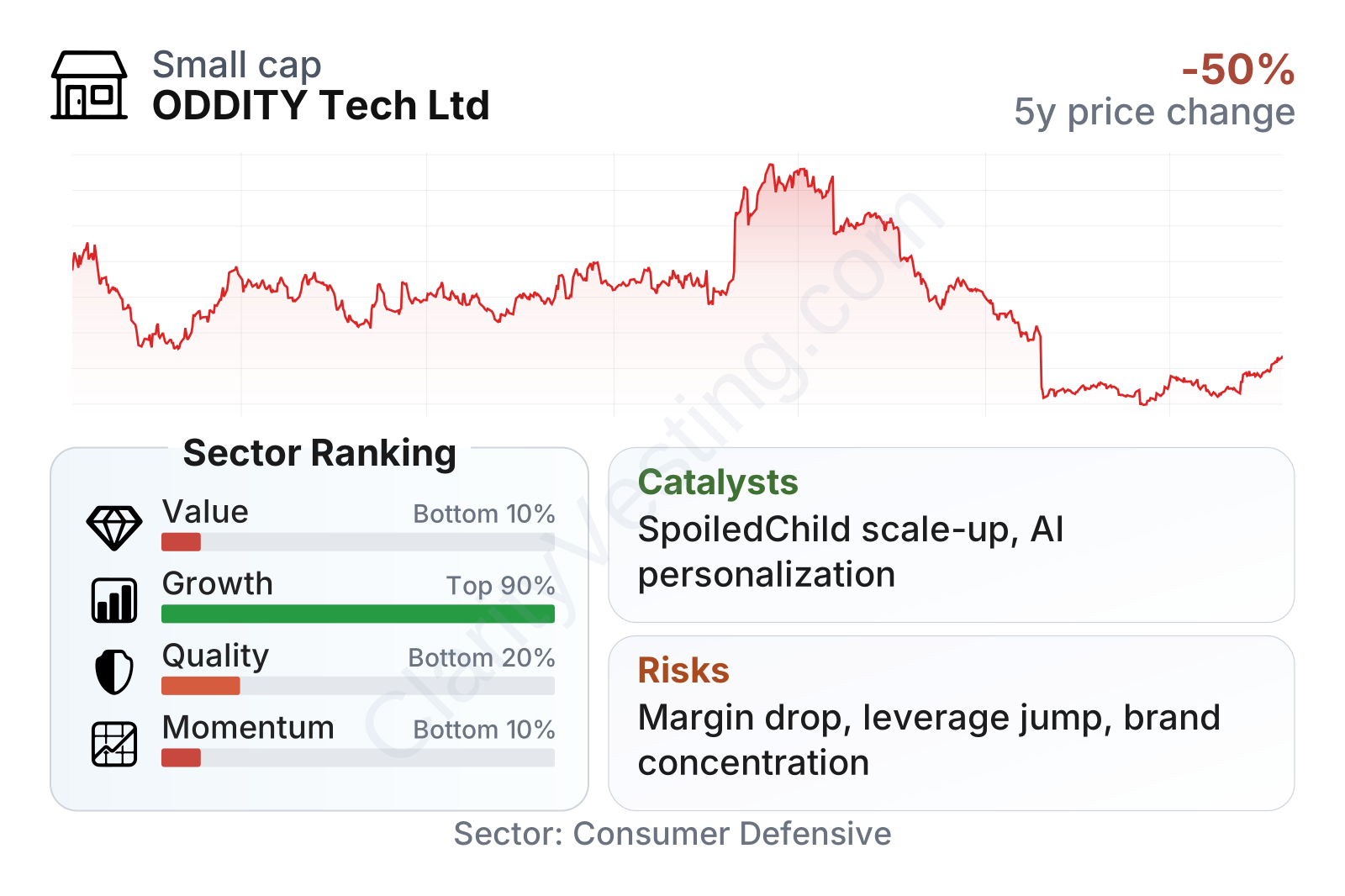
ODDITY is a small-cap company with unusually high share-price volatility, reflected in a beta above 2. On growth measures, it ranks near the top of its sector thanks to strong multi-year expansion in revenue per share, book value per share, and free cash flow over a five-year view. However, the current snapshot is less favorable: value metrics screen weakly, quality metrics have dropped well below sector norms, and momentum remains mixed after a steep decline followed by a partial rebound.
The broad takeaway is that this is no longer being judged like a stable consumer-products business. The market is treating it as a higher-risk, higher-expectation growth company whose current financial profile has become less consistent than its earlier track record suggested.
Growth
ODDITY operates in beauty, wellness, and personalization software, which are attractive markets for long-term expansion. Beauty is a large global category with repeat purchases, brand loyalty, and room for premium pricing. Wellness and age-focused personal care also remain active areas of consumer spending. The company’s direct-to-consumer model gives it more control over customer data, pricing, and product testing than wholesale-led competitors. That can support faster product iteration and potentially higher gross margins when execution is strong.
The strategic logic is clear: use technology to lower product-matching friction, increase online conversion, and build brands without relying heavily on third-party retail shelves. If this works, ODDITY can launch products faster, keep more consumer data in-house, and expand customer lifetime value across brands. That model also creates optionality for future brand incubation or monetization of internal technology capabilities.
The near-term growth picture, however, has become more complicated. Through 2024 and 2025, year-over-year revenue growth stayed in a strong range around the mid-20s. In 2026, that trend reversed sharply, with revenue turning negative year over year by roughly 25% to 26%. For a company that previously traded on sustained rapid expansion, this is a major change. It does not erase the multi-year record, but it raises the bar for proving that the slowdown is temporary rather than structural.
Cash generation tells a similar story. Free cash flow was strongly positive during the earlier growth phase and then moved into negative territory more recently. That shift matters because direct-to-consumer businesses often spend heavily on marketing, and when revenue decelerates, the underlying operating leverage can weaken quickly. A return to positive cash flow would be an important sign that the model is stabilizing.
One meaningful catalyst is the company’s ability to keep expanding beyond its original flagship brand. SpoiledChild has shown that ODDITY can build a second growth engine rather than depend entirely on IL MAKIAGE. Another catalyst is any evidence that AI-based personalization continues to improve customer acquisition efficiency or repeat purchase behavior. If management can show that newer products and brands scale with better returns on advertising spend, the growth case becomes much stronger.
Recent company updates have also emphasized continued investment in new technology and product development. For a business built around personalization and digital distribution, that is strategically coherent. The key issue is not whether the company has room to grow in its markets; it is whether it can resume efficient growth after a period of much weaker reported momentum.
Risks
This article is for informational purposes only and does not constitute financial advice. Some content is AI-generated. See Disclaimer


