Stock Analysis · Ocular Therapeutix Inc (OCUL)
Overview
Ocular Therapeutix is a biotechnology company focused on eye diseases. Its work centers on treatments that can release medicine over time inside or around the eye, with the goal of reducing how often patients need repeat procedures or frequent dosing. The company’s commercial product base has historically been linked to ophthalmology procedures, while its larger long-term ambition is to build a retinal disease franchise, especially in wet age-related macular degeneration and other back-of-the-eye conditions.
Today, the business has two very different layers: a modest revenue-producing commercial platform and a much larger clinical development effort. That distinction matters for long-term analysis because the current income statement mostly reflects a company funding future products rather than one already earning mature profits.
The main sources of revenue are concentrated in product sales and collaboration-related activities. Based on recent company reporting, revenue appears to come primarily from the following areas:
- Product revenue: approximately 85% to 95% of total revenue in recent periods. This mainly reflects sales of the company’s marketed ophthalmic product portfolio.
- License, collaboration, and other revenue: approximately 5% to 15% of total revenue, depending on period. This can include partner-related activity, milestone-related recognition, and other non-product items.
One important operating trend is that revenue has remained relatively small compared with spending. Gross profit has stayed positive, which shows the product business itself is not the problem; the real pressure comes from the large rise in research and development expenses as Ocular Therapeutix invests aggressively in its pipeline.
Over the last several years, the business has shifted from a more balanced commercial-and-development profile to a much more pipeline-driven model. Revenue improved gradually through 2024, but operating expenses rose far faster, led by research and development. That tells readers the company is increasingly being valued on future drug candidates rather than on its current sales base.
Key Figures
| Metric | Value | Sector ⓘ |
|---|---|---|
| Date | Oct 03, 2026 | |
| Context | ||
| Sector | Healthcare | |
| Industry | Biotechnology | |
| Market Cap ⓘ | $1.68B | |
| Beta ⓘ | 0.97 | |
Value (Cheapness) | ||
| P/E Ratio ⓘ | N/A | 24.06 |
| P/B Ratio ⓘ | 3.15 | 3.08 |
| FCF Yield ⓘ | -15.14% | 3.07% |
| Dividend Yield ⓘ | N/A | 2.05% |
| EBIT / EV ⓘ | -17.30% | 0.63% |
| PEG ⓘ | N/A | |
Growth (Business expansion) | ||
| Revenue Growth ⓘ | 0.10% | 7.50% |
| RPS Growth (5Y CAGR) ⓘ | -14.98% | 8.70% |
| EPS Growth (5Y CAGR) ⓘ | -7.39% | -18.20% |
| BVPS Growth (5Y CAGR) ⓘ | 34.40% | 3.95% |
| Margin Growth (5Y Trend) ⓘ | N/A | -0.58% |
| FCF Growth (5Y CAGR) ⓘ | N/A | 0.88% |
| DPS Growth (5Y CAGR) ⓘ | 139.54% | 6.80% |
Quality (Business durability) | ||
| ROIC (Latest) ⓘ | -39.33% | 3.29% |
| ROA (Latest) ⓘ | -55.71% | 3.02% |
| ROIC (5Y Median) ⓘ | -42.38% | 4.75% |
| ROA (5Y Median) ⓘ | -40.23% | 1.93% |
| Net Debt / EBIT (Latest) ⓘ | N/A | 1.33 |
| Net Debt / EBIT (5Y Median) ⓘ | N/A | 1.83 |
| Net Debt / EBITDA (Latest) ⓘ | N/A | 0.99 |
| Net Debt / Assets ⓘ | -77.35% | 5.33% |
| EBITDA / Interest ⓘ | N/A | 9.63 |
| Operating Margin (Latest) ⓘ | -557.20% | 9.25% |
| Operating Margin (5Y Median) ⓘ | -124.32% | 7.80% |
| Debt to Equity (Latest) ⓘ | 15.26% | 28.99% |
| Profit Margin (Latest) ⓘ | N/A | 3.60% |
| Free Cash Flow (Latest) ⓘ | -$255.10M | |
Momentum (Price trend) | ||
| 3Y Return ⓘ | +147.12% | +37.48% |
| 12M Return (excl. last month) ⓘ | -13.43% | +20.85% |
| 6M Return ⓘ | -12.48% | +9.73% |
| Price vs. 200-Day MA ⓘ | -24.55% | +4.69% |
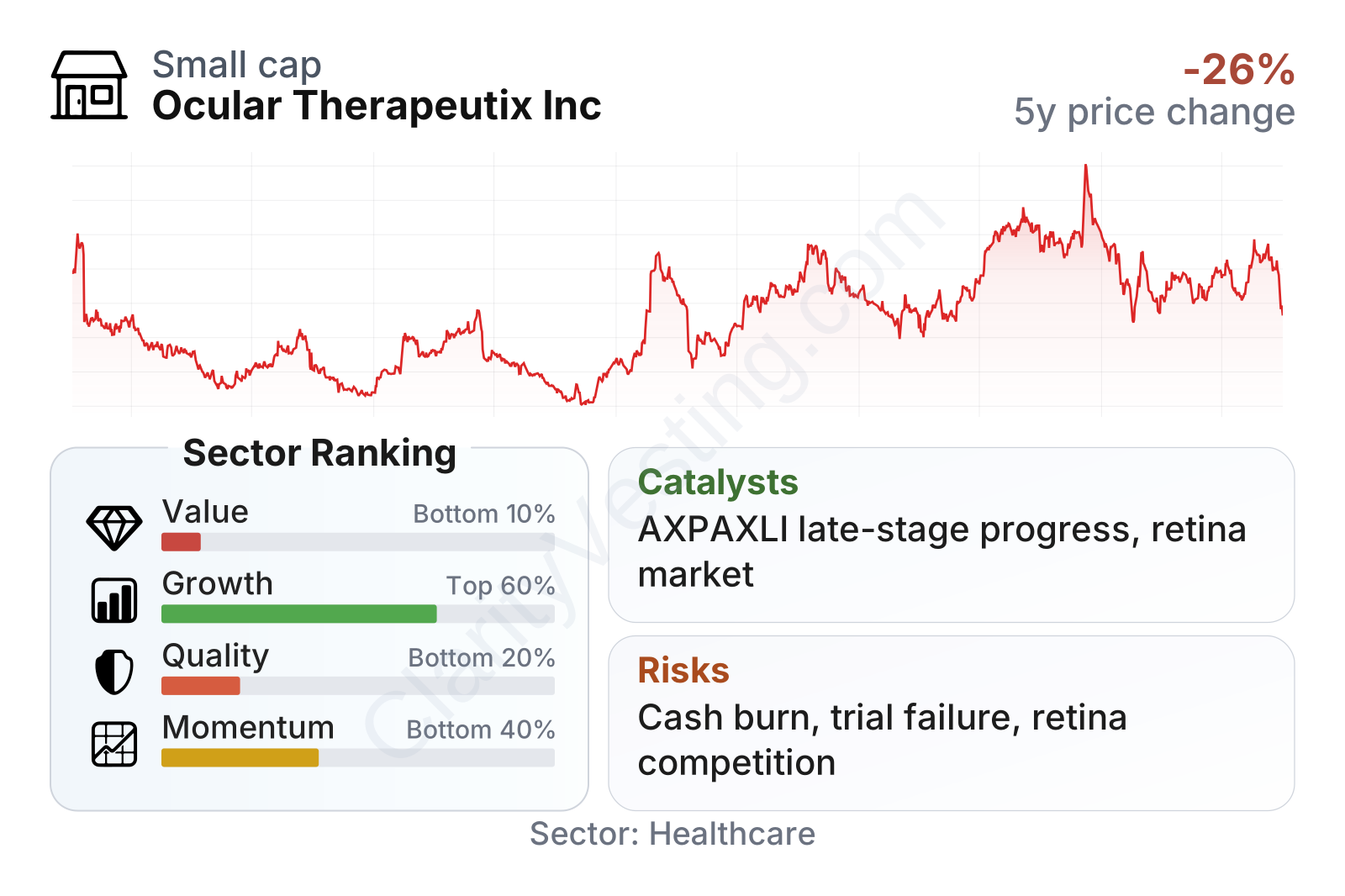
Ocular Therapeutix is a mid-sized biotechnology company by market value, with share-price behavior that has been volatile but not unusually detached from the broader market. The factor profile is mixed: valuation screens look weak because the company is loss-making and burning cash, while balance-sheet leverage looks comparatively restrained for the sector. Growth metrics are also mixed, with long-term book value expansion but limited recent sales growth. Overall, the company ranks better on financial flexibility than on profitability or traditional value measures.
The stock chart also shows how sentiment has changed in waves rather than in a straight line. Shares fell sharply from 2021 into 2023, then recovered strongly, which is common for clinical-stage biotech names where expectations around trial progress and pipeline value matter more than near-term earnings.
Growth
Ocular Therapeutix operates in a part of healthcare with attractive long-term demand drivers. Eye disease is supported by aging populations, longer life expectancy, and the large medical burden of retinal conditions such as wet age-related macular degeneration. This is a meaningful market because current standards of care often require frequent injections, creating a clear need for therapies that can last longer and reduce treatment burden.
The company’s strategy broadly makes sense in that context. Instead of trying to compete only on another standard eye treatment, it is aiming at sustained-delivery ophthalmology, where convenience, durability, and real-world adherence can become important advantages. If its lead retinal programs show strong efficacy and longer dosing intervals, the commercial opportunity could be much larger than its current revenue base suggests.
Revenue growth, however, has not yet become a strong proof point. Sales improved for several years and reached a higher level in 2024, but then turned weaker in 2025 before flattening in 2026. That pattern suggests the present business is not yet delivering the kind of self-funded expansion that would normally support a premium on fundamentals alone. The bigger growth case therefore depends much more on pipeline execution than on current commercial momentum.
Cash generation tells the same story from another angle. Free cash flow has become increasingly negative as clinical spending accelerated. This is typical for a biotech moving deeper into expensive development stages, but it means future value creation depends heavily on whether those investments translate into successful trial outcomes, regulatory progress, and eventually a larger product base.
The most important catalysts are tied to the retinal pipeline, especially AXPAXLI, which the company has been advancing for wet age-related macular degeneration and other retinal diseases. In 2026, Ocular Therapeutix continued to communicate development progress around late-stage planning and clinical execution, keeping attention focused on whether the platform can produce durable treatment results that stand out in a competitive field. For a company of this size, credible late-stage progress in retina is the kind of event that can reshape how the entire business is viewed.
Another positive point is that management has been willing to invest heavily behind the lead opportunity rather than protect short-term optics. That raises financial pressure today, but strategically it is consistent with building a more valuable ophthalmology franchise if the science works.
Risks
This article is for informational purposes only and does not constitute financial advice. Some content is AI-generated. See Disclaimer