Stock Analysis · Octave Intelligence plc (OCTV)
Overview
Octave Intelligence plc operates in application software, with a focus on analytics, planning, and decision-support tools used by organizations to manage performance, reporting, and operational planning. In simple terms, the company sells software that helps businesses collect information, analyze it, and turn it into budgets, forecasts, dashboards, and business plans.
The business appears to be primarily software-driven, with revenue coming from recurring customer relationships rather than one-time hardware sales. Based on the company’s financial profile and public business description, the main revenue sources are likely organized as follows:
- Software subscriptions and licenses: the largest source of revenue, including access to the company’s core applications, cloud-based usage, and ongoing software rights.
- Maintenance and support: recurring fees tied to updates, technical support, and continued access for legacy or on-premise customers.
- Professional services and implementation: consulting, deployment, training, and customization work associated with customer rollouts.
Publicly available materials support the view that recurring software-related revenue is the core of the model, but a precise 2026 revenue split by segment is not clearly available in the materials reviewed, so it is more reliable to describe the ranking than to assign unsupported percentages.
The company’s economics show a software business with solid gross profitability. Revenue increased from about $1.37 billion in 2022 to about $1.64 billion in 2025, while gross profit remained above $1.0 billion each year. That indicates a business where the product itself scales well, even if growth has recently slowed and costs have fluctuated.
The cost structure also shows a meaningful commitment to product development and customer acquisition. Research and development spending rose from roughly $122 million in 2022 to about $183 million in 2025, while selling and administrative spending was also substantial in earlier years. This is consistent with a software company trying to protect its product relevance while defending its customer base.
Key Figures
| Metric | Value | Sector ⓘ |
|---|---|---|
| Date | Oct 17, 2026 | |
| Context | ||
| Sector | Technology | |
| Industry | Software - Application | |
| Market Cap ⓘ | $5.48B | |
| Beta ⓘ | N/A | |
Value (Cheapness) | ||
| P/E Ratio ⓘ | 17.74 | 30.28 |
| FCF Yield ⓘ | 7.99% | 4.19% |
| Dividend Yield ⓘ | N/A | 1.30% |
| EBIT / EV ⓘ | 5.89% | 2.79% |
| PEG ⓘ | N/A | |
Growth (Business expansion) | ||
| Revenue Growth ⓘ | -3.60% | 15.70% |
| RPS Growth (5Y CAGR) ⓘ | 3.10% | 8.56% |
| EPS Growth (5Y CAGR) ⓘ | N/A | -11.54% |
| Margin Growth (5Y Trend) ⓘ | -1.54% | 0.46% |
| FCF Growth (5Y CAGR) ⓘ | 15.53% | 9.72% |
| DPS Growth (5Y CAGR) ⓘ | N/A | 7.73% |
Quality (Business durability) | ||
| ROIC (Latest) ⓘ | N/A | 9.44% |
| ROIC (5Y Median) ⓘ | N/A | 8.35% |
| Net Debt / EBIT (Latest) ⓘ | 1.17 | 0.50 |
| Net Debt / EBIT (5Y Median) ⓘ | N/A | 0.48 |
| Net Debt / EBITDA (Latest) ⓘ | 0.77 | 0.28 |
| Net Debt / Assets ⓘ | 5.88% | 3.48% |
| EBITDA / Interest ⓘ | N/A | 12.91 |
| Operating Margin (Latest) ⓘ | 20.37% | 9.77% |
| Operating Margin (5Y Median) ⓘ | 21.22% | 8.53% |
| Debt to Equity (Latest) ⓘ | 13.74% | 34.51% |
| Profit Margin (Latest) ⓘ | -111.26% | 7.14% |
| Free Cash Flow (Latest) ⓘ | $437.59M | |
Momentum (Price trend) | ||
| 3Y Return ⓘ | N/A | +56.52% |
| 12M Return (excl. last month) ⓘ | N/A | +13.17% |
| 6M Return ⓘ | N/A | +15.38% |
| Price vs. 200-Day MA ⓘ | N/A | +7.53% |
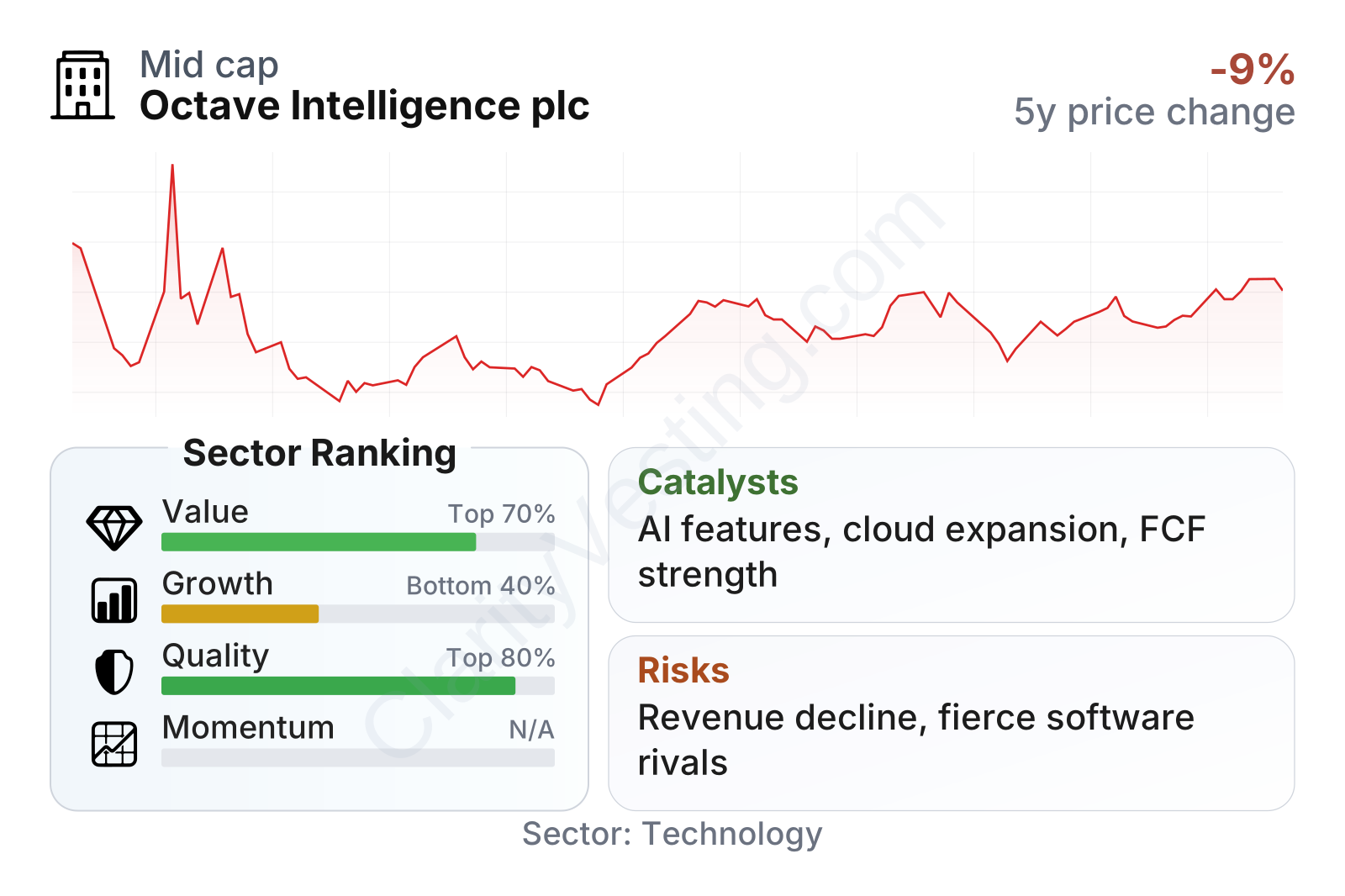
The market value places Octave Intelligence in the mid-cap range within software. On valuation, the shares screen less expensive than the sector median on earnings and free-cash-flow yield, which suggests the market is not assigning a premium growth multiple. Free cash flow is a notable strength: trailing free cash flow is around $438 million, and the cash-flow yield is well above the sector median.
Growth metrics are weaker. Recent revenue declined slightly year over year, and the five-year revenue-per-share growth rate trails the sector median by a wide margin. At the same time, free cash flow has compounded faster than the sector median over five years, which points to a business that has become better at turning revenue into cash even without standout top-line expansion.
Balance-sheet risk looks manageable. Debt-to-equity is around 14%, clearly below the sector median, and net debt as a share of assets is modest, although slightly above the typical software peer. One figure that stands out negatively is the latest profit margin, which is deeply negative on a trailing basis and does not fit the stronger cash-flow profile. That kind of mismatch often reflects non-cash charges, accounting adjustments, or one-off items, so it deserves attention when reviewing the most recent annual filing.
The share price also softened between late May and late August 2026, which aligns with a market view that sees a stable but slower-growth software company rather than a high-momentum technology name.
Growth
Octave Intelligence operates in a sector that still has favorable long-term demand drivers. Companies continue to invest in cloud software, automation, planning tools, data analysis, and AI-assisted decision systems. Those trends support the broader category in which Octave competes, because enterprises want software that can connect operational data with planning and performance management.
The strategic logic for future growth is therefore understandable: if Octave can deepen customer usage, migrate more activity toward recurring cloud arrangements, and add AI-enabled features that improve forecasting or workflow automation, it can remain relevant even without explosive expansion. In software, steady renewal rates and expansion within existing accounts can be almost as important as winning entirely new customers.
There is also a practical positive signal in the financial profile. Even though revenue growth has recently been weak, the company still generates substantial free cash flow and has kept leverage under control. That combination can support product investment, selective acquisitions, or shareholder returns without placing the balance sheet under obvious strain.
A further potential catalyst is the valuation backdrop. Because the shares trade on lower earnings and stronger cash-flow yield than the sector median, the market seems to be pricing Octave more like a mature software business than a high-growth platform. If management can show that recent revenue softness is temporary, even moderate improvement in organic growth could materially change how the company is viewed.
No major 2026 public event from the allowed source set appears to point to a transformational opportunity by itself, but the combination of durable software demand, room for cloud and AI-led product enhancement, and strong cash generation creates a credible path for gradual improvement.
Risks
This article is for informational purposes only and does not constitute financial advice. Some content is AI-generated. See Disclaimer


