Stock Analysis · Oaktree Specialty Lending Corp (OCSL)
Overview
Oaktree Specialty Lending Corp is a business development company, or BDC. In simple terms, it lends money to middle-market businesses that are often too large for small-bank lending but not large enough to access the bond market easily. It focuses mainly on companies backed by private equity sponsors and earns income from the interest and fees attached to those loans. As a regulated investment company, it is built to pass through most of its income to shareholders, which helps explain its notably high dividend yield.
The portfolio is centered on privately negotiated debt investments rather than operating a traditional product or service business. That means the core question for long-term shareholders is not unit sales or store growth, but credit quality, loan yields, funding costs, portfolio diversification, and how well management protects net asset value over time.
Based on recent company filings, OCSL’s investment portfolio is heavily concentrated in first-lien senior secured loans, with smaller allocations to second-lien debt, unsecured debt, and equity or equity-related investments. Revenue is therefore driven primarily by recurring interest income from its loan book, with a smaller contribution from fees and investment gains.
- Interest income from first-lien loans: approximately 75% to 85% of investment income. These are senior secured loans, meaning OCSL generally has a higher claim on assets if a borrower gets into trouble.
- Interest income from second-lien and other debt investments: approximately 10% to 20%. These positions usually carry higher yields but also higher credit risk than first-lien loans.
- Fee income: approximately 2% to 6%. This can include prepayment fees, amendment fees, structuring fees, and other lending-related charges.
- Dividend income and realized/unrealized gains: usually a small and more variable share of total return. These come mainly from equity co-investments or valuation changes in the portfolio.
Sector diversification also matters because OCSL is effectively a lender to many different industries rather than a single operating niche. Its manager, Oaktree, is one of the best-known credit-focused investment firms, and that affiliation is a meaningful part of the company’s identity: OCSL’s proposition is not scale leadership, but disciplined underwriting and sponsor-backed lending within private credit.
The income profile has been volatile from year to year, which is normal for a lender exposed to changing rates, repayments, and valuation marks. Still, one consistent feature stands out: interest expense absorbs a meaningful share of gross income, so the spread between portfolio yield and borrowing cost is central to results.
Key Figures
| Metric | Value | Sector ⓘ |
|---|---|---|
| Date | Oct 17, 2026 | |
| Context | ||
| Sector | Financial Services | |
| Industry | Asset Management | |
| Market Cap ⓘ | $1.05B | |
| Beta ⓘ | 0.58 | |
Value (Cheapness) | ||
| P/E Ratio ⓘ | 24.81 | 12.26 |
| P/B Ratio ⓘ | 0.75 | 1.23 |
| FCF Yield ⓘ | 26.46% | 10.40% |
| Dividend Yield ⓘ | 13.04% | 3.02% |
| EBIT / EV ⓘ | N/A | 8.14% |
| PEG ⓘ | 0.93 | |
Growth (Business expansion) | ||
| Revenue Growth ⓘ | -7.80% | 9.35% |
| RPS Growth (5Y CAGR) ⓘ | -6.70% | 12.19% |
| EPS Growth (5Y CAGR) ⓘ | -13.79% | -9.53% |
| BVPS Growth (5Y CAGR) ⓘ | -8.50% | 4.99% |
| Margin Growth (5Y Trend) ⓘ | -96.99% | -3.86% |
| FCF Growth (5Y CAGR) ⓘ | N/A | 4.81% |
| DPS Growth (5Y CAGR) ⓘ | 3.90% | 8.79% |
Quality (Business durability) | ||
| ROIC (Latest) ⓘ | N/A | 9.49% |
| ROE (Latest) ⓘ | 2.97% | 13.90% |
| ROA (Latest) ⓘ | 1.44% | 1.55% |
| ROIC (5Y Median) ⓘ | 6.29% | 7.86% |
| ROE (5Y Median) ⓘ | 3.86% | 12.17% |
| ROA (5Y Median) ⓘ | 1.80% | 1.30% |
| Net Debt / EBIT (Latest) ⓘ | N/A | 0.96 |
| Net Debt / EBIT (5Y Median) ⓘ | 6.64 | 0.73 |
| Net Debt / EBITDA (Latest) ⓘ | 7.50 | 0.92 |
| Operating Margin (Latest) ⓘ | N/A | 22.30% |
| Operating Margin (5Y Median) ⓘ | 144.38% | 24.63% |
| Debt to Equity (Latest) ⓘ | 104.03% | 58.56% |
| Profit Margin (Latest) ⓘ | 14.45% | 26.57% |
| Free Cash Flow (Latest) ⓘ | $277.57M | |
Momentum (Price trend) | ||
| 3Y Return ⓘ | -14.47% | +88.33% |
| 12M Return (excl. last month) ⓘ | +5.56% | +19.38% |
| 6M Return ⓘ | -2.56% | +4.75% |
| Price vs. 200-Day MA ⓘ | +1.80% | +3.50% |
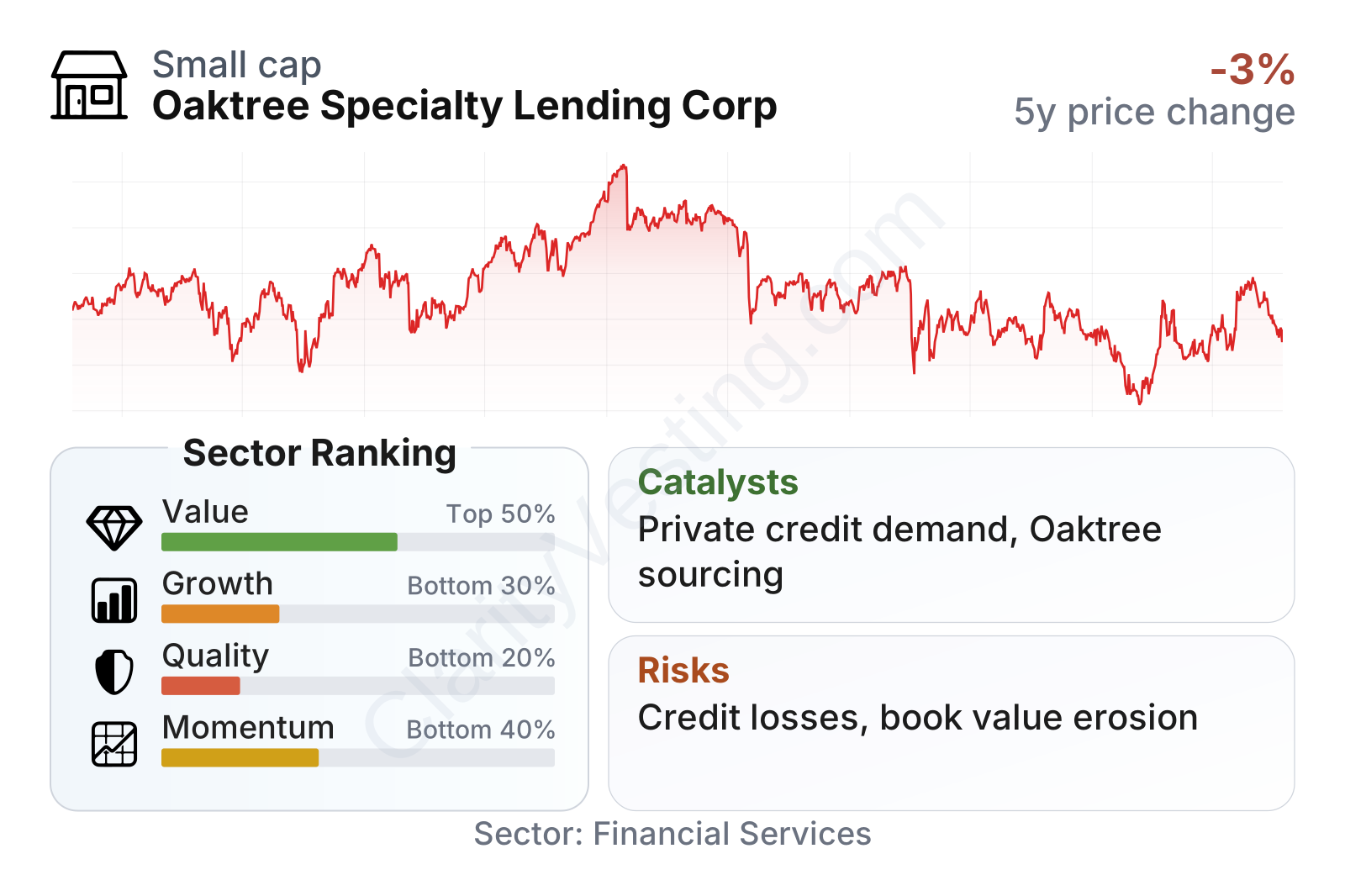
OCSL is a relatively small public lender within financial services, with lower share-price volatility than the broader market, as reflected by a beta well below 1. On valuation, the picture is mixed: the stock trades at a lower price-to-book ratio than the sector median, but its earnings multiple is higher than the sector median. The dividend yield is far above the sector norm, which is a major part of the stock’s profile. At the same time, the factor breakdown points to weaker growth, weaker quality metrics, and only modest price momentum versus peers, so the market is not treating the discount to book as a simple bargain.
The stock chart also shows a fairly narrow trading range over the last several years. That fits the business model: for a BDC, long-term returns often come more from income generation and preservation of book value than from rapid share-price appreciation.
Growth
OCSL operates in private credit, which has been one of the more important growth areas in finance. Banks have pulled back from parts of middle-market lending because of regulation, capital requirements, and risk limits. That has opened room for specialized lenders and BDCs to finance companies directly. This broader industry trend is supportive because it expands the addressable market for firms with underwriting teams, sponsor relationships, and access to capital.
Its strategy also makes sense in the current structure of the market. OCSL emphasizes senior secured lending, especially first-lien positions, which can help limit loss severity compared with lower-ranking debt. It also benefits from Oaktree’s platform, sourcing network, and credit experience. For a lender in this part of the market, that backing can matter more than raw size because loan selection and workout capability are major drivers of long-run outcomes.
That said, growth has not been especially strong in the numbers. Revenue has recently declined year over year, and longer-term per-share trends have been soft. Earnings per share rose into 2023 and then moved lower afterward, suggesting that the peak benefit from higher base rates has faded and that portfolio or funding pressures have become more visible.
The earnings pattern suggests a lender that benefited from the rising-rate cycle but has not fully converted that into durable profit expansion. For a BDC, a key test is whether income can remain stable after rate tailwinds ease, while credit costs stay contained.
Book value per share is another critical measure because it reflects how well management preserves the value of the underlying portfolio. Here the direction has been less encouraging, with book value trending down after peaking earlier in the period.
A falling book value does not automatically signal a broken model, since portfolio marks and realized losses can fluctuate, but sustained declines can limit future flexibility and often explain why a lender trades below book value. In OCSL’s case, future growth likely depends less on dramatic portfolio expansion and more on maintaining credit quality, recycling capital into attractive spreads, and using Oaktree’s origination network to find new senior loans without stretching underwriting standards.
Recent company updates have also highlighted portfolio activity, repayments, and originations rather than transformative acquisitions or strategic shifts. That points to an incremental opportunity set: OCSL can benefit if private credit remains in demand and if sponsor-backed middle-market borrowers continue to prefer direct lenders, but the near-term upside appears tied to execution rather than a single major catalyst.
Risks
This article is for informational purposes only and does not constitute financial advice. Some content is AI-generated. See Disclaimer


