Stock Analysis · OCI N.V (OCINF)
Overview
OCI N.V. is a chemicals and fertilizers company with operations centered on nitrogen-based products. In simple terms, it turns natural gas and other inputs into products used in farming, industry, and cleaner fuels. Its portfolio has historically included ammonia, urea, nitrate fertilizers, methanol, and products linked to lower-carbon applications such as blue ammonia and cleaner fuel value chains.
For long-term analysis, the most important point is that OCI has been reshaping itself. Recent annual reporting and company announcements show a business that is no longer just a traditional fertilizer producer: it has been monetizing assets, simplifying its structure, and focusing more on nitrogen and energy-transition-related products. That makes the company easier to understand than a diversified chemicals group, but it also means recent reported numbers can be distorted by disposals and one-time gains.
OCI’s revenue mix has changed materially because of portfolio sales. Based on recent company reporting, revenue is now largely tied to nitrogen products rather than methanol. A practical way to think about the current business is:
- Nitrogen products: approximately 80% to 90% of revenue. This includes ammonia, urea, and other nitrogen fertilizer and industrial nitrogen products sold to agricultural and industrial customers.
- Other chemicals and services: approximately 10% to 20% of revenue. This can include remaining non-core activities, logistics, trading, and other items depending on the reporting period.
Within nitrogen, OCI’s products serve several end markets. Ammonia is the key building block, used both in fertilizers and industrial uses. Urea and nitrates are sold into agriculture, while lower-carbon ammonia is part of the company’s longer-term positioning around cleaner fuels, shipping, and decarbonization.
A notable trend in the financial flow over the last several years is the extreme swing from the 2022 boom to much weaker operating results in 2023-2025. Revenue and gross profit fell sharply after the fertilizer price spike faded. Net income in 2024 was unusually high because of exceptional items rather than strong underlying operations, so it should not be read as a normal earnings level.
Key Figures
| Metric | Value | Sector ⓘ |
|---|---|---|
| Date | Oct 17, 2026 | |
| Context | ||
| Sector | Basic Materials | |
| Industry | Agricultural Inputs | |
| Market Cap ⓘ | $1.02B | |
| Beta ⓘ | 0.39 | |
Value (Cheapness) | ||
| P/E Ratio ⓘ | N/A | 16.90 |
| P/B Ratio ⓘ | 0.95 | 1.65 |
| FCF Yield ⓘ | 5.27% | 5.76% |
| Dividend Yield ⓘ | N/A | 2.13% |
| EBIT / EV ⓘ | N/A | 6.30% |
| PEG ⓘ | N/A | |
Growth (Business expansion) | ||
| Revenue Growth ⓘ | 11.40% | 11.10% |
| RPS Growth (5Y CAGR) ⓘ | -35.69% | 4.49% |
| EPS Growth (5Y CAGR) ⓘ | N/A | -13.47% |
| BVPS Growth (5Y CAGR) ⓘ | -25.71% | 5.51% |
| Margin Growth (5Y Trend) ⓘ | N/A | -1.54% |
| FCF Growth (5Y CAGR) ⓘ | N/A | 0.37% |
| DPS Growth (5Y CAGR) ⓘ | 11.98% | 6.08% |
Quality (Business durability) | ||
| ROIC (Latest) ⓘ | N/A | 9.26% |
| ROA (Latest) ⓘ | -2.39% | 4.91% |
| ROIC (5Y Median) ⓘ | -3.09% | 7.70% |
| ROA (5Y Median) ⓘ | 6.03% | 3.86% |
| Net Debt / EBIT (Latest) ⓘ | N/A | 1.40 |
| Net Debt / EBIT (5Y Median) ⓘ | N/A | 1.70 |
| Net Debt / EBITDA (Latest) ⓘ | N/A | 0.95 |
| Net Debt / Assets ⓘ | 2.40% | 13.69% |
| EBITDA / Interest ⓘ | N/A | 12.34 |
| Operating Margin (Latest) ⓘ | N/A | 13.20% |
| Operating Margin (5Y Median) ⓘ | -6.99% | 11.80% |
| Debt to Equity (Latest) ⓘ | N/A | 40.56% |
| Profit Margin (Latest) ⓘ | -14.59% | 6.43% |
| Free Cash Flow (Latest) ⓘ | $53.90M | |
Momentum (Price trend) | ||
| 3Y Return ⓘ | +10.78% | +68.89% |
| 12M Return (excl. last month) ⓘ | -14.31% | +30.21% |
| 6M Return ⓘ | +6.83% | -4.16% |
| Price vs. 200-Day MA ⓘ | +11.25% | -1.27% |
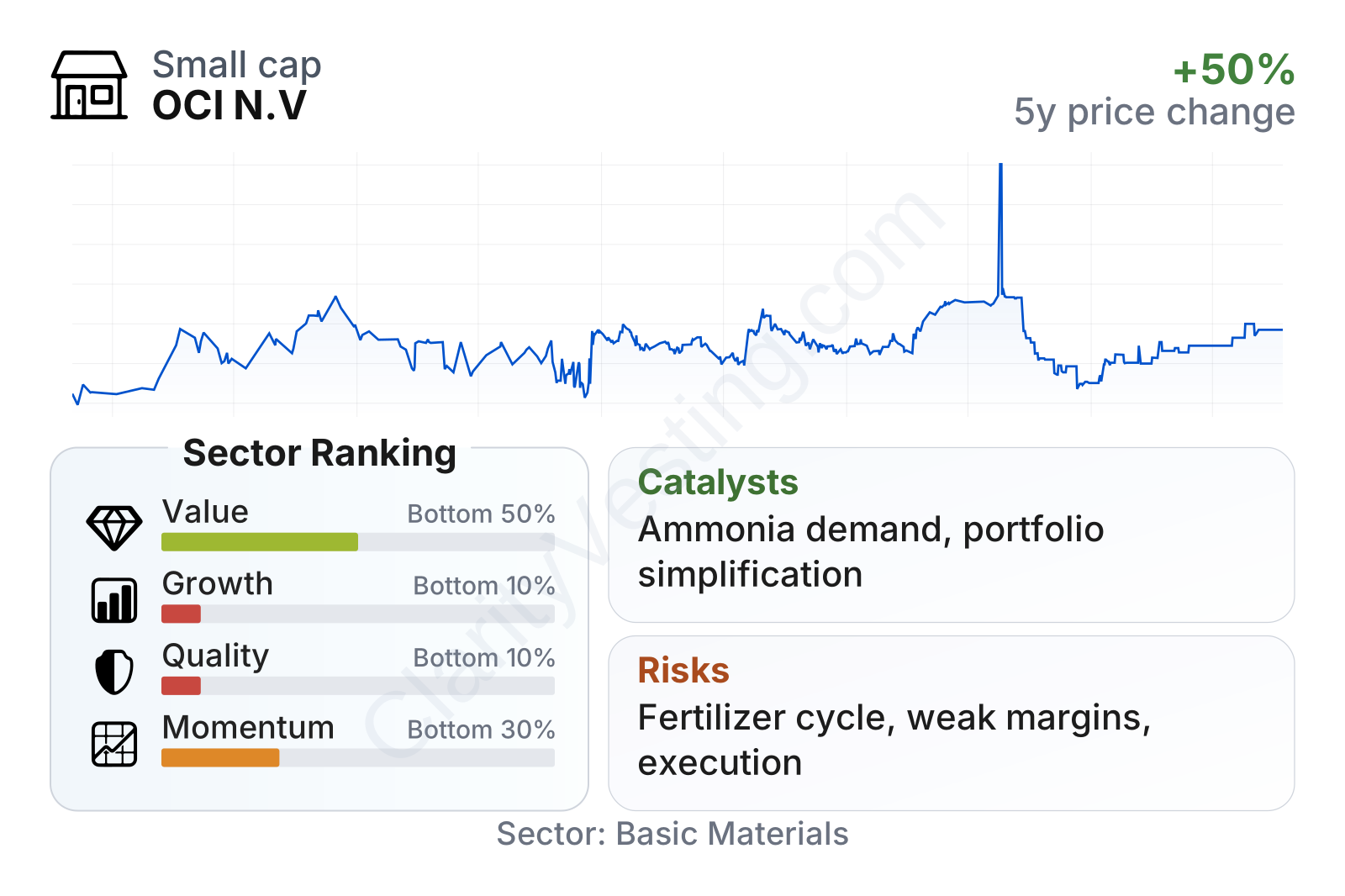
OCI is currently a relatively small public company by market value, and its share price behavior has been less volatile than many materials stocks, with a beta of about 0.32. On valuation, the picture looks mixed rather than clearly cheap or clearly expensive. The stock trades around book value, which is below the sector median, while free cash flow yield is roughly in line with the sector.
The table also shows an important contrast. Balance-sheet leverage appears conservative, with net debt representing only about 2% of assets, well below the sector median. However, profitability and returns are weak: recent return on assets is negative, profit margin is negative, and the quality and growth rankings sit near the bottom of the sector. In other words, OCI does not currently screen as a high-performing business even though it does not look heavily indebted.
Price momentum has also been uneven. The stock has recovered over the last six months and trades above its 200-day average, but the longer three-year record still trails the broader sector. That fits the company’s transition profile: balance-sheet risk has improved, but operating performance has not yet fully stabilized.
Growth
OCI operates in a sector that should remain structurally relevant. Nitrogen fertilizers are essential for global crop yields, and ammonia is also gaining attention as a possible low-carbon fuel, hydrogen carrier, and industrial decarbonization feedstock. Those themes give the company exposure to both a mature necessity market and a potential future growth market.
That said, current growth should be viewed carefully. Near-term demand for fertilizers is real, but earnings in this industry are driven heavily by commodity prices, energy costs, and plant utilization. OCI’s strategy makes the most sense when seen as a simplification and repositioning effort rather than a straightforward volume-growth plan. Management has been selling assets, returning capital, and concentrating on core nitrogen and ammonia platforms that may be better aligned with future decarbonization demand.
Recent year-over-year revenue growth looks better than the sector median, but that does not tell the full story. Over a longer five-year view, revenue per share has contracted sharply and book value per share has also declined. This suggests the company is still working through the aftereffects of portfolio changes and the collapse in fertilizer pricing from the 2022 peak.
The strongest long-term catalyst is ammonia’s widening role outside traditional agriculture. OCI already has industrial-scale ammonia capabilities, and that matters if low-carbon ammonia demand develops meaningfully in marine fuel, power, hydrogen transport, or heavy industry. Another catalyst is corporate simplification: if disposals continue to unlock cash and reduce complexity, OCI may emerge as a cleaner, more focused nitrogen platform with a clearer earnings profile than in recent years.
Recent company updates have also highlighted major strategic transactions and capital returns. Those moves can create a significant opportunity if they leave OCI with a stronger balance sheet, lower complexity, and a more transparent asset base. The main question is whether the remaining business can produce consistently better returns once the reshaping phase is complete.
Risks
This article is for informational purposes only and does not constitute financial advice. Some content is AI-generated. See Disclaimer


