Stock Analysis · Ocado Group PLC (OCDGF)
Overview
Ocado Group PLC is a U.K.-based company that operates at the intersection of online grocery retail, warehouse automation, and logistics software. Many people know Ocado for its online grocery business in the United Kingdom, but the longer-term idea behind the company is broader: it builds automated fulfillment systems, robotics, and software that other grocery chains can use to run e-commerce operations more efficiently.
Its business is typically discussed in three main parts. Based on the company’s recent annual reporting structure, revenue is mainly generated from the following sources:
- Retail: approximately 40% to 45% of revenue. This is Ocado’s U.K. online grocery retail operation, run through its joint venture with Marks & Spencer. It includes grocery sales delivered directly to consumers.
- Logistics: approximately 30% to 35% of revenue. This part includes fees from supplying fulfillment and delivery services, mainly tied to automated customer fulfillment centers and last-mile operations.
- Technology Solutions: approximately 20% to 25% of revenue. This includes software, robotics, platform services, and fees from international partners using Ocado Smart Platform.
The exact mix can move from year to year because some contracts are milestone-driven and retail sales are naturally more volume-based. What matters for long-term analysis is that Ocado is not simply a grocery seller. It is trying to become a technology and infrastructure provider for global food retail, which could eventually carry better margins than ordinary supermarket operations if adoption scales.
The financial flow over recent years shows how uneven that transition has been. Revenue has been volatile, partly because of accounting effects, contract timing, and changing segment performance, while operating costs and interest expense have remained heavy. That explains why the company has struggled to translate its technology platform into consistent accounting profits even as it continues to expand its capabilities and customer base.
The overall picture is of a business with sizable gross profit generation but still meaningful operating leakage. In simple terms, Ocado has been able to create revenue and gross profit at scale, yet overhead, deployment costs, and financing expenses have consumed too much of that value.
Key Figures
| Metric | Value | Sector ⓘ |
|---|---|---|
| Date | Oct 31, 2026 | |
| Context | ||
| Sector | Consumer Defensive | |
| Industry | Grocery Stores | |
| Market Cap ⓘ | $3.68B | |
| Beta ⓘ | 2.34 | |
Value (Cheapness) | ||
| P/E Ratio ⓘ | N/A | 18.67 |
| P/B Ratio ⓘ | 1.73 | 1.15 |
| FCF Yield ⓘ | 13.45% | 12.26% |
| Dividend Yield ⓘ | N/A | 2.71% |
| EBIT / EV ⓘ | N/A | 6.07% |
| PEG ⓘ | N/A | |
Growth (Business expansion) | ||
| Revenue Growth ⓘ | 53.90% | 4.10% |
| RPS Growth (5Y CAGR) ⓘ | -17.91% | 6.22% |
| EPS Growth (5Y CAGR) ⓘ | N/A | -13.75% |
| BVPS Growth (5Y CAGR) ⓘ | -5.21% | 3.26% |
| Margin Growth (5Y Trend) ⓘ | N/A | -0.17% |
| FCF Growth (5Y CAGR) ⓘ | N/A | 4.88% |
| DPS Growth (5Y CAGR) ⓘ | N/A | 6.57% |
Quality (Business durability) | ||
| ROIC (Latest) ⓘ | N/A | 11.83% |
| ROA (Latest) ⓘ | 3.55% | 6.19% |
| ROIC (5Y Median) ⓘ | -5.92% | 10.49% |
| ROA (5Y Median) ⓘ | -6.79% | 5.44% |
| Net Debt / EBIT (Latest) ⓘ | N/A | 1.95 |
| Net Debt / EBIT (5Y Median) ⓘ | N/A | 2.32 |
| Net Debt / EBITDA (Latest) ⓘ | 1.78 | 1.38 |
| Net Debt / Assets ⓘ | 23.35% | 20.45% |
| EBITDA / Interest ⓘ | 3.44 | 9.66 |
| Operating Margin (Latest) ⓘ | -6.72% | 8.88% |
| Operating Margin (5Y Median) ⓘ | -15.44% | 9.61% |
| Debt to Equity (Latest) ⓘ | 110.64% | 70.87% |
| Profit Margin (Latest) ⓘ | -14.29% | 5.40% |
| Free Cash Flow (Latest) ⓘ | $494.94M | |
Momentum (Price trend) | ||
| 3Y Return ⓘ | -26.67% | +21.77% |
| 12M Return (excl. last month) ⓘ | -0.65% | +2.99% |
| 6M Return ⓘ | +56.58% | +1.77% |
| Price vs. 200-Day MA ⓘ | +51.23% | +2.67% |
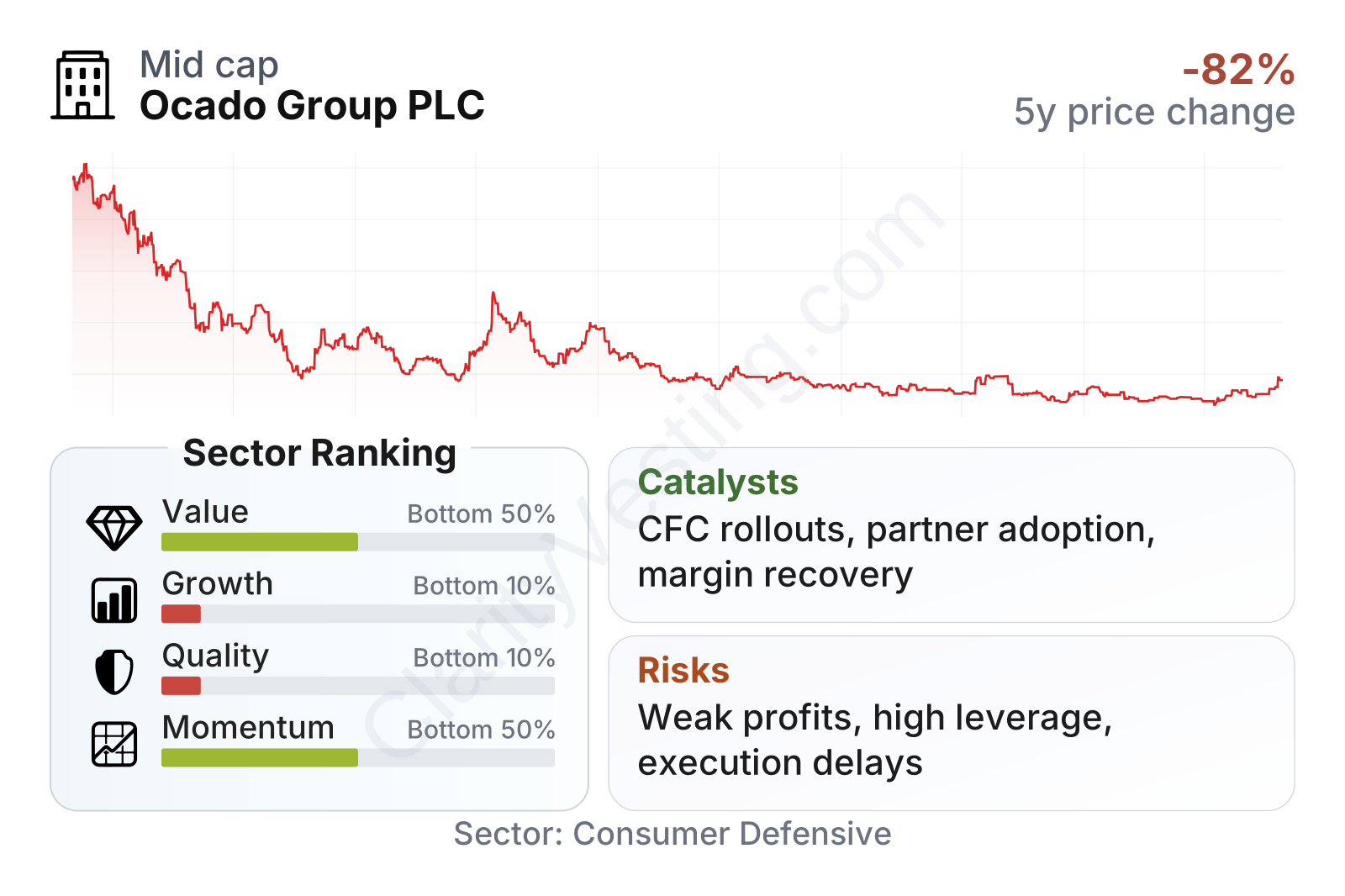
Ocado sits in the mid-cap range and has shown very high share-price volatility, with a beta above 2. The stock has fallen dramatically from its 2021 highs, although shorter-term trading has recently improved. That combination usually signals a market still debating whether the company is moving toward a durable operating model or simply passing through another temporary rebound.
The factor mix is unusual. On value, the company screens around the lower half of the sector, but not because the shares trade on a rich earnings multiple. In fact, the recent P/E has been well below the sector median. The issue is that earnings quality and consistency remain weak, so a low multiple alone does not say much.
Growth metrics are pulled in two different directions. Recent year-over-year revenue growth has been strong on a short-term basis, but the longer five-year record remains weak, with revenue per share and book value per share both trending down. Quality is also clearly below sector norms, with margins and returns on capital still under pressure. Free cash flow looks better than profitability, which gives the company more breathing room than the income statement alone would suggest.
Growth
Ocado operates in a sector with a credible long-term tailwind. Online grocery remains a relatively low-penetration category in many markets compared with general e-commerce, largely because food delivery is operationally difficult. That is exactly the gap Ocado is trying to address. If grocery chains want to improve delivery economics, reduce picking costs, and raise order accuracy, warehouse automation and software become increasingly important.
Ocado’s strategy makes logical sense for future growth because it focuses on infrastructure rather than only on consumer demand. Instead of betting exclusively on one retail brand, the company sells a platform that can be used by multiple grocers across countries. This creates the possibility of repeatable revenue from software, services, maintenance, and capacity expansion once a partner is onboarded. In theory, this is a more scalable model than running a standard supermarket business.
A major catalyst is the build-out and optimization of customer fulfillment centers. Each new live site can add service revenue, strengthen proof of concept, and make the platform more attractive to other potential partners. Ocado has also continued improving robotic efficiency, item handling, and automated storage density, which matters because grocery economics can change materially with small shifts in labor and throughput.
Another important element is the company’s relationship with established grocery chains. Ocado’s international partners give it access to large end markets without having to build local consumer brands from scratch. If those partners increase volumes, open more automated sites, or broaden the use of Ocado’s software stack, growth could become more durable and less dependent on one-off milestones.
The recent revenue pattern underlines both the appeal and the challenge. Short-term growth can look sharp, but it has not yet formed a stable multi-year trend. For long-term observers, the central question is not whether Ocado can produce occasional bursts of expansion. It is whether those bursts can turn into recurring, compounding platform revenue with better margins.
Recent company updates have continued to emphasize technology deployment, fulfillment efficiency, and partner development. The significant opportunity is clear: if more grocers decide that building advanced automated infrastructure internally is too costly or too slow, Ocado’s outsourced platform becomes more relevant.
Risks
This article is for informational purposes only and does not constitute financial advice. Some content is AI-generated. See Disclaimer


