Stock Analysis · Owens Corning Inc (OC)
Overview
Owens Corning is a building materials manufacturer focused on products used in residential, commercial, and industrial construction. The company is best known for roofing shingles, fiberglass insulation, and composite materials. Its products are tied to both new construction and repair or remodeling activity, which gives it exposure to broad building demand rather than a single niche.
Since the addition of doors operations through the Masonite acquisition, Owens Corning now operates across three main businesses. Based on its latest annual reporting structure, revenue is approximately distributed as follows:
- Roofing: about 37% of revenue. This includes asphalt shingles, underlayment, and roofing components sold mainly for residential reroofing and new construction.
- Insulation: about 32% of revenue. This includes fiberglass and foam insulation used in homes, commercial buildings, and industrial applications, as well as related accessories.
- Doors: about 21% of revenue. This business includes residential interior and exterior doors, door systems, and related components, primarily from the Masonite business.
- Composites: about 10% of revenue. This segment produces glass fiber reinforcements and engineered materials used in construction, infrastructure, transportation, and industrial markets.
That mix matters because it gives Owens Corning more than one engine of demand. Roofing tends to be supported by replacement cycles and storm repair, insulation benefits from energy-efficiency standards, composites serve industrial customers, and doors expand the company further into residential products. Over the last several years, revenue climbed from roughly $8.5 billion in 2021 to more than $10.0 billion in 2025, although profit has been much more uneven than sales.
Latest business flow in simple terms: the company still converts a large portion of revenue into gross profit before overhead, but the gap between operating profit and net income widened recently as interest expense rose and profitability weakened. That helps explain why the business can still generate cash while reported earnings have come under pressure.
Key Figures
| Metric | Value | Sector ⓘ |
|---|---|---|
| Date | Oct 24, 2026 | |
| Context | ||
| Sector | Industrials | |
| Industry | Building Products & Equipment | |
| Market Cap ⓘ | $8.84B | |
| Beta ⓘ | 1.32 | |
Value (Cheapness) | ||
| P/E Ratio ⓘ | N/A | 22.29 |
| P/B Ratio ⓘ | 2.42 | 1.98 |
| FCF Yield ⓘ | 10.15% | 6.26% |
| Dividend Yield ⓘ | 2.78% | 1.92% |
| EBIT / EV ⓘ | 0.33% | 4.83% |
| PEG ⓘ | 1.62 | |
Growth (Business expansion) | ||
| Revenue Growth ⓘ | 0.30% | 9.30% |
| RPS Growth (5Y CAGR) ⓘ | 10.41% | 7.76% |
| EPS Growth (5Y CAGR) ⓘ | -21.45% | -13.17% |
| BVPS Growth (5Y CAGR) ⓘ | 2.86% | 6.13% |
| Margin Growth (5Y Trend) ⓘ | -13.42% | 0.74% |
| FCF Growth (5Y CAGR) ⓘ | -3.01% | 10.79% |
| DPS Growth (5Y CAGR) ⓘ | 28.01% | 9.41% |
Quality (Business durability) | ||
| ROIC (Latest) ⓘ | 0.21% | 10.75% |
| ROA (Latest) ⓘ | -5.11% | 5.41% |
| ROIC (5Y Median) ⓘ | 15.31% | 9.37% |
| ROA (5Y Median) ⓘ | 10.21% | 4.95% |
| Net Debt / EBIT (Latest) ⓘ | 109.16 | 2.04 |
| Net Debt / EBIT (5Y Median) ⓘ | 1.50 | 2.27 |
| Net Debt / EBITDA (Latest) ⓘ | 8.00 | 1.39 |
| Net Debt / Assets ⓘ | 42.87% | 19.27% |
| EBITDA / Interest ⓘ | 2.58 | 9.58 |
| Operating Margin (Latest) ⓘ | 0.51% | 10.49% |
| Operating Margin (5Y Median) ⓘ | 16.33% | 10.30% |
| Debt to Equity (Latest) ⓘ | 151.88% | 64.82% |
| Profit Margin (Latest) ⓘ | -6.81% | 6.67% |
| Free Cash Flow (Latest) ⓘ | $897.00M | |
Momentum (Price trend) | ||
| 3Y Return ⓘ | -3.03% | +67.77% |
| 12M Return (excl. last month) ⓘ | -14.35% | +12.05% |
| 6M Return ⓘ | -6.79% | 0.00% |
| Price vs. 200-Day MA ⓘ | -9.97% | +0.67% |
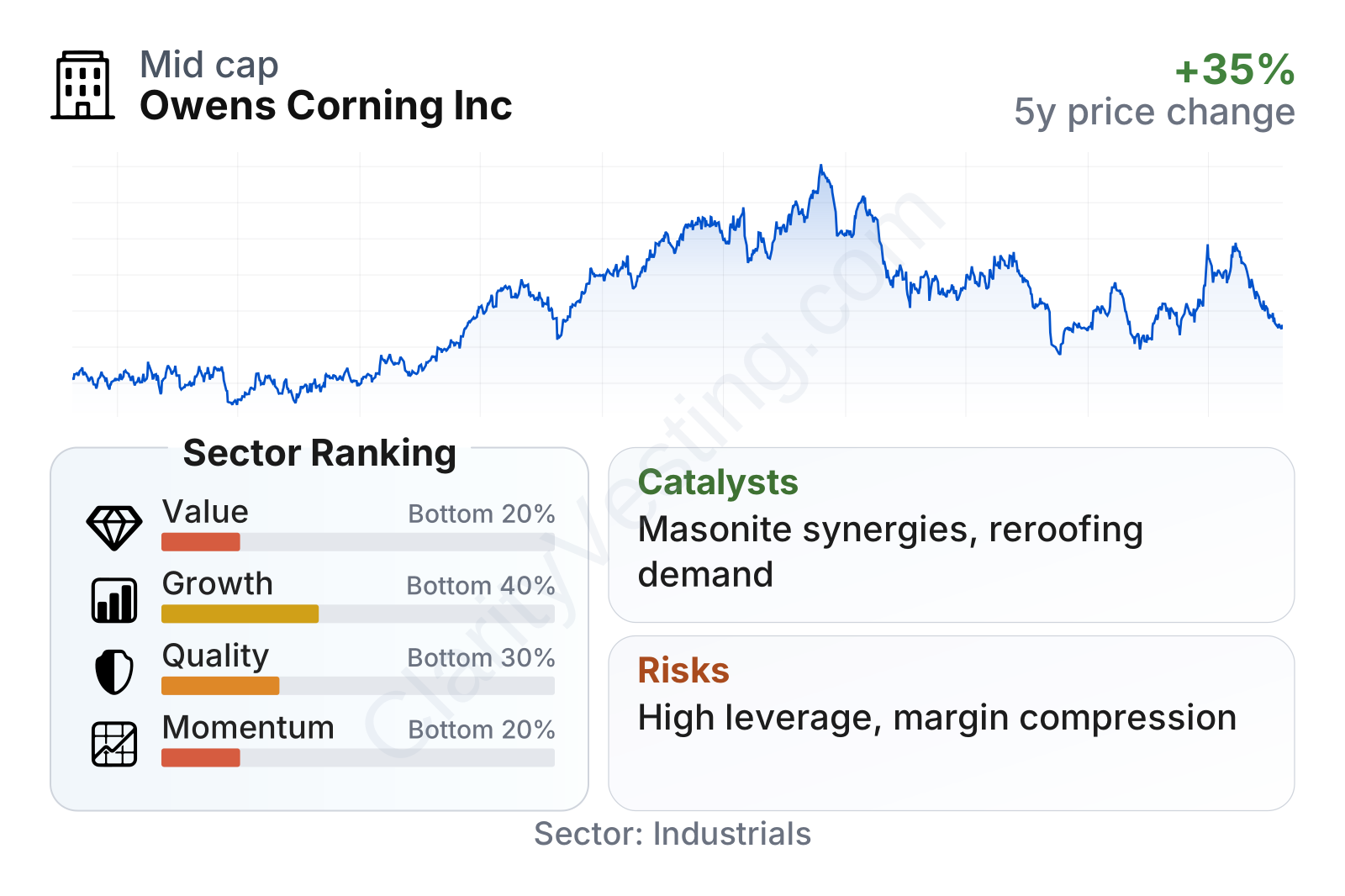
Owens Corning is a mid-to-large building products company with a market value around $10 billion and a stock that has been more volatile than the broader market, reflected by a beta above 1.3. The share price had a strong run through 2023 and much of 2024, then gave back a meaningful part of those gains before recovering somewhat in 2026.
The overall factor picture is mixed to weak right now. Relative to the broader industrials peer group, value, growth, quality, and momentum all sit in the lower part of the sector rankings. The most important reason is not that the company lacks a profitable history, but that recent results have been distorted by weaker margins, higher leverage, and a drop in earnings. At the same time, the dividend yield is slightly above the sector median, five-year revenue per share growth has been better than the sector median, and the company continues to produce positive free cash flow.
Growth
Owens Corning operates in a sector with long-term support from housing maintenance, energy efficiency, and building modernization. Insulation is especially helped by stricter building codes and demand for lower energy use in homes and commercial buildings. Roofing benefits from the replacement nature of the market: roofs wear out, storm damage happens, and repairs cannot be deferred forever. Composites add exposure to infrastructure, industrial production, and lightweight materials trends. The doors business broadens the company’s position in residential and repair markets.
The company’s strategy also makes industrial sense. Owens Corning has spent years building a portfolio around residential and commercial envelopes: roof, insulation, and now doors. That creates potential cross-selling advantages with distributors, contractors, and builders. It also reduces reliance on any one product category. Management has emphasized a model centered on higher-value building products rather than commodity-like volume alone, which is important in cyclical industries.
Near-term growth, however, has been uneven. Revenue growth was very strong in parts of 2024 and early 2025, then turned negative before flattening close to zero most recently. That pattern suggests the company is moving through a transition period rather than a smooth expansion phase. It is not a simple volume growth case at the moment.
Cash generation remains one of the more constructive points. Free cash flow has come down sharply from prior peaks, but it remains positive at roughly $0.5 billion on a trailing basis. For a building-products manufacturer, that matters because cash can support debt service, dividends, buybacks, and integration spending even when accounting earnings are under pressure.
A major catalyst is the integration of Masonite, which significantly increased Owens Corning’s reach in residential building products. If the company captures expected synergies, improves procurement, and strengthens distribution efficiency, that deal could raise earnings power beyond what recent headline results suggest. Another supportive factor is weather-driven reroofing demand in North America, which can create bursts of activity independent of new home construction.
Recent company communications have also highlighted portfolio reshaping, productivity actions, and a focus on higher-return categories. That does not guarantee faster growth, but it supports the idea that management is trying to improve business mix and resilience rather than simply chase volume.
Risks
This article is for informational purposes only and does not constitute financial advice. Some content is AI-generated. See Disclaimer


