Stock Analysis · Origin Bancorp Inc (OBK)
Overview
Origin Bancorp is the parent company of Origin Bank, a regional bank headquartered in Louisiana. It serves individuals, small and mid-sized businesses, and commercial clients across markets in Louisiana, Texas, Mississippi, Alabama, and the Florida Panhandle. In simple terms, the company gathers deposits from customers, lends that money out at higher rates, and also earns fees from banking services.
Its revenue mix is driven primarily by interest income, which is typical for a regional bank. Based on recent annual results, the largest sources of revenue are approximately:
- Net interest income: about 70% to 80% of total revenue. This is the spread between what the bank earns on loans and securities and what it pays on deposits and other funding.
- Mortgage banking and related home lending fees: about 5% to 10%. This includes gains and fees tied to originating and selling residential mortgage loans.
- Service charges, card fees, and treasury management fees: about 5% to 10%. These come from deposit accounts, payments activity, and cash-management services for business customers.
- Insurance commission and investment-related fees: low single-digit share. These are smaller but recurring non-interest revenue streams.
- Other banking fees and miscellaneous income: remaining share. This can include swap fees, wealth-related services, and other customer activity.
What stands out is that Origin is still mainly a traditional spread-based bank rather than a highly diversified financial company. That means its performance is closely linked to loan growth, deposit costs, credit quality, and interest rates.
Revenue has expanded strongly over the last several years, but profits have not followed the same path because funding costs and operating expenses rose materially. The business has become larger, yet earnings conversion has been less efficient than many peers.
The long-term picture shows a bank that has grown revenue meaningfully since 2021, while interest expense and overhead also climbed sharply. More recently, revenue has stayed near peak levels, but net income remains well below the 2021 high, which highlights the pressure from the rate environment and cost structure.
Key Figures
| Metric | Value | Sector ⓘ |
|---|---|---|
| Date | Oct 10, 2026 | |
| Context | ||
| Sector | Financial Services | |
| Industry | Banks - Regional | |
| Market Cap ⓘ | $1.61B | |
| Beta ⓘ | 0.74 | |
Value (Cheapness) | ||
| P/E Ratio ⓘ | 16.45 | 12.38 |
| P/B Ratio ⓘ | 1.28 | 1.23 |
| FCF Yield ⓘ | 10.87% | 10.23% |
| Dividend Yield ⓘ | 1.33% | 3.01% |
| EBIT / EV ⓘ | 10.67% | 8.08% |
| PEG ⓘ | N/A | |
Growth (Business expansion) | ||
| Revenue Growth ⓘ | 33.30% | 9.50% |
| RPS Growth (5Y CAGR) ⓘ | 11.87% | 12.21% |
| EPS Growth (5Y CAGR) ⓘ | -12.55% | -9.62% |
| BVPS Growth (5Y CAGR) ⓘ | 6.72% | 4.98% |
| Margin Growth (5Y Trend) ⓘ | -29.09% | -4.07% |
| FCF Growth (5Y CAGR) ⓘ | -2.40% | 4.76% |
| DPS Growth (5Y CAGR) ⓘ | 5.62% | 8.79% |
Quality (Business durability) | ||
| ROIC (Latest) ⓘ | 7.72% | 9.35% |
| ROE (Latest) ⓘ | 7.99% | 13.91% |
| ROA (Latest) ⓘ | 0.99% | 1.53% |
| ROIC (5Y Median) ⓘ | 5.78% | 7.86% |
| ROE (5Y Median) ⓘ | 8.33% | 12.22% |
| ROA (5Y Median) ⓘ | 0.86% | 1.29% |
| Net Debt / EBIT (Latest) ⓘ | 0.38 | 0.99 |
| Net Debt / EBIT (5Y Median) ⓘ | -0.38 | 0.73 |
| Net Debt / EBITDA (Latest) ⓘ | 0.34 | 0.93 |
| Operating Margin (Latest) ⓘ | 21.26% | 22.19% |
| Operating Margin (5Y Median) ⓘ | 18.37% | 24.30% |
| Debt to Equity (Latest) ⓘ | 10.68% | 60.24% |
| Profit Margin (Latest) ⓘ | 26.42% | 26.49% |
| Free Cash Flow (Latest) ⓘ | $175.38M | |
Momentum (Price trend) | ||
| 3Y Return ⓘ | +95.07% | +88.52% |
| 12M Return (excl. last month) ⓘ | +40.29% | +19.65% |
| 6M Return ⓘ | +21.03% | +6.00% |
| Price vs. 200-Day MA ⓘ | +11.80% | +3.61% |
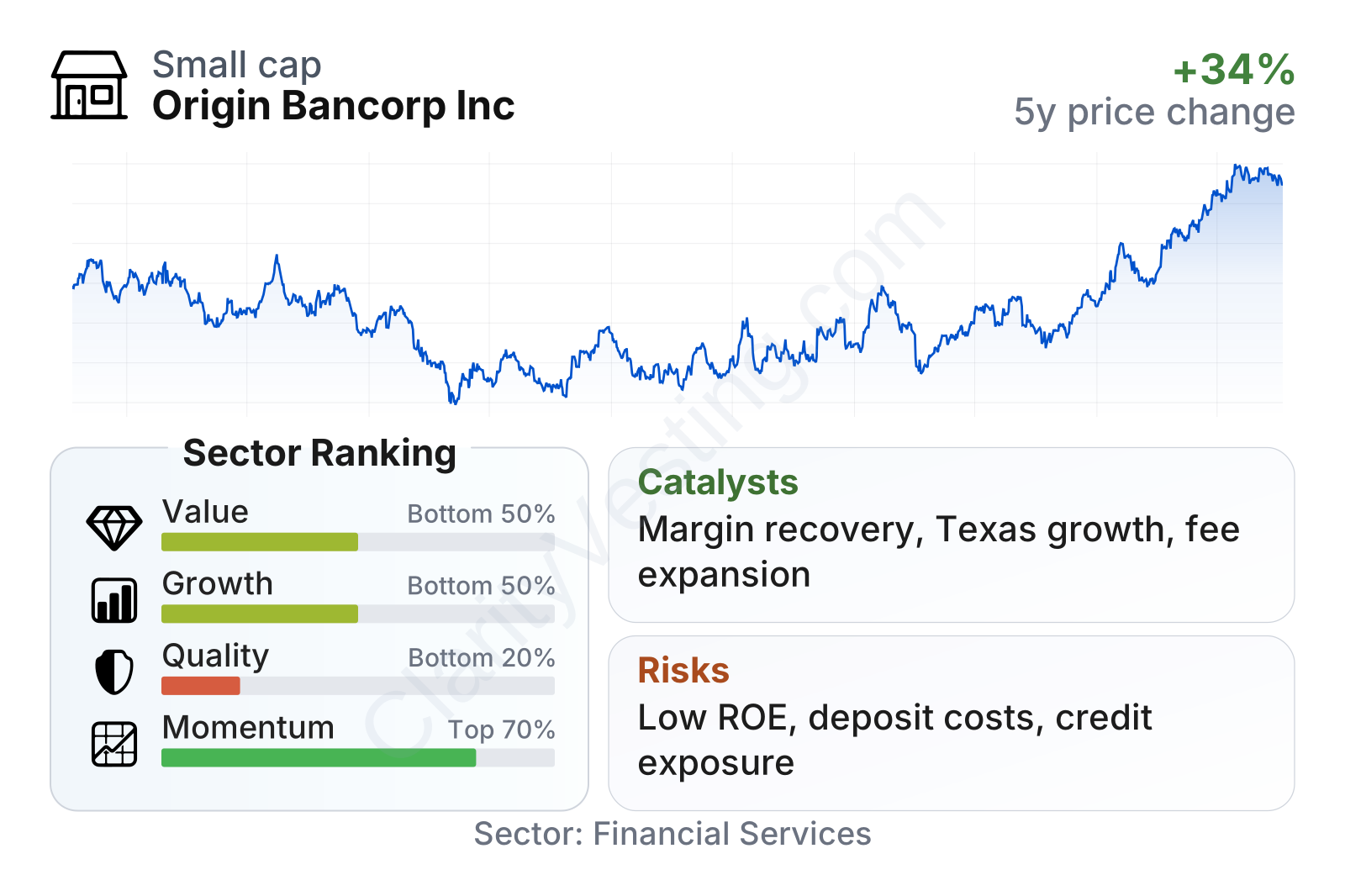
Origin Bancorp is a small-cap regional bank with relatively low share-price volatility, as reflected by a beta below 1. In the factor breakdown, it ranks in the lower part of the sector on value, growth, and especially quality, while momentum is clearly better. In practice, that means the stock’s recent market performance has improved faster than the underlying profitability metrics.
The valuation multiples are not extreme, but they are not obviously discounted either. The price-to-earnings ratio sits above the sector median, and the price-to-book ratio is also slightly above the median in the latest snapshot. At the same time, return measures such as return on equity and return on assets remain below many regional bank peers. That combination suggests the market is already giving some credit to improving conditions.
Another important point is balance-sheet conservatism. Debt-to-equity is much lower than the sector median, and free cash flow generation remains positive. For a bank, that does not remove risk, but it does indicate that the company is not operating from an aggressively stretched financial position.
Growth
Origin operates in regional banking, a sector that is mature rather than structurally fast-growing. Long-term expansion usually comes from gaining deposits, adding commercial relationships, growing loans in attractive markets, and widening fee income. That makes geography and client mix especially important. Origin’s footprint in Texas and the broader Gulf South gives it exposure to some markets that have seen above-average population and business activity compared with slower-growth areas of the country.
The company’s strategy is centered on relationship banking for businesses and affluent households, with an emphasis on commercial banking, treasury services, and community-market presence. That approach can support durable growth if the bank continues attracting low-cost deposits and cross-selling more services to existing clients. It is a sensible model, but it is not a scale-driven national platform; execution matters more because Origin competes market by market.
Earnings per share show why the investment case is not purely about headline revenue growth. EPS fell sharply from the 2021 peak, then began to recover in 2024 and 2025. That pattern suggests the company has already gone through a difficult rate-adjustment period and is now trying to rebuild earnings power rather than simply expand its balance sheet.
Book value per share has trended upward over the last five years, despite some uneven profitability. That matters for banks because book value is a useful anchor for measuring the long-term accumulation of capital. Origin’s book value growth has been better than the sector median over five years, which supports the view that the franchise has kept building underlying balance-sheet value even during a tougher earnings stretch.
A meaningful catalyst is the possibility of further normalization in funding costs. If deposit pricing becomes less competitive or if asset yields stay firm, net interest margin could improve. In addition, loan growth in business-heavy Southern markets and more contribution from fee businesses such as treasury management could help diversify results. These are realistic opportunities, although none of them looks transformative on its own.
Recent company communications and filings have continued to emphasize disciplined capital management, credit monitoring, and profitability improvement. For a regional bank in the current environment, those are the right priorities. The key question is whether better spreads and moderate loan growth can lift returns enough to close the gap with stronger peers.
Risks
This article is for informational purposes only and does not constitute financial advice. Some content is AI-generated. See Disclaimer